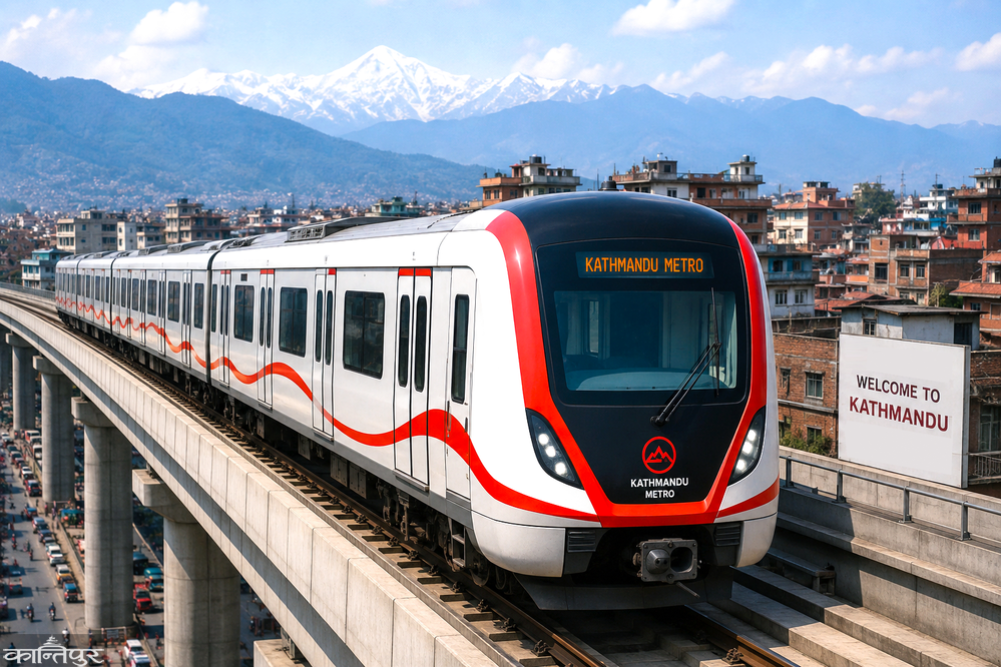
The Metro Rail and Monorail Development Project issued a notice on 1st Jestha, giving time until 1st Ashar to select an international consultant.
We use Google Cloud Translation Services. Google requires we provide the following disclaimer relating to use of this service:
This service may contain translations powered by Google. Google disclaims all warranties related to the translations, expressed or implied, including any warranties of accuracy, reliability, and any implied warranties of merchantability, fitness for a particular purpose, and noninfringement.
The government has shown its readiness to prepare a detailed project report (DPR) by selecting a specific route to build a metro railway in the valley. For that, the Metro Rail and Monorail Development Project under the Railway Department has called for information on 1st Jestha to select an international consultant. The time is till 1st Ashar.
The first phase of the DPR is being conducted to select a consultant for a distance of 27.5 kilometers from Narayan Gopal Chowk via Chabahil, Koteshwor, Satdobato, Ratna Park and then connecting Narayan Gopal Chowk, said Bodh Bhandari, Information Officer of the Railway Department. ‘There is still time, how many companies come to compete, then we will shortlist them,’ he said, ‘later we will ask for proposals from the selected companies.’
According to the initial study conducted in 2011/12 with the investment of the Government of Nepal, Line One was planned to go from Narayan Gopal Chowk to Satdobato and from there to the Ring Road as Line Three. ‘The process of selecting a consultant to prepare the DPR has now been started by combining some parts of Line One and Three,’ he said.
Bhandari said that the consultant selected for the DPR and design will have to work at three levels. ‘One is to reconsider the pre-feasibility study done earlier, the second is to prepare a detailed report to attract investors to work on the Engineering Procurement Construction (EPC) model, and the third is to work on the design,’ he said. ‘The selected consultant will have to complete the work within 18 months from the date of the agreement.’ He said that the selected company will have to work in all three processes.
‘The route currently selected for the DPR is one of the routes with the most traffic jams. Since the railway line to be built later will pass through Narayan Gopal Chowk-Chabahil-Koteshwor, it will also be easier and faster for passengers going towards Suryabinayak-Dhulikhel,’ he said. ‘Now, an attempt is being made to include the three routes.’ He said that the cost and time involved in the construction will be known once the detailed design is ready. ‘Documents will also be prepared for financing closure,’ he said, ‘after the study is completed, what kind of investment is required, the Investment Board will also have a role in this.’ He clarified that the investment modalities will be discussed after the project documents are prepared.
A feasibility study conducted by a Korean company in 2011/12 has clarified the possibility of operating a metro rail in the valley. The study had clarified that a metro rail could be operated on 77 km of the valley. After that, no further study was conducted. Although attempts were made to conduct a DPR-level study, further work could not proceed. According to the study conducted by the Korean company, it was found that there is a possibility of placing poles above the road at 52 km and underground metro rail at 25 km.
Earlier, although preliminary studies were conducted at various stages by various bodies and the government, the further process could not proceed, so now preparations are being made to select a route and conduct a DPR, said Harikumar Pokharel, Director General of the Railway Department.
‘During the DPR level study around 2076, it was not possible to build a railway at Rato Matsyendranath in Lalitpur and Kalmochanghat in Thapathali, in which the study did not include the idea of running the railway underground in that area,’ Pokharel said, ‘After that, the contract with the company that prepared the DPR was terminated on the basis of convenience. Now, we have moved forward with the work by requesting a multi-year resource agreement with the Ministry of Finance in a new way.’
Pokharel clarified that after the Ministry of Finance agreed to provide the cost for three years during the study, the way was opened for the work to proceed. "This is not a project that can be completed in a year, it is a matter of detailed study. After the currently selected route, the Ratnapark-Bhaktapur section, which is subject to heavy traffic jams, falls," he said. "The pre-feasibility study of this section is also under discussion." Pokharel said that Chinese, Korean, and Japanese companies have expressed interest in the notice calling for a DPR for the route from Narayan Gopal Chowk-Chabahil-Koteshwor-Satdobato-Ratnapark.
"Financial proposals are sought from the companies on the shortlist, and the company that submits the lowest financial proposal is selected. The DPR is being prepared with the government's investment," he said. He said that the DPR will now be prepared to run the standard gauge electric. Earlier, the Kathmandu Metropolitan City has also repeatedly raised the issue of running a metro rail, but the study has not been completed.
Former Director General of the Railway Department Balram Mishra said that during his time, the process of conducting a feasibility study from Budhanilkantha to Satdobato and connecting it to Chobhar was initiated, but it was later canceled. “After the contract was awarded, I retired before the process was completed. Later, another Director General came. The contract was terminated because there was a problem in Lalitpur,” he said. “But the long-term development of the valley requires a metro rail, traffic jams are increasing.”
Mishra said that since it is not possible by developing other transport infrastructure, no one sees the need to oppose the metro rail as it is an absolute necessity. However, infrastructure experts have accused the government of rushing to select a consultant to prepare a DPR by selecting a route for the train.
Infrastructure expert Acharya said that such a task cannot be done by a consultant. ‘The metro rail system in Kathmandu can be a subject of discussion whether there can be two/three or how many lines, without the construction of the metro rail, Kathmandu cannot play its role as its capital and economic center in the future,’ he said, ‘This is a matter that can be easily concluded in terms of technology and planning.’
Acharya clarified that the route currently decided and the process started are wrong. ‘In the first phase, the government should integrate the studies prepared so far by the Korea International Cooperation Agency (KOICA), the Asian Development Bank (ADB), and the Japan International Cooperation Agency (JICA), and if necessary, it should be prepared within three/four months by involving foreign experts,’ he said, ‘Does Kathmandu need a metro rail, and if so, how many lines and where, a master plan should be prepared first.’ Acharya suggests that the master plan should be approved by the Office of the Prime Minister and Council of Ministers and then move forward.