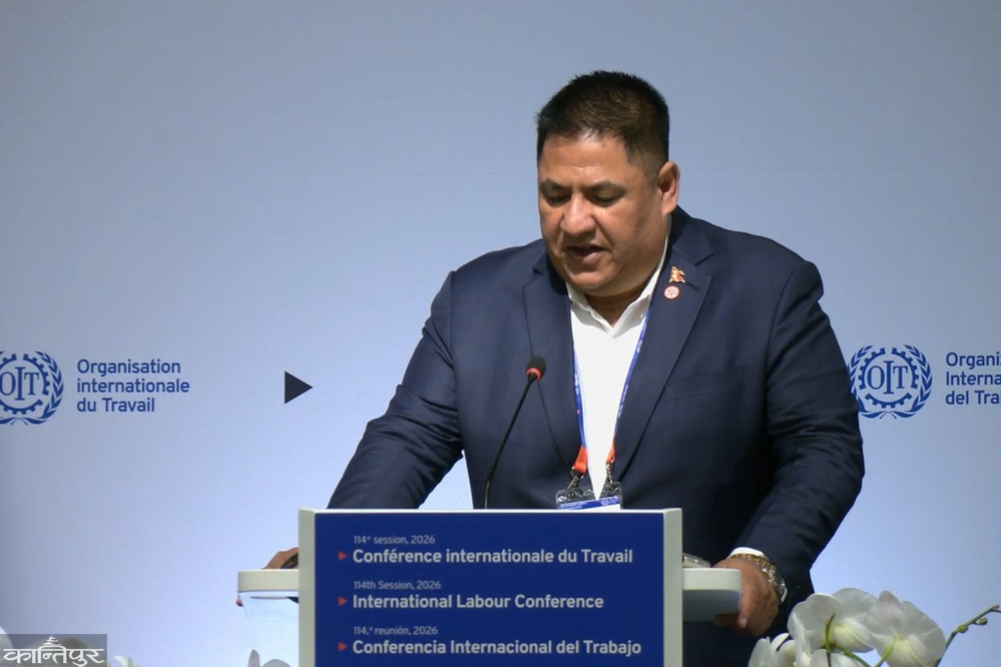
During his address, Vice President Pandey presented the issue of Nepal's young workforce continuously migrating to foreign destinations for employment as a major concern.
We use Google Cloud Translation Services. Google requires we provide the following disclaimer relating to use of this service:
This service may contain translations powered by Google. Google disclaims all warranties related to the translations, expressed or implied, including any warranties of accuracy, reliability, and any implied warranties of merchantability, fitness for a particular purpose, and noninfringement.
Prabaljung Pandey, Associate Vice President of the Federation of Nepalese Chambers of Commerce and Industry, has emphasized the need for practical policy flexibility, enterprise productivity growth and strong tripartite cooperation to address the current changes and challenges in the labor market.
Vice President Pandey made the remarks while addressing the 114th session of the International Labor Organization (ILO) held in Geneva, Switzerland, on behalf of the Nepal Employers' Council today. While delivering his speech among delegates, dignitaries and social partners from around the world, Vice President Pandey noted that Nepal is currently going through a phase of important economic transition.
Despite the government's commitment to good governance, investment promotion and infrastructure development, he drew the attention of the world community to the persistent challenges such as slow economic growth, limited industrial development and rising business costs in the domestic market. During his address, Vice President Pandey presented the issue of continuous migration of Nepal's young workforce to foreign destinations for employment as a major concern. He pointed out the need to create decent and productive employment opportunities in the country by linking investment-friendly policies, skill development and education with the real demands of the labor market.
Discussing the changing global environment and the digital economy, Vice President Pandey said that the involvement of youth in digital services such as online businesses, ride-sharing and delivery platforms is increasing rapidly in Nepal as well. He said that while this has brought new opportunities for entrepreneurship, it has also created a new debate on labor standards and social security issues.
He clarified that developing countries like Nepal should be given the necessary flexibility to implement labor reforms and legal arrangements in accordance with their national realities, institutional capacity and economic conditions, instead of imposing rigid global standards. Vice President Pandey also presented details of the key priorities put forward by Nepali employers and the efforts being implemented. He said that after the implementation of the National Occupational Safety and Health Action Plan, there has been an increase in awareness among employers that a safe and healthy workplace is not only a social responsibility but also an indispensable element for productivity, sustainability and business competitiveness. Under this, he informed that preliminary work has begun by preparing special guidelines in sectors such as tea and cardamom.
In addition, the federation has successfully launched a pilot project of the 'Care Model' in selected industries, expressing confidence that it will greatly contribute to creating employment opportunities, especially for women, and enhancing social inclusion and community welfare in the workplace.
Considering the serious impact of floods, landslides and climate change on industry, agriculture and livelihoods, Vice President Pandey emphasized that the global discussions on the future of the workplace should include green jobs and technical assistance to countries like Nepal that are at risk of climate change.
Similarly, he noted that the role of employers is crucial in protecting jobs, ensuring business continuity, and strengthening mutual communication, as the ongoing geopolitical tensions in the Middle East directly impact economies like Nepal that rely on remittances, imports, and tourism.
Vice President Pandey called for long-term technical cooperation with the International Labor Organization (ILO) to increase enterprise productivity, promote workplace collaboration, skill development, and promote innovation.