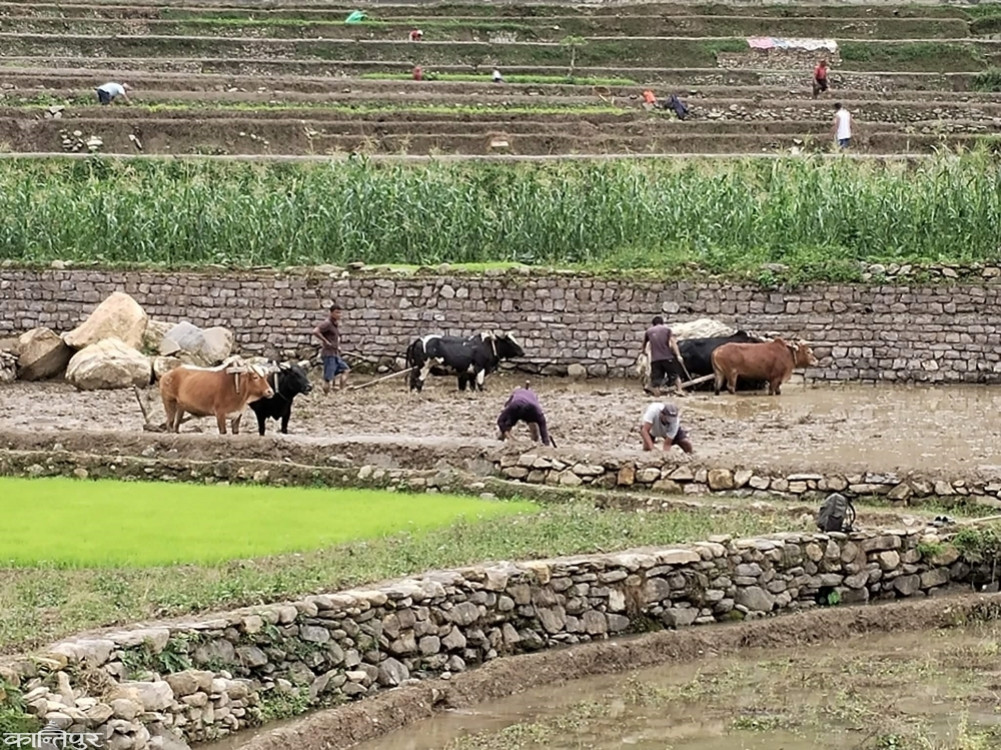
After this policy was formulated last year and subsidies were provided to farmers, farmers have also taken the initiative to conserve indigenous crops.
We use Google Cloud Translation Services. Google requires we provide the following disclaimer relating to use of this service:
This service may contain translations powered by Google. Google disclaims all warranties related to the translations, expressed or implied, including any warranties of accuracy, reliability, and any implied warranties of merchantability, fitness for a particular purpose, and noninfringement.
While there is a competition to cultivate developed and hybrid varieties, Baglung Municipality-13 has launched a campaign to protect indigenous rice. The ward has decided to reward farmers with grants if they plant traditional varieties of rice and other crops.
Ward Chairman Narayan Poudel has made a program to provide grants if farmers in the ward conserve indigenous rice. After making this policy and providing grants to farmers since last year, farmers have also taken the initiative to conserve indigenous crops. The ward working committee has also decided to create a program to encourage the production of 5 types of rice designated for indigenous crops. A grant of one thousand rupees per bushel will be provided from the ward's economic development and agriculture sector budget for the production of indigenous rice. Last year, 40 farmers received grants in such a campaign.
The subsidy has been given to farmers who grow rice of the traditional varieties of Jarneli, Anati, Jhinuwa, Ramani and Anga. The ward chairman has been giving cash after reaching the farmers' fields during the paddy storage period. 'On the day of harvesting, the ward committee officials have been visiting them and giving them incentive money,' said Poudel. 'Farmers are also happy after this arrangement.' The production of the indigenous variety is lower compared to the hybrid variety. If farmers are not encouraged, they have stopped cultivating low-yielding crops.
The ward has been providing information to farmers when sowing rice seeds and the ward also keeps a record of the farmers' sowing. A plan has also been made to store the farmers' rice in the presence of the ward committee officials. If there is a situation where many farmers have to store their rice on the same day, the ward committee can also deploy the Tole Development Committee for work. He said that this method and policy is being implemented to protect rice as it is an endangered species. The ward has allocated Rs 50,000 every year under this heading. Ward No. 13 is a large and agricultural ward within Baglung Municipality. The ward has also been providing some assistance to settlements where rice does not grow. In the Dalit settlement of Musurabari, which has 140 households in Ward No. 13, it has helped those who plant at least 5 orange and lemon saplings per household. Last year, the saplings were purchased with Rs 50,000 and given to the farmers. The ward has been providing a subsidy of Rs 2 per kg for the transportation of chemical fertilizers since last year.
Free distribution of medicines for livestock and poultry, and free medical treatment for senior citizens above 70 years of age at the municipal hospital have also been arranged. Apart from that, it has also made arrangements to give a crate of eggs every time a pregnant woman comes for a pregnancy test. The ward has been running a nutrition-friendly program for five years. Poudel informed that an awareness campaign has also been launched for teenagers to prevent misuse of social media.