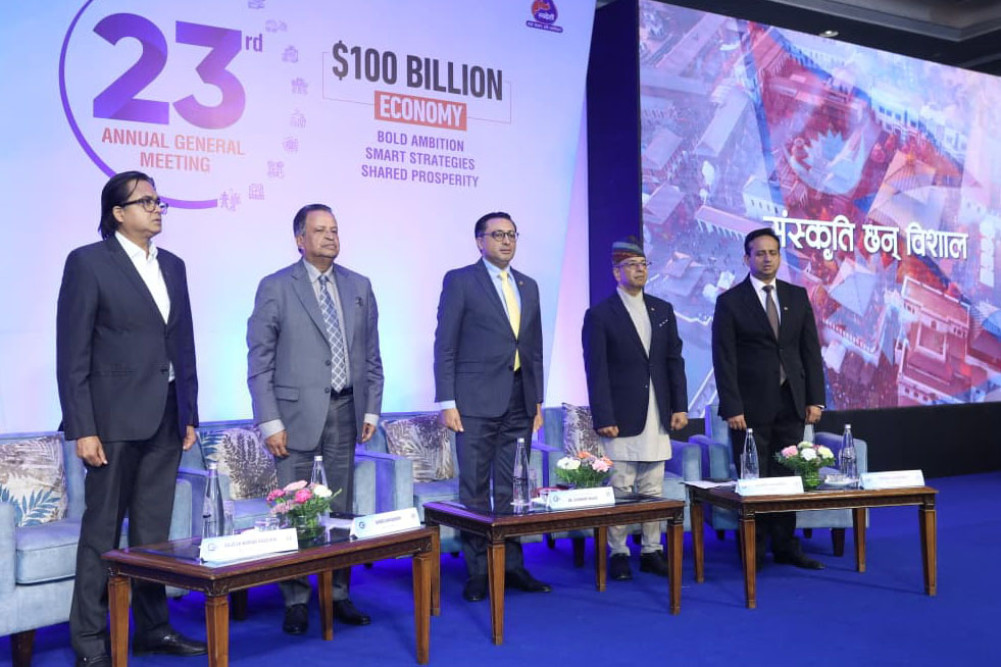
Birendra Raj Pandey, President of the Confederation of Nepalese Industries, requested the implementation of a system focused on financial penalties for economic offenses.
We use Google Cloud Translation Services. Google requires we provide the following disclaimer relating to use of this service:
This service may contain translations powered by Google. Google disclaims all warranties related to the translations, expressed or implied, including any warranties of accuracy, reliability, and any implied warranties of merchantability, fitness for a particular purpose, and noninfringement.
The Confederation of Nepalese Industries (CNI) has suggested that the government impose financial penalties instead of detaining and investigating industrialists and businessmen for economic offenses.
Although the government has said that it will hear them first and detain them only after the offense is proven, it is conducting investigations by keeping some industrialists and businessmen in suspense. At the same time, the Confederation has stated that instead of detaining businessmen for economic offenses, it will impose financial penalties.
Speaking at the 23rd Annual General Meeting of the Confederation, President Birendra Raj Pandey requested to implement a system focused on financial penalties for economic offenses. He said that the practice of giving priority to financial penalties over imprisonment for economic offenses is common in many developed countries, including India.
The Government of Nepal had announced in its budget statement for 2081/82 that it would provide 75 percent exemption on rent for Special Economic Zones (SEZs) and 50 percent exemption on rent for industries operating within industrial zones. Although the decision was implemented immediately in SEZs, it has not been implemented in the industrial sector so far. Chairman Pandey urged for facilitation in implementing this concessional arrangement, which has been mentioned in the government's policy, as soon as possible.
'As industrialists are facing problems due to the issue of rent in the industrial sector, I would also like to request for a resolution to the long-standing rent dispute,' he said, 'We want to see the country prosper in our own time and contribute to that. Significant improvements in the size of the economy, per capita income and social indicators are necessary to achieve prosperity.'
With this objective in mind, Pandey informed that the Confederation of Nepalese Industries, in collaboration with the Investment Board, has studied the possibility of increasing the current economy of about $45 billion to $100 billion within a decade.
'According to a study conducted by more than 20 experts for about 8 months, Nepal can become an economy of $100 billion by 2033 at current prices and $100 billion by 2039 at real prices,' Pandey said, 'For this, an average economic growth of 6 percent is required. The government has set a target of 7 percent growth, and our study has shown that the target can be achieved if it is maintained at 6 percent in the long term.'
To advance this goal, the Confederation has proposed 100 'growth pathways' related to energy, manufacturing, tourism, ICT, agriculture, infrastructure and institutional reforms.
The foreign exchange reserves and balance of payments have been strong in recent months. Inflation has averaged 4.47 percent as of Chaitra. Banks and financial institutions have more than 1 trillion rupees in investable funds, and interest rates have also fallen to single digits. Despite the decline in interest rates and the availability of sufficient investable funds, industrialists and businessmen have not been able to take new loans or expand investments due to the lack of overall demand. This problem has persisted for the past few years.
Chairman Pandey said that the capital stagnant in the banking system needs to be mobilized for production, employment and economic activities. 'Due to the contraction in demand, industries have not been able to expand production. Non-performing loans of banks have reached 5.60 percent and the number of borrowers on the blacklist has exceeded 160,000,' Pandey said, 'We are confident that the upcoming monetary policy will meet the aforementioned challenges and follow the direction of reforms taken by the budget.'
The role of government capital expenditure is important in keeping the economy moving. But the situation of capital expenditure has been weak since the past. Only about 31 percent of the capital expenditure has been made so far in the current fiscal year. The federation argues that the government should take effective steps to increase capital expenditure in the coming days.
'The government has worked to create hope in a short period of time to give a new direction to the country's economy,' Pandey said, 'The efforts made in policy and legal reforms and public service delivery have made the private sector optimistic.'