The Ministry of Federal Affairs and General Administration (currently the Ministry of Land Management, Cooperatives, Federal Affairs and General Administration) has the lowest capital expenditure.
We use Google Cloud Translation Services. Google requires we provide the following disclaimer relating to use of this service:
This service may contain translations powered by Google. Google disclaims all warranties related to the translations, expressed or implied, including any warranties of accuracy, reliability, and any implied warranties of merchantability, fitness for a particular purpose, and noninfringement.
As the 10 months of the current fiscal year are about to end, the overall capital expenditure situation is disappointing. As of Thursday of the current fiscal year 2082/83, 30.72 percent of the total budget of Rs 47.88 billion allocated for capital has been spent. That is, only Rs 124.61 billion 37 million has been spent on the allocated capital budget.
In the last fiscal year 2081/82, 37.72 percent of the total allocated capital budget was spent. When the budget was allocated in the current fiscal year, the ministries had not been merged. Earlier, the number of ministries including the Office of the Prime Minister and the Council of Ministers was 22. Now there are 18 ministries.
There are a dozen ministries with capital expenditure of less than 30 percent. The Ministry of Federal Affairs and General Administration (currently Land Management, Cooperatives, Federal Affairs and General Administration) has the lowest capital expenditure. Out of Rs 756.2 million allocated for capital in the current fiscal year, only Rs 23.9 million has been spent. That is, only 3.163 percent of the allocation has been spent.
‘So far, the ministry’s capital expenditure has been seen as low, as Rs 660 million received from donor agencies should have been spent through the local level and the amount spent in this way has not been entered into the system,’ said Ekdev Adhikari, Joint Secretary and Spokesperson of the Ministry.
The Ministry of Federal Affairs and General Administration (currently Land Management, Cooperatives, Federal Affairs and General Administration) has the lowest capital expenditure. Rs 87.9 million was allocated for the construction of the National Library building. He said that this work should have been done by the Urban Development and Building Construction Department, but the land issue has not been resolved. Next in line is the Ministry of Culture, Tourism and Civil Aviation. Of the Rs 4.84 billion allocated for this ministry in the current fiscal year, only 7.421 percent has been spent so far. Looking at this in figures, only Rs 359.6 million has been spent. The underspending occurred because the allocated amount was withheld in the initial stage, said Jayanarayan Acharya, Joint Secretary and Spokesperson of the Ministry of Culture, Tourism and Civil Aviation.
‘Now, when calculating the total budget including the withheld amount, it seems that the expenditure has been low,’ Acharya said. ‘About 75 percent of the allocated budget was withheld by the government formed after the Gen-G movement. It remained withheld until the election. Even if it is released only after the election, it is not possible to spend capital and less expenditure has been seen,’ Acharya said. ‘Even if it is released now, it seems that time will run out to complete the contract process in the current fiscal year,’ he said. ‘Since there will be no work under the contract, the expenditure should not increase much.’ He claims that by reducing the withheld amount in the total capital budget, the overall expenditure will reach 70 to 80 percent by mid-Asard.
Other ministries that spent less are Youth and Sports at 11.5 percent, Industry, Commerce and Supplies at 11.25 percent, Labor, Employment and Social Security at 11.96 percent, Communication and Information Technology at 14.51 percent, and Forest and Environment at 16.33 percent of the allocated capital budget. Urban Development (currently Infrastructure Development), which is a development ministry, has spent only Rs 15.59 billion 22 million out of the allocated capital budget of Rs 72.84 billion 45 million. That is, only 21.4 percent has been spent.
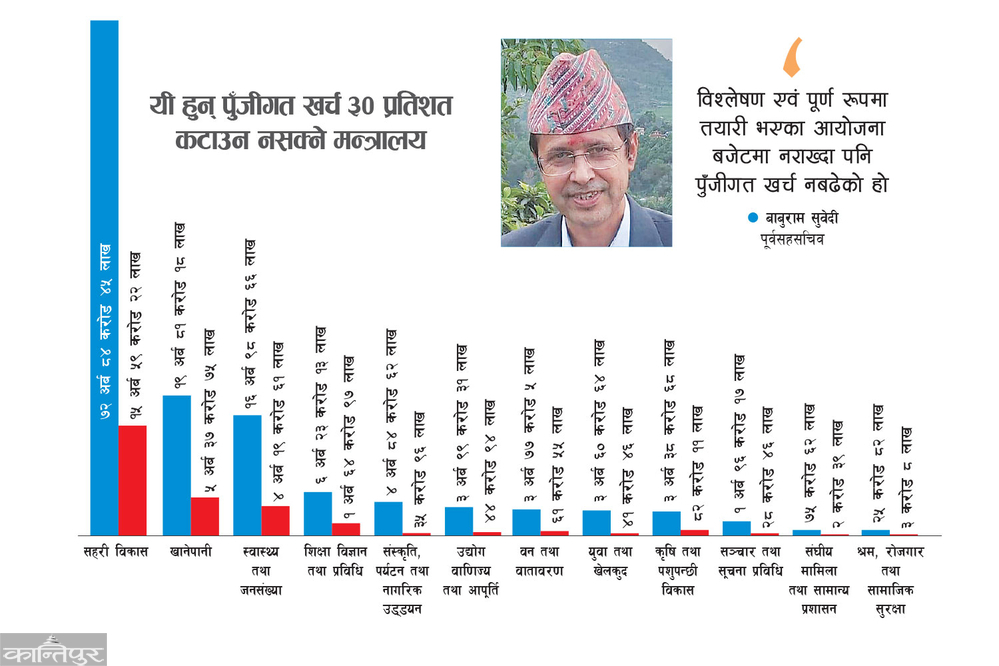
The main reason for the low spending is the withholding of the allocated budget, said Dilip Bhandari, Chief and Joint Secretary of the Planning, Building and Housing Division of the Ministry of Urban Development (currently Infrastructure Development). ‘Of the 62 billion budget that was withheld, 24 billion rupees were released in Falgun-Chait,’ he said. ‘Although the budget was shown in the appropriation, the progress of expenditure could not be calculated.’ In the past, when the budget for successive projects was low, it was sent to the Ministry of Finance for transfer, but it was delayed for a long time and the authority to transfer the money was given to the concerned ministry only some time ago, so it is being done accordingly, he said.
For this, out of the 756.2 million rupees allocated for capital in the current year, only 239 million rupees have been spent, which is only 3.163 percent of the allocation. ‘Capital expenditure could not increase due to non-payment due to non-transfer,’ Bhandari said. ‘Currently, due to price increase, construction entrepreneurs have not worked on the project fully, so progress has not been made.’ Only 24.7 percent of capital expenditure was spent by Health and Population, 24.24 percent by Agriculture and Livestock Development, 26.4 percent by Education, Science and Technology, and 27.14 percent by the Ministry of Water Supply. According to the Office of the Comptroller General, it is also mentioned that the expenditure made by the ministries was transferred and paid. The Ministry of Physical Infrastructure and Transport, which received the highest budget, has not been able to deduct even 50 percent of its expenditure towards capital so far.
For the Ministry of Physical Infrastructure, 146.2 billion rupees were allocated in the current fiscal year. Of that, the ministry spent only 604.82 billion rupees. In percentage terms, this is 41.34 percent. The then Ministry of Land Reforms and Management (now merged with General Administration) is the one that spends the most. Out of the 825.5 million rupees allocated for capital in the current fiscal year for this ministry, 465 million rupees have been spent. That is, 55.79 percent of the amount has been spent by the ministry.
As the payment system could not be improved in the last month of Ashar, capital expenditure is now seen as low. When payments are made at the last minute, capital expenditure tends to increase. Former Joint Secretary Baburam Subedi said that capital expenditure has not increased even when fully prepared projects are not included in the budget.
‘If we include a program in the budget but the project is not fully prepared, it naturally gets delayed as it takes time to prepare,’ Subedi said, ‘The issue of road construction is not something that can be completed in a day. It has a process, and since it takes time, capital expenditure is reduced.’ He believes that capital expenditure has also been reduced due to the lack of working capacity of the concerned ministries and agencies.
‘When requesting a budget, the concerned ministries ask for it ambitiously, and when proposing a budget without analyzing the implementation situation, they are unable to implement it,’ Subedi said, ‘After requesting a budget, there should be the capacity to implement it.’ He said that sufficient attention should be paid to prioritizing and preparing projects while formulating the budget. "Capital expenditure increases when work is completed on time in multi-year projects," he said, "but in small projects, the process of contracting every year has led to delays in work."

