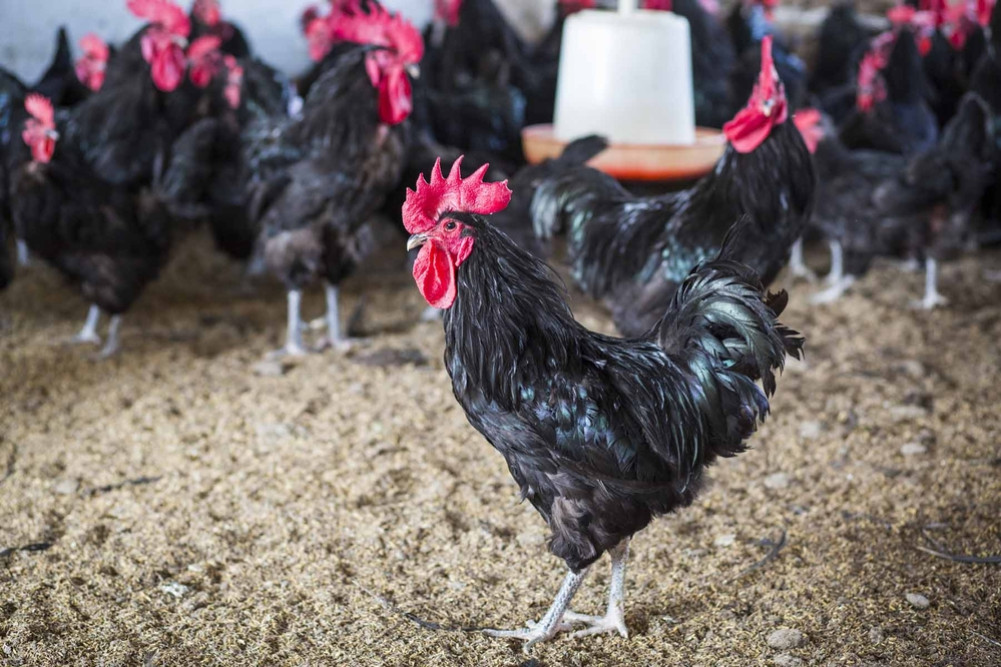
Bird flu has been detected in farms in Kirtipur, Gokarneshwor, Tarakeshwor, Godavari, Suryabinayak and Bhaktapur municipalities in the valley.
We use Google Cloud Translation Services. Google requires we provide the following disclaimer relating to use of this service:
This service may contain translations powered by Google. Google disclaims all warranties related to the translations, expressed or implied, including any warranties of accuracy, reliability, and any implied warranties of merchantability, fitness for a particular purpose, and noninfringement.
Bird flu (H-5N-1), which spread from Morang in Chaitra last year, has recently spread to the Kathmandu Valley. According to the Department of Animal Services, bird flu, which spread from Sundarharaicha-4 and Urlabari-8 in Morang on Chaitra 4, has been seen in 55 farms in 10 districts. The Department's Director General Dr. Umesh Dahal informed that although the infection is currently under control in other districts, it has been seen in the Kathmandu Valley. According to him, bird flu has been seen in farms in Kirtipur, Gokarneshwor, Tarakeshwor, Godavari, Suryabinayak and Bhaktapur municipalities in the valley. Director General Dr. Dahal informed that the infection has been seen in local and layer chickens in Kathmandu. 'Bird flu has been seen in farms where biosecurity has not been adopted and where there is no management.' In some places, the infection has also been seen in farms located near the forest,' he said. Bird flu was confirmed in crows that died in Kirtipur and Toudaha areas last Chaitra.
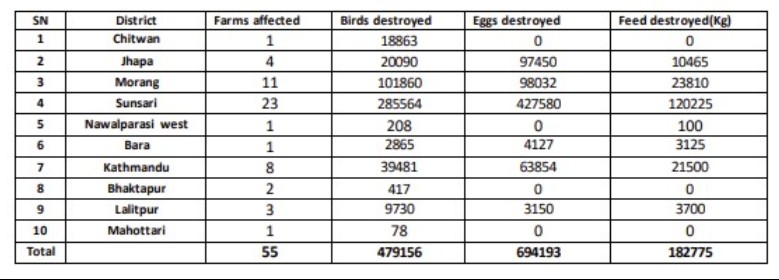
Thirteen farms in Kathmandu, Bhaktapur and Lalitpur have been affected by bird flu. 39,481 chickens have been destroyed in 8 farms in Kathmandu. Similarly, 63,854 eggs and 21,500 kg of feed have been destroyed in Kathmandu. Similarly, 417 chickens from 2 farms in Bhaktapur have been destroyed. 9,730 chickens, 3,150 eggs and 3,700 kg of feed have been destroyed in 3 farms in Lalitpur.
According to the data of the Animal Services Department as of 18th, 23 chicken farms in Sunsari were the most affected. Similarly, bird flu was found in 11 poultry farms in Morang, 4 in Jhapa, Chitwan, Nawalparasi West, Bara and one each in Mahottari. According to the latest data from the department, a total of 479,156 chickens and ducks have been destroyed in all farms. Similarly, 694,193 eggs and 182,775 kg of feed have also been destroyed. Director General Dr. Dahal said that chickens, eggs and feed were destroyed and disinfected as soon as the infection was confirmed. He says, 'The only way to prevent the spread of bird flu is to adopt biosecurity.' It has also been found that used egg crates were reused in some farms.' He has also urged farmers to prevent unnecessary people and vehicles from entering poultry farms.
The department has also identified various factors as the main factors of bird flu infection. According to the department, tall trees near the farms are suitable for wild birds . The department estimates that the infection may have spread because the birds come into contact with chickens, ducks and other birds raised on the farm .
Similarly, the farms are located near wetlands, not paying attention to standard biosecurity, uncontrolled movement of vehicles and visitors, reuse of egg crates without proper disinfection, and trading of live chickens and chicken meat by the same person without adequate protective measures may also be reasons for the spread of the infection, the department said
How do farmers get compensation ?
The department's Dr. Director General Dahal said that farmers will get relief according to the 'Standards for Relief of Items Destroyed During Bird Flu Control' 2079 BS .
The compensation is determined according to the market value. There is a provision for farmers to get relief up to 75 percent of the cost price based on the recommendation of the Rate Determination Committee coordinated by the Chief District Officer
Bird flu is considered a contagious viral disease that affects birds including chickens and ducks. Veterinarians say that the disease can spread through direct contact with infected birds, waste or infected materials, and in rare cases, it can also infect humans.
Bird flu was first detected in Nepal in 2009 in Jhapa. 10 years later, in 2019, a person died of bird flu in Nepal. A 21-year-old man from Kavre died during treatment. He had symptoms of fever and cough.
The department has also urged that dead birds be buried in a pit as soon as possible and that anyone working on a poultry farm should contact a health institution immediately if they have any health problems.
How to protect yourself?
Do not touch sick or dead birds
Do not shake hands with anyone in areas where bird flu has been reported Avoid direct contact with birds Do not touch the scythe
Clean the cages and utensils of birds kept at home daily
Wear a mask and gloves when working with poultry production