The project says that the construction of toll plazas on both Kathmandu and Dhading sides and the testing of equipment placed inside the tunnel have been completed.
We use Google Cloud Translation Services. Google requires we provide the following disclaimer relating to use of this service:
This service may contain translations powered by Google. Google disclaims all warranties related to the translations, expressed or implied, including any warranties of accuracy, reliability, and any implied warranties of merchantability, fitness for a particular purpose, and noninfringement.
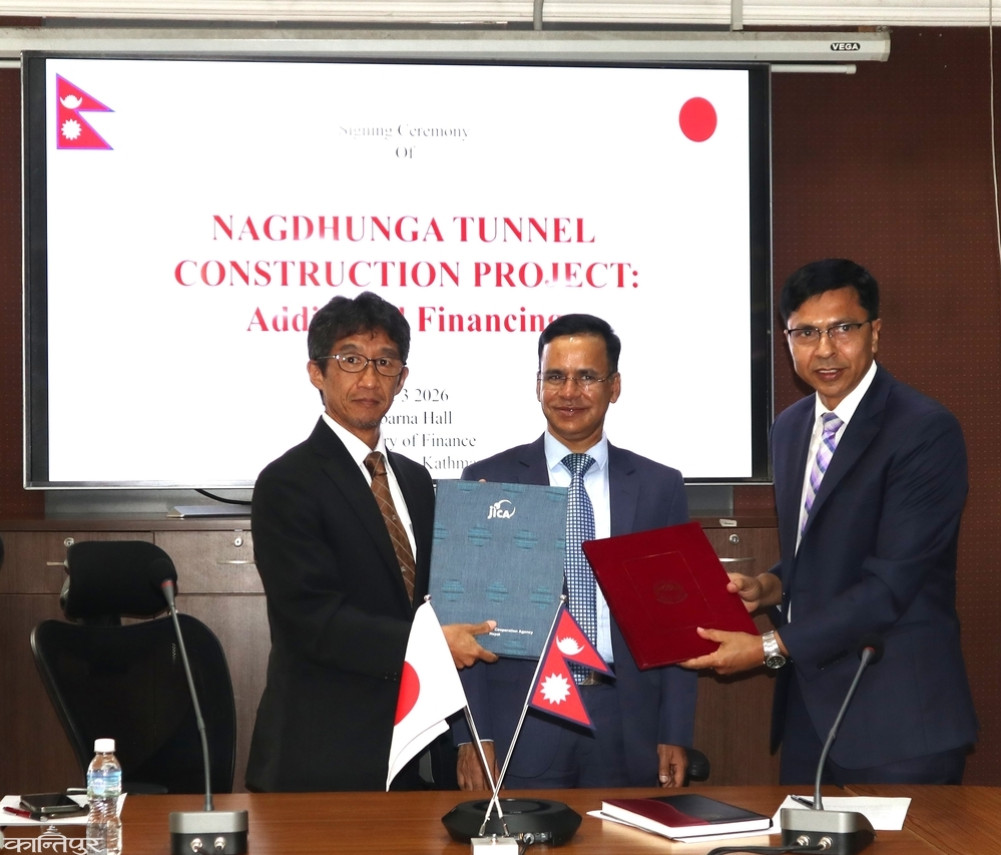
An additional loan agreement has been signed with the Japanese government for the Nagdhunga-Sisnekhola tunnel. Its construction was started with a concessional loan of 16 billion rupees from Japan. After the amount was insufficient, an additional loan agreement of 5.5 billion rupees was signed. The exchange of notes regarding additional assistance was signed on behalf of the Nepalese government by Ghanashyam Upadhyay, Secretary of the Ministry of Finance, and Maeda Toru, Japanese Ambassador to Nepal, on behalf of the Japanese government, on Wednesday.
The loan agreement was signed on behalf of the Nepalese government by Dhaniram Sharma, Head of the Foreign Aid Coordination Division of the Ministry of Finance, and Matsuzaki Mizuki, Head of the Nepal Office of the Japan International Cooperation Agency (JICA). The additional loan was taken due to the need for price increase, additional work on landslide management towards Dhading, and payment to consultants, said Soujanya Nepal, Director of the Nagdhunga Tunnel Construction Project.
The project has stated that the Nepalese government has invested 6 billion rupees in compensation and other works in the construction. The project says that a total of 21.5 billion rupees have been borrowed from the Japanese government for the construction of the tunnel. Even though Japan's loan has been added to the tunnel construction, the work has not been completed. After 81 months of its construction, preparations are underway to operate the tunnel from next Shrawan. The budget statement for the next fiscal year mentions that the tunnel will be operated from next Shrawan.
The project is preparing to open the tunnel, which was built on 4 Kartik 2076, to the public within the month of next Shrawan. For this, training of the employees working there is being started. Before that, some vehicles will be tested by driving it, said the project director Nepal. 'We had prepared to test it in Baisakh, but later it could not be done due to safety reasons,' he said, 'We are preparing to test it first and bring it into operation within Shrawan.'
There will be 150 employees on the tunnel route. The USIN-ART JV has been given the responsibility of operating the tunnel. USIN is a Chinese company and ART is a Nepali company. ‘Preparatory work including recruitment of staff, purchase of necessary machines for training are underway,’ he said. ‘The staff working in the tunnel are in the final stage of being approved by the Road Department.’
Most of the landslide prevention work has been completed. The project says that the construction of toll plazas on both sides of Kathmandu and Dhading and the testing of equipment placed inside the tunnel have been completed. Nepal said that a limited number of vehicles will be sent through the tunnel during the training period to train the staff. The contract for the construction of the tunnel has been awarded to Japanese company Hazma Endo Corporation.
Hazma will hand over the tunnel to the Nepal government by the time it becomes operational. Hazma will have to maintain it for a year after the tunnel becomes operational. ‘Regular tunnel operation and its management will be done by the service provider company,’ said Director Nepal. ‘The staff will also be trained by an expert team from the service provider company.’ Director Nepal says that the training will include employees of the Road Department, project employees, expert groups from the consulting company, and technical teams from the construction company.
The fee for vehicles using the tunnel has also been fixed. The selected employees will be trained in the system inside the tunnel for some time. After that, they will be taught what they will do from the flyover in Kathmandu's KCPD to the section that exits the tunnel towards Dhading.
The service provider will have to manage and operate the tunnel for five years. The company that takes charge of the operation will have to maintain the tunnel, traffic management, emergency rescue, toll collection, and maintenance of the entire tunnel and the 2.8-kilometer access road connecting Kathmandu and Dhading for five years. The service provider will have to operate and manage the tunnel around the clock. The service provider will have to deposit the toll collected by the service provider into the Road Board Nepal account every day.
Cars and vans using the tunnel will have to pay a fee of Rs 65 when entering Kathmandu and Rs 60 when exiting. It is estimated that about 859 such vehicles will enter and 646 will exit the Nagdhunga Tunnel construction project per day. A toll of Rs 115 has been set for minibuses, trucks and tippers when entering Kathmandu and Rs 80 when leaving. It is estimated that 540 of these vehicles will enter the valley daily and 406 will exit. Buses and trucks will have to pay a toll of Rs 260 when entering Kathmandu through the tunnel and Rs 200 when exiting through the same route.
The Project Office estimates that 794 such vehicles will enter and 597 will exit daily. Large trucks and heavy vehicles (lorries) will have to pay a toll of Rs 600 when entering the valley through the tunnel and Rs 250 when exiting. It is estimated that 596 of these vehicles will enter and 448 will exit daily.
According to the Nagdhunga-Sisnekhola Tunnel Transport Operation Directive, 2081, after the tunnel is operational, pedestrians, two-wheelers, three-wheelers and non-motorized vehicles will not be allowed to enter the tunnel. Vehicles carrying highly flammable and explosive materials, including diesel, petrol, gas, etc., are also prohibited in the tunnel route.
Such vehicles will be allowed to use the Nagdhunga-Sisnekhola road outside the tunnel route. The construction of the tunnel began on 4 Kartik 2076. According to this, the work should be completed within 42 months from the start of construction. However, despite repeated extensions, the work has not been completed. The main tunnel is 2,688 meters long and the emergency tunnel is 2,557 meters long.