Changes to issues such as VAT on electricity transactions and household consumption, road construction fees on electric vehicles priced below Rs 2 million, and green tax on the import of petrol and diesel.
We use Google Cloud Translation Services. Google requires we provide the following disclaimer relating to use of this service:
This service may contain translations powered by Google. Google disclaims all warranties related to the translations, expressed or implied, including any warranties of accuracy, reliability, and any implied warranties of merchantability, fitness for a particular purpose, and noninfringement.
The government uploaded the Finance Bill on the Finance Ministry's website on 15th Jestha and removed it the next day on 16th. It was re-uploaded 2/4 hours later, with some changes and additions to tax rates and provisions. The Finance Bill currently on the Finance Ministry's website is the third amendment.
The Finance Bill, which was presented on 15th Jestha when Finance Minister Swarnim Wagle presented the budget for the upcoming fiscal year in Parliament, has been changed four times as of Tuesday. In each change, some tax rates have been reduced and some have been increased. Some have been given relief while some have been imposed heavy taxes. Many have viewed the arbitrary changes in tax rates since the day the budget was made public as a matter of concern and suspicion.
Although the bill allows the Finance Minister to change tax rates, it has its own method and process, so it cannot be changed contrary to it, said former Finance Minister Surendra Pandey. 'The Finance Minister can make changes when necessary. But there are methods and processes for this.' According to which, the Finance Minister can only amend the bill after getting a decision from the Council of Ministers and passing it through Parliament,' Pandey said, 'However, in principle, tax rates cannot be changed immediately after the budget is presented. In this way, changing tax rates repeatedly without any rules and procedures confirms that the Finance Minister is unstable.' He said that changing tax rates in this way would raise suspicions.
Similarly, MP and former Finance Minister Barshaman Pun also said that the government is trying to manipulate the economy bill by changing tax rates arbitrarily. 'In the past, common errors such as typos, repetitions, etc. were corrected in the bill. But there has never been a case of adding new provisions and increasing or decreasing tax rates like now.' Pun said that such activities of the government have raised suspicions that there has been internal manipulation.
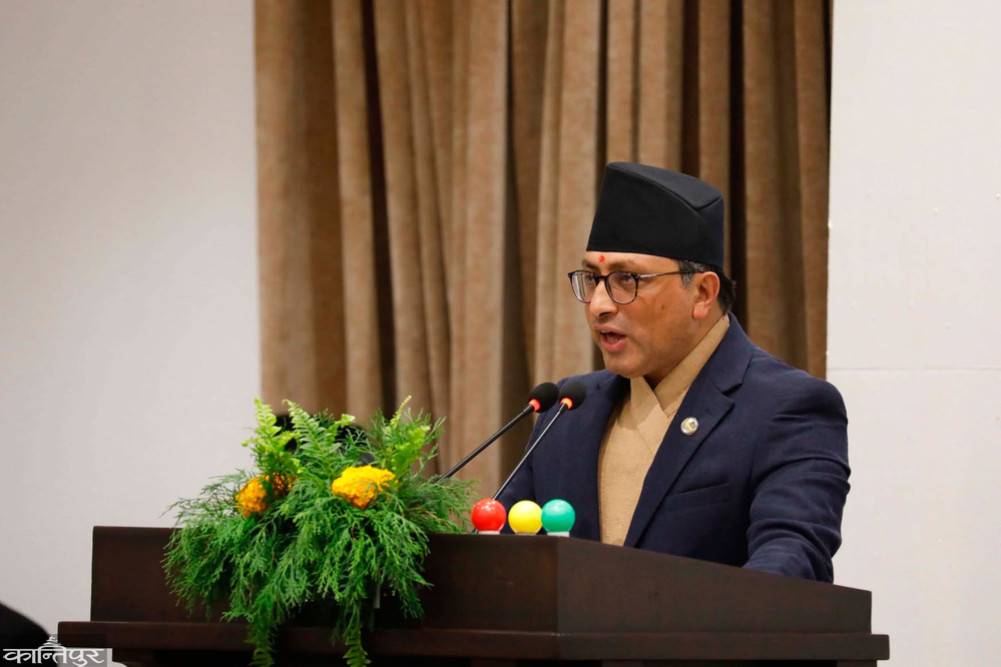
 Finance Minister Wagle admits that the economy bill was amended after common errors including percentage and rupee were found. '2/3 errors were found, what should have been a percentage turned out to be rupee. Such common errors have occurred. This has been informed to the parliament,' he said, 'in previous years, there were up to 40 changes. Employees must have made common mistakes while working till 4 am.'
Kantipur has tried to analyze the main differences between the financial bill, which was first uploaded on the website of the Ministry of Finance on 15 Jestha and the one currently there. The government had amended the Value Added Tax (VAT) Act and initially made a provision that electricity consumed for household purposes up to 50 units per consumer would not be subject to VAT.
This provision was mentioned in the VAT Act. In which, a provision was made that 'electricity consumed for household purposes up to 50 units per consumer' would not be subject to VAT, but anything in excess of that would be subject to VAT. According to this provision, VAT would be levied on sales from a business that trades electricity to a business that trades electricity (for example, when an electricity promoter sells to the Nepal Electricity Authority).
The current provision has been amended to exempt electricity traders and household use up to 50 units from VAT. The latest revised economic bill states that ‘electricity sold by businesses that trade electricity to businesses that trade electricity and electricity consumed up to 50 units per month per customer for household use’.
The latest amendment exempts electricity traders from VAT, but VAT will be levied on electricity consumed in excess of 50 units per month per customer. When Kantipur asked why this change was made, Finance Minister Wagle said that he was unaware of this matter.
Second, as per the provisions of the latest bill, the government has reduced the road construction fee for electric vehicles worth less than Rs 2 million to 2.5 percent. Generally, the road construction fee was levied on all types of vehicles at five percent. This provision was continued in the first bill made public on 15 Jestha. However, the provision has been revised in the latest bill.
‘Notwithstanding anything written in Chapter 1, a 2.5 percent road construction fee will be levied on motor vehicles falling under subheadings 8703.80.91 and 8703.80.99 with a transaction value of up to 2 million rupees determined at customs at the time of import,’ the latest economic bill states.
Finance Minister Wagle said that the government has reduced the road construction fee for vehicles worth less than 2 million rupees with the aim of preventing the price of low-value vehicles from increasing, and that it was initially omitted from the economic bill due to an error. ‘When I was drafting the economic bill, it was decided to impose half the 5 percent road construction fee on vehicles worth less than 2 million rupees. However, when the bill was finally reviewed by the Law Ministry, the note was omitted. Only that has been included now,’ he said.
Third, the government has also corrected the economic bill in the provisions related to fuel customs duty and green tax exemption. In which initially the import of petrol and diesel was 10 percent per liter. By amending it, the government has said that ‘notwithstanding anything else written in this Act, a green tax of Rs 10 per liter shall be levied on the import of petrol and diesel.’ It seems that the provision of Rs 10 per liter has been corrected.
Fourth, the government has added 3 (b) to Section 11 of the Income Tax Act in the Finance Bill to provide tax exemption for ten years to cinema halls established in areas other than metropolitan cities and sub-metropolitan cities. Finance Minister Wagle had mentioned this in his budget speech. He had said that arrangements have been made to provide complete income tax exemption for the first ten years to those establishing new cinema halls in areas other than metropolitan cities and sub-metropolitan cities. However, this issue was not included in the initial Finance Bill
. In the latest bill, a provision has been added to Section 5 of Sub-section 11 of the Income Tax Act by adding 3(b) to Clause (b) to ‘Movie houses established in areas other than metropolitan cities and sub-metropolitan cities shall be exempt from tax for 10 years from the date of commencement of business.’
Fifth, Section 11 of the Income Tax Act has been added to Section 16 (b) to provide that ‘Notwithstanding anything contained elsewhere in this section, if a natural person has insured a private building owned by him with a resident insurance company, the annual premium paid for such insurance or ten thousand rupees, whichever is less, shall be deducted from the taxable income and the tax shall be calculated as per this section only on the remaining amount. This provision was also in the budget statement. But it was not in the Finance Act. It has been included through an amendment.
Similarly, by amending the bill, the government has made a provision to allow a person to deduct 25 percent of the annual amount paid to a resident person for the education of his children as tuition fees or 25 thousand rupees, whichever is less, from the taxable income. ‘Notwithstanding anything contained elsewhere in Section 16(b) of the Act, tax shall be calculated as per this section on the amount remaining after deducting from taxable income 25 percent of the annual amount paid by a resident natural person towards education fees for the education of his/her children to a resident natural person or 25 thousand rupees, whichever is less, from the amount remaining,’ the latest bill states. This provision was not present in the original bill.