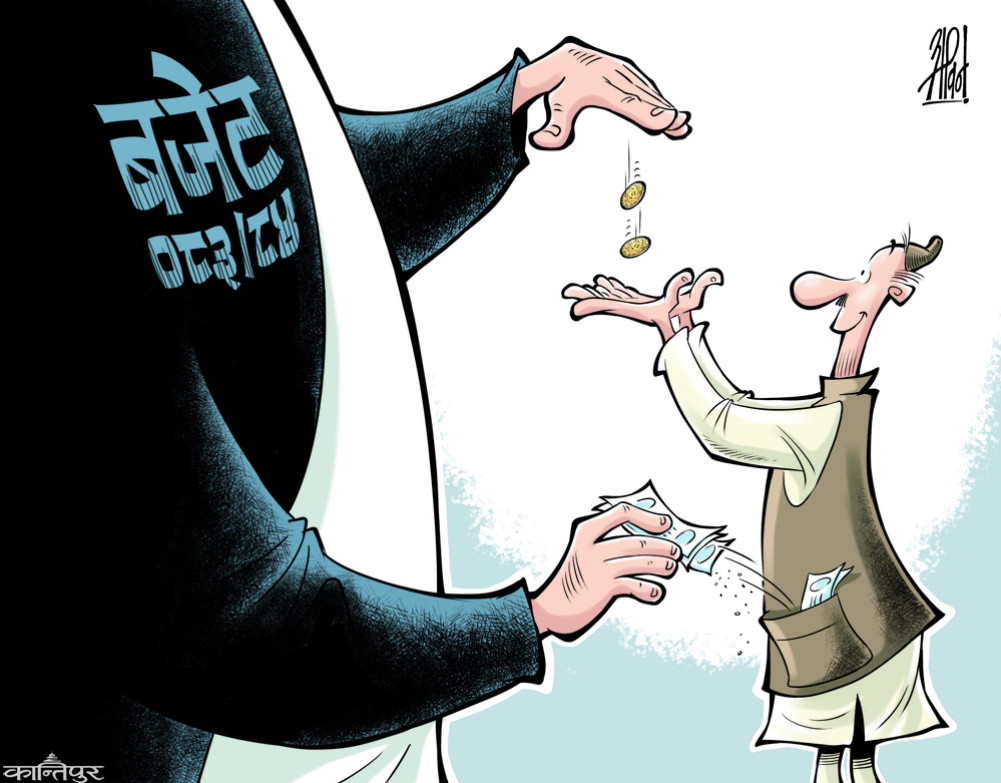
Former energy ministers have commented that imposing VAT on electricity consumption of more than 50 units will not only impose a financial burden on customers but will also reduce consumption.
We use Google Cloud Translation Services. Google requires we provide the following disclaimer relating to use of this service:
This service may contain translations powered by Google. Google disclaims all warranties related to the translations, expressed or implied, including any warranties of accuracy, reliability, and any implied warranties of merchantability, fitness for a particular purpose, and noninfringement.
The Value Added Tax (VAT) on electricity will affect 2.6 million household customers from the coming fiscal year. According to the Nepal Electricity Authority, around 2.6 million customers consume more than 50 units of electricity per month. The budget for the fiscal year 2083/84 mentions that a five percent VAT will be imposed on customers consuming more than 50 units of electricity.
The number of household customers consuming more than 50 units of electricity is more than 2.6 million, confirmed the Authority's spokesperson Rajan Dhakal. 'There are 1.998 million customers consuming up to 20 units, 4.21 million customers consuming 21 to 30 units, and 6.15 million customers consuming 31 to 50 units,' Dhakal said. 'There are 1.75 million customers consuming 51 to 100 units, 1.089 million customers consuming 1.05 million units, and 4.42 million customers consuming more than 250 units,' Dhakal said. The data mentioned is only for household customers and does not include the number of community, industrial and other customers. Meanwhile, Finance Minister Swarnim Wagle claims that the burden of the tax on electricity will be very low for the common citizen, but it will help raise the necessary resources for the construction of the country's energy infrastructure. He commented that only 1.4 million customers will be subject to VAT under the new system.
'According to our estimate, there are about 1.2 million households in Nepal that consume 51 to 150 units of electricity. The 5 percent VAT will only cost them an additional Rs 24 per month. There are only 200,000 households that consume 151 to 250 units of electricity, and they use facilities like AC and EV fast charging. The VAT will only cost them an additional Rs 25 to 102,' Wagle said at a press conference held on Sunday.
The government needs to build energy infrastructure worth more than Rs 85 billion, and it will take three to four years, Wagle said. Finance Minister Wagle has said that if the electricity tariff cannot be paid due to the imposition of VAT, it can be reviewed. He has commented that there are complaints that the government has imposed a negligible 5 percent VAT here while trying to do good work by transforming the energy sector.
‘Five percent VAT has been under discussion for a long time and we have done what many could not dare to do. This is in the long-term interest of the country,’ he said at a program organized in the capital on Monday, ‘However, due to the current crisis in West Asia and rising inflation, we are aware that we should not immediately burden consumers. We will not allow the additional burden of 5 percent to fall on consumers.’
VAT will be implemented from 1st July and until then, the government will not allow additional burden on consumers through various options (reducing electricity tariff by 5 percent, compensating for it through 700 megawatts of electricity owned by the government under the authority or any other option), Finance Minister Wagle said. ‘The sector that does not burden consumers but has trillions of rupees of investment should have been brought under the tax net, we did,’ Finance Minister Wagle added, ‘I urge everyone to advocate for this far-reaching program that is in the interest of the country instead of criticizing it.’
Finance Minister Wagle said that the government will not back down from the 5 percent VAT imposed on consumers consuming more than 50 units of electricity. ‘VAT has come on electricity, it will come. The government will not back down from this,’ Minister Wagle said. Commenting that if everything is free or distributed only, the country will be in a situation like Venezuela and Zimbabwe, he claimed that the government is moving towards a consumption-based tax rather than an income-based tax.
Prime Minister Balendra Shah had also defended the VAT imposed on electricity in the House of Representatives meeting on Sunday. He said that the amount collected for VAT would be spent on energy infrastructure. He had also said that it was not a huge amount, but only Rs 5 per 100 rupees was taxed. Prime Minister Shah was clear that the country is not in a position to immediately move into the electric age.
Prime Minister Shah had commented that if every kitchen uses electric stoves, all transformers and substations will explode. ‘Indeed, if every kitchen in the country uses electric/induction cooking, all transformers and substations will explode. It does not have the capacity. Money is needed to develop that capacity,’ he said. ‘For that money, the Finance Minister has introduced a system to impose 5 percent Value Added Tax (VAT) on above 50 units. The amount collected for VAT will be used to upgrade transformers, transmission lines and substations across the country.’
Former energy ministers and former officials disagree with the clarifications of Prime Minister Shah and Finance Minister Wagle. They argue that VAT should not be imposed on electricity. According to former energy minister Kulman Ghising, if VAT is imposed on consumption exceeding 50 units, consumers will be discouraged and will reduce consumption and will emphasize consumption below 50 units.
He also said that the money received from the tax will not be spent on improving the services of the authority or expanding its infrastructure, but will go to the state treasury. Ghising said that Rs 420 million will be collected monthly from VAT alone. ‘If the government needs resources for additional investment, it should be explained clearly and transparently. There should be no attempt to justify the tax by blaming the electricity infrastructure,’ he said.
Former Energy Minister and RPP Chairman Rajendra Lingden said that imposing the tax increases the risk of increasing the price of electricity along with the general inflation. ‘Nepal’s main strength is electricity. We should increase consumption by making electricity cheaper by increasing production,’ he said. ‘We should have made it cheaper, brought in industries and created jobs in the country. We should have gone on the path of making electricity even cheaper.’ Lingden commented that it is shameful for the government to impose the tax saying that transformers will explode when the dependence on fuel and gas imports should be reduced by promoting electric vehicles and electric stoves.
‘The common man will not be affected. It is said that whoever consumes more will pay. But even when paddy is crushed in a simple rice mill in the village, the price will increase,’ said Lingden, ‘Like Jagdamba Steel pays a monthly electricity bill of Rs 50-60 million. When the price of electricity increases, it increases the price of its products. The consumer will bear that. This is wrong. The government should withdraw it.’
Lingden argues that the government should increase electricity consumption by emphasizing on increasing the capacity of transformers and substations. Former Energy Minister Ghising also says that it is not appropriate to make statements that discourage the people by creating unfounded doubts about the structural capacity.
//
The purpose of infrastructure construction is to manage the future increasing electricity consumption, and Ghising says that the justification for the tax cannot be justified by using that as an excuse. The authority says that the number of customers consuming more than 50 units of electricity in the Terai region will increase in summer and decrease in winter.
Former Secretary Anup Upadhyay said that the government is trying to collect consumption tax from customers in the name of VAT. 'If the government has collected VAT, it should be refunded. Therefore, this is not VAT, this is consumption tax,' he said, 'Currently, only companies registered for VAT get a refund. Other companies do not get it. Therefore, this is not VAT.’
Upadhyay says that while revenue has been collected by levying various taxes on petroleum products, a tax has been imposed on electricity, which is consumed more, by deducting that tax. ‘The price of electricity should not be allowed to increase. It should be charged only at a fair price,’ he said, ‘the government has gone for a pure revenue policy.’
Upadhyay claims that when electricity prices were determined, the tariff was determined by adding cost price, maintenance, principal, interest, loan repayments, ‘expansion’, service charges and profits. But now, he comments, the tax has been added in the name of infrastructure development. ‘The NEA has been collecting money for infrastructure development by adding it to its tariff, why did it have to levy a separate tax?’ he said. Upadhyay says that the government’s policy will put a greater burden on middle-class customers, increase production costs, reduce consumption and waste electricity that could have been produced.
‘It is hot in the Terai. At this time, fans run more. If the electricity tariff increases, the common man will be affected. "They would have reduced their consumption if they could not pay at the time of consumption," she said. "On the other hand, the electricity generated was wasted."
Former Energy Minister Pampha Bhusal said that the government has done nothing to benefit the country and the people by reducing dependence on petroleum through abundant use of energy, consuming clean energy in sectors such as agricultural production, drinking water, and transportation, and not increasing electricity consumption in the country. She alleged that there are middle and lower class customers who consume up to 300 units of electricity and that they are being burdened with more burden.
When Nepal was facing fuel problems worldwide due to geopolitical wars, it imposed VAT on electricity to face the energy crisis or force them to consume expensive electricity, Bhusal said.
"When I was the Energy Minister, we provided free electricity to 2.4 million people in the Authority and communities who consumed 20 units per month," she said. "At that time, 2.4 million customers out of 6 million used electricity for free. Now the number has reduced to 2 million.’
The Ministry of Finance has not yet been able to clarify who will pay the VAT imposed. The Inland Revenue Department has said that it is preparing to formulate a procedure for the implementation of the multi-rate VAT. The department says that it will mention this in the procedure as the new system will be implemented from Shrawan 2083.
The department understands that the Value Added Tax (VAT) will be levied at 5 percent for household customers and 13 percent for other customers. Shiva Sharma, Director of the Inland Revenue Department, said that the VAT will be levied at 5 percent for household customers and 13 percent for the rest. If the 13 percent VAT is imposed on industrial and commercial businesses, the end consumer will also be affected. In addition, domestic goods will become more expensive, discouraging production.
However, Sharma said that the department will clarify the final explanation after discussing with the Electricity Authority. He said that since it will be implemented only from Shrawan, he will consult with the authority on this issue.
According to the authority, there are customers in industrial, commercial, non-commercial, irrigation, drinking water, transportation, religious and spiritual places, street lighting, temporary connections, non-domestic, entertainment businesses, etc.