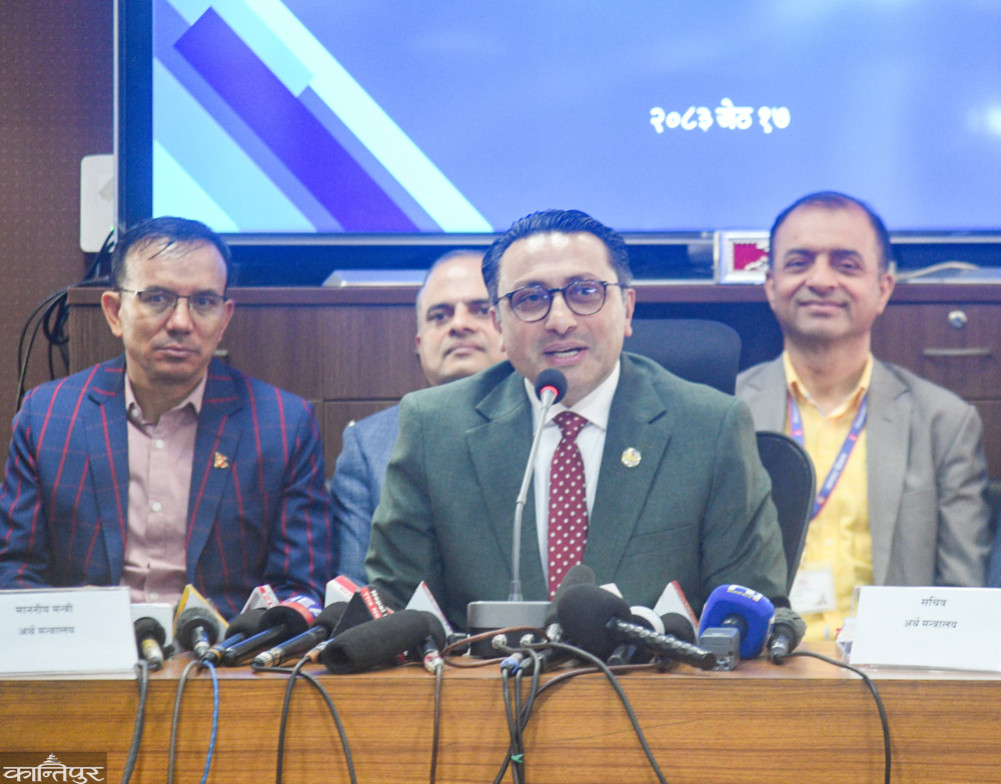
The Finance Minister also claimed that he is creating an environment where parents will opt for government schools instead of private schools for their children's education.
We use Google Cloud Translation Services. Google requires we provide the following disclaimer relating to use of this service:
This service may contain translations powered by Google. Google disclaims all warranties related to the translations, expressed or implied, including any warranties of accuracy, reliability, and any implied warranties of merchantability, fitness for a particular purpose, and noninfringement.
Finance Minister Swarnim Wagle has said that taxes have been imposed on education and health to provide relief to the lower classes of the country. Finance Minister Wagle has defended his tax-related decision at a time when there are comments that the government has imposed additional burden on citizens by imposing taxes through the budget instead of adopting a policy to make basic services including education and health accessible. At a press conference organized on Sunday regarding the budget for the fiscal year 2083/84, Finance Minister Wagle said that 5 percent VAT has been imposed to raise resources for infrastructure construction in the energy sector. ‘Some critics, including former finance ministers, have exaggerated the issue of taxes imposed on education, health, electricity, etc. There was also talk that the middle class was being deprived through the equality tax. But in the budget, we have kept the nutrition allowance that we have been giving to the very poor and children who are far behind in the human development index in 25 districts, which is a liability of Rs 6.5 billion 52 billion,’ he said.
Finance Minister Wagle also said that a Dalit-centric program has been introduced in the budget to end institutional and structural discrimination against the Dalit community. He said, ‘We have doubled the nutrition allowance for 313,753 Dalit children across the country.’
Wagle said that the government’s aim is to upgrade the lower class to the middle class. ‘This work requires resources, in which even a small contribution from parents who send their children to private schools will provide great relief to the lower class,’ he said, ‘For example, parents who send their children to private schools after paying a monthly fee of Rs 2,000 will now have to pay only Rs 60 more. There are also expensive schools here. Those who pay more fees there will also have to pay more tax. In this way, it is also a progressive tax. Because those who pay more fees will pay more and those who pay less will pay less tax.’
Finance Minister Wagle said that no one will be harmed if the tax collected from the upper and middle classes is spent on nutritious food for Dalit children in Jajarkot, Dailekh, Mugu and other districts. He said that the tax collected from the education and health sectors, which do not come into the public finances by specifying a specific title, will be collected in the Equity Fund. ‘We have made arrangements so that the tax collected in this way goes directly to the nutrition of Dalit children. If this can be explained to the citizens, there will be less objection,’ he said, ‘Rather than saying that Wagle imposed the tax to hurt the middle class, it should be understood that the government has started working to improve the disparity between private and community schools with your small contribution.’
- Finance Minister Swarnim Wagle The Finance Minister also claimed that parents are trying to create an environment where parents can choose government schools for their children’s education instead of private schools. Regarding the three percent tax imposed on treatment in private health institutions, Finance Minister Wagle said, ‘A three percent tax has also been imposed in the health sector under the concept of equality.’ In the budget, the government has doubled the child nutrition allowance provided to Dalit children across the country to one thousand rupees per month. Finance Minister Wagle said that Dalit-centric investment will be increased in an integrated manner, including activities for preserving traditional skills of the Dalit community, generating income, and upgrading technology. He also informed that Rs 3 billion has been allocated for nutritional support for Dalit children under the age of five. We have made arrangements so that the tax collected in this way goes directly to the nutrition of Dalit children. If this can be explained to the citizens, there will be less objection.
Finance Minister Wagle said that a 5 percent value-added tax (VAT) has been imposed on electricity consumption of more than 50 units to develop infrastructure in the energy sector. The government has decided to impose VAT on electricity for the first time in Nepal through the budget.
He claimed that the burden of this tax on electricity will be very low for the common citizen, but it will help raise the necessary resources for the construction of the country's energy infrastructure. 'There are about 1.2 million households in Nepal that consume 51 to 150 units of electricity. 5 percent VAT will only cost them an additional 24 rupees per month. There are only 200,000 households that consume 151 to 250 units of electricity, and they use facilities like AC and EV fast charge. VAT will only cost them 25 to 102 rupees extra,' he said, 'But we will have to build energy infrastructure worth more than 85 billion. Which will take three to four years.’ Finance Minister Wagle says that if the electricity tariff cannot be paid due to the imposition of VAT, it can be reviewed. ‘There is an Electricity Regulatory Commission that determines the price of electricity. The rate can also be reduced tomorrow,’ he said, ‘VAT will not be charged up to 50 units. So it does not mean that VAT will be charged for everyone.’
Meanwhile, Prime Minister Balendra Shah has said that the country is not in a position to immediately move to the electric age. While answering a question from a member of parliament in the House of Representatives meeting on Sunday, he said that if electric stoves are used in every kitchen in the country, all transformers and substations will explode. ‘Indeed, if electricity/induction cooking is used in every kitchen in the country, all transformers and substations will explode. It does not have the capacity. Money is needed to develop that capacity,’ he said, ‘For that money, the Finance Minister has introduced a system to impose 5 percent value-added tax (VAT) on more than 50 units. This is not a huge amount. 5 rupees for every 100 rupees.’ Prime Minister Shah said that the amount raised through VAT will be used to upgrade transformers, transmission lines and substations across the country. ‘Only then can we truly move into the electronic era. The Nepal government is taking the lead for that,’ he said. Excess liquidity has accumulated in the financial system for the last three years. In recent months, it has continuously increased to 1382 billion rupees as of 10 Jestha. Similarly, foreign exchange reserves are around 35 trillion. The government was expected to bring a policy through the budget that would utilize the investment in the financial system. In this context, Finance Minister Wagle admitted that it was not possible to directly bring a policy that would utilize the excess liquidity in the banks. ‘I saw a news in a newspaper that there was no policy to utilize the liquidity in the financial system in the budget. The government has not been able to think about liquidity utilization due to the constitutional limit of not being able to take internal loans exceeding 5.5 percent of GDP. But there are other tools in the budget for liquidity utilization,' he said. 'We have made arrangements in the budget to allow projects to raise investment from outside the government's balance sheet (budget system).' He claims that this will help in utilizing the liquidity in the bank.
Finance Minister Wagle said that the understanding that the government's budget of around Rs 200 billion alone will achieve economic growth is wrong. Stating that Nepal's economy is worth around Rs 700 billion, he said that the government's focus is on expanding the overall economy rather than a budget of Rs 200 billion.
Finance Minister Wagle said that the government is focused on getting the country out of the illusion that spending Rs 200 billion will lead to 7 percent economic growth. 'We want to get the country out of the illusion. The government's budget of Rs 200 billion is to facilitate the economy, the economy is worth around Rs 700 billion. "While preparing the budget, we focused on the entire economy of 70 trillion rupees, not the 20 trillion rupees," he said. "We are not going to run the economy with 20 trillion rupees alone, but rather make the economy of 70 trillion rupees dynamic."
Finance Minister Wagle said that the government expects the infrastructure and services such as roads, electricity, peace and security, and the justice system to be built by the government to increase the confidence of the private sector and thereby attract private investment and expand economic activity. He said that the goal is to increase Nepal's economy from 70 trillion rupees to 100 trillion rupees to 150 trillion rupees within the next seven years.