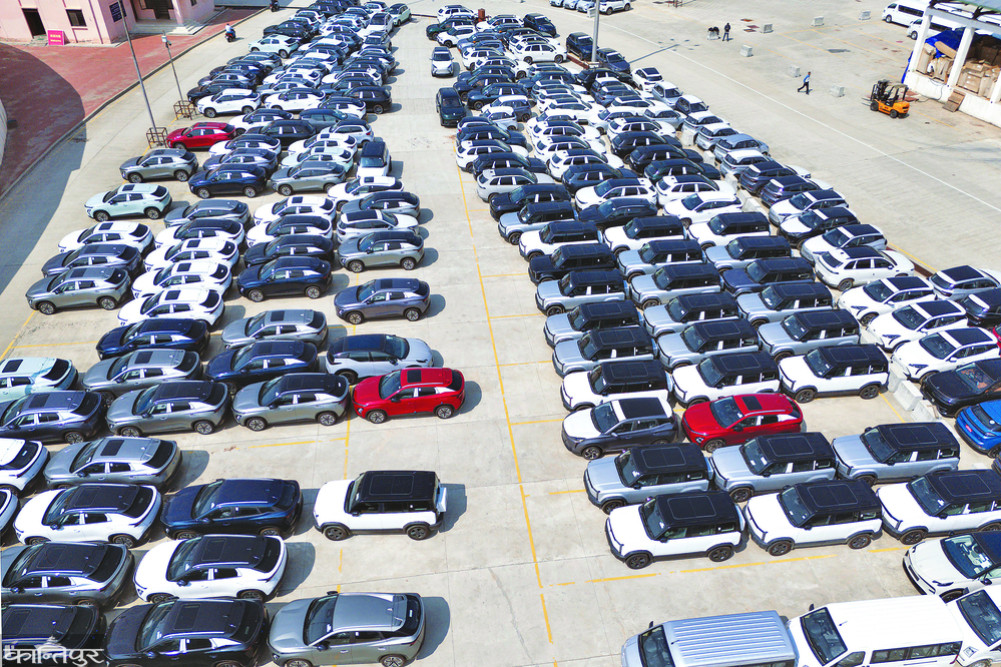
Dhruv Thapa, former president of NADA Automobiles Association of Nepal, estimates that the government's tax policy could increase the price of electric vehicles by a minimum of 200,000 to a maximum of 10 million rupees.
We use Google Cloud Translation Services. Google requires we provide the following disclaimer relating to use of this service:
This service may contain translations powered by Google. Google disclaims all warranties related to the translations, expressed or implied, including any warranties of accuracy, reliability, and any implied warranties of merchantability, fitness for a particular purpose, and noninfringement.
The price of electric vehicles is set to increase with the increase in taxes in the budget for the coming fiscal year. The government has removed the excise duty on electric vehicles and imposed a Clean Infrastructure Investment Fee (CIIF). According to the Finance Bill 2083, the customs duty has been fixed at 20 percent on all types of vehicles. The clean infrastructure investment fee has been imposed from 2.5 percent to 130 percent. Road construction fee of 5 and value added tax (VAT) of 13 and customs duty of 20 percent will be added to it. Earlier, customs duty was 15 to 80 percent and excise duty was 5 to 50 percent based on kilowatt. Road construction fee and VAT remained the same.
Dhruv Thapa, former president of NADA Automobiles Association of Nepal, estimates that the price of electric vehicles could increase by a minimum of 200,000 to a maximum of 10 million rupees due to the government's tax policy. 'The price of small vehicles will not increase much. But the higher the price, the higher the tax. And, accordingly, the price will increase,' he said, 'expensive vehicles will become more expensive.'
The government had previously been setting the tax rate based on the motor peak power. But it was becoming controversial because it was being reduced by bringing the motor peak power. Therefore, the government has now set the tax rate in Nepali rupees based on the transaction value. The government has stated that all taxes will be levied on the basis of cost, insurance and freight (CIF) value. However, electric vehicle sellers have said that the tax should be determined based on dollars rather than Nepali rupees.
Thapa's comment is that for businessmen who have been demanding a fixed tax on electric vehicles, the tax has now become even more unstable. Gaurav Sharada, director of SPG Automobiles, the official distributor of Omoda & JECO automobiles for Nepal, says that the tax should be determined based on dollars rather than Nepali rupees. 'Recently, the rupee has become cheaper and the dollar has become stronger than other foreign currencies,' he said, 'Prices can fluctuate when converting dollars or other currencies into Nepali. How is the tax rate determined in such a situation? He said that the tax increase will affect the price of all types of vehicles.
According to the economic bill, a 2.5 percent clean infrastructure investment fee will be levied on electric vehicles with a transaction value of up to Rs 2 million at the customs point. Such vehicles will be subject to customs duty of 20 percent, road construction fee of 5 percent, and value-added tax (VAT) of 13 percent. A 20 percent clean infrastructure investment fee has been fixed for vehicles with a transaction value of Rs 2 million to 3 million. Other taxes, including customs, remain unchanged.
Only 35 percent clean infrastructure investment fee will be levied on electric vehicles with a transaction value of Rs 3 million to 4 million. A 90 percent clean infrastructure investment fee will be levied on electric vehicles with a transaction value of Rs 4 million to 5 million. A 130 percent clean infrastructure investment fee has been arranged for electric vehicles worth more than Rs 5 million. Customs duty of 20 percent, road construction fee of 5 percent, and VAT of 13 percent will be levied on all vehicles. The government's tax policy has significantly increased the tax burden on expensive electric vehicles. Sharda said that there should be a limit to only 2/3 categories of tax on the basis of price.
Sharda commented that the tax has increased significantly on electric vehicles sold for more than 60 to 70 million rupees. ‘Now, vehicles priced above 60 to 70 million rupees cannot be imported,’ he said, ‘an additional tax of 20 to 25 million has been increased on that. Now its price may exceed 90 to 95 million rupees.’ He said that even ordinary models of Omoda and JEC vehicles will see a minimum increase of 2 to 4 lakh rupees.
After the government changed the tax rate, BYD Atto 1’s starting price could reach 31 lakh rupees and a maximum of 36 lakh rupees, according to Yamuna Shrestha, Managing Director of BYD’s official dealer, Cymax Inc. She said that the highest tax increase has been made on vehicles with a capacity of 51 to 100 kilowatts, which are the most sold in the country.
On the one hand, she said that while electric vehicles are being promoted, the tax rate will fluctuate on the other hand. Shrestha said that setting taxes based on prices has increased instability while demanding a stable policy. “How can we book a vehicle now when the dollar is rising? It may be expensive today and cheap tomorrow. The government should clarify this issue,” she said. MAW Vriddhi Managing Director Bishnukumar Agrawal said that the price of Deepal’s S05 may also increase by two to three lakh rupees. “While we are selling it, the price of Deepal’s S05 will increase by two to three lakh rupees,” he said, “We have not brought the S Zero Seven yet. The E-Zero Seven vehicle is not in the market.”
Sharda understands that electric vehicles with a transaction value of more than five million rupees are taxed the same as diesel/petroleum vehicles. When customs duty, clean infrastructure investment fee, road tolls and value-added tax are imposed, the overall tax burden has reached the same level as petroleum fuel-based vehicles, said former Energy Minister Kulman Ghising. Ghising says that the tax policy adopted by the government through the budget for the upcoming fiscal year has given a clear signal that it will discourage the use and expansion of electric vehicles instead of encouraging them.
‘The government’s policy is against the national goals of increasing the consumption of clean green energy produced domestically, reducing the import of petroleum products, and developing an environment-friendly transportation system,’ he said.
Thapa says that now the tax rate will differ after the vehicle passes customs inspection. Thapa comments that since the tax will be determined by converting the exchange rate of foreign currencies into Nepali rupees, the price of the vehicle will now be like the price of gold, silver, petrol/diesel.
‘Let’s say, if it costs 3.95 million rupees, the price of that vehicle will be cheaper today,’ he said, ‘If the dollar price increases tomorrow, the Chinese yuan also increases in the same way, or the currency in which the order is made fluctuates slightly, the same tax slab will change tomorrow.’ Thapa says that the government’s new tax system is not scientific. ‘This tax system has become more like a return back,’ he said, ‘This has increased the possibility of tax evasion. The price of vehicles has also started fluctuating like gold and silver.’
Agarwal estimates that the price of vehicles up to Rs 2 million will not increase much, and vehicles between Rs 20 and 30 million may increase by Rs 1-2 lakh. He said that due to the new tax policy, Deepal’s E Zero Seven and Avatar models will not survive in the market. He comments that the price of these two vehicles may double.
Agarwal says that the CIIF for vehicles between Rs 4 million and 5 million has been increased to 90 percent, and there is a big difference from 35 percent to 90 percent at once. ‘The government has increased it from 35 to 90 percent and from 90 to 130 percent. This is a big difference,’ he said, ‘Instead, if the difference was only 15/15 percent, vehicles could be imported. They could be sold. The government could also get more revenue. Now there will be no imports.'
Agrawal believes that vehicles of this level will no longer be able to come to Nepal due to the unnatural tax increase. 'Prices will fluctuate in the future. One price when ordering, another when passing customs inspection,' he said. 'When doing business, it should be predictable. Since it is not in dollars, it is not predictable. The government loses revenue due to this. Customers also do not get good cars.'