With liquidity at around 1.4 trillion, foreign exchange reserves at 3.5 trillion, experts say that there were not enough programs in the budget to manage the liquidity in the financial system and expand investment.
We use Google Cloud Translation Services. Google requires we provide the following disclaimer relating to use of this service:
This service may contain translations powered by Google. Google disclaims all warranties related to the translations, expressed or implied, including any warranties of accuracy, reliability, and any implied warranties of merchantability, fitness for a particular purpose, and noninfringement.
Currently, banks and financial institutions have more than 1.4 trillion rupees in lending (excess liquidity). The country's foreign exchange reserves are at an all-time high of around 3.5 trillion rupees. With sufficient investable funds and external indicators continuing to strengthen, many expected the government to introduce investment incentive programs through the budget for the upcoming fiscal year.
The budget for the fiscal year 2083/84, released by Finance Minister Swarnim Wagle on Friday, also included some policies and programs to expand investment. However, experts say that managing the liquidity in the financial system is not enough to expand investment.
'The government is trying to provide relief to foreign investment through the Investment Express Policy, and to make arrangements such as informing the Rastra Bank when the returns are withdrawn,' says Min Bahadur Shrestha, former vice chairman of the Planning Commission. 'These things are very new and are not ways to make a leap in the economy. Because work is being done to increase investment through the one-door policy and frequent investment conferences. But the results have not come .’
The government is trying to provide relief to foreign investment through the Investment Express Policy, and to provide information to the National Bank when withdrawing the returns. These are not new and are not ways to make a leap in the economy: Min Bahadur Shrestha, former vice-chairman of the Planning Commission The economy has been sluggish for a long time . Even though interest rates are at the lowest point in history and there is enough money in the banks, investors have not been able to demand loans . Now, investors are looking for security of investment and reasonable returns more than interest rates and availability of easy loans . The private sector is very nervous, mainly after the Gen-G movement . That is why the private sector says that the policies and programs introduced by the government through the budget to boost the morale of the private sector and expand investment are not sufficient .
‘We are studying the budget, so far there is no plan to immediately provide bank loans,’ says Anjan Shrestha, president of the Federation of Nepalese Chambers of Commerce and Industry. ‘If the problems seen in cooperatives are resolved and the central bank also facilitates them, there may be demand for loans from small and medium industries.’ He responded by saying that they are trying to solve the problems of the private sector.
Capital formation in the economy is weak. Total investment as a percentage of GDP was 39.5 percent in the fiscal year 2074/75, but it is limited to 28.1 percent in the fiscal year 2081/82. The National Statistics Office has stated that the overall investment situation has deteriorated due to the government’s weak capital expenditure and a decrease in private sector investment. Private sector investment has averaged 19.6 percent of GDP in the past decade, but after the COVID-19 pandemic, its ratio has gradually decreased to 14.7 percent in the fiscal year 2081/82.
Since the implementation aspect is weaker than the law and policy in Nepal, the results depend on how the policies are implemented rather than what policies are included in the budget, says financial sector expert and former banker Parashuram Kunwar. ‘As the arrangements included in the budget start being implemented, the confidence level of everyone, including the private sector and investors, gradually increases,’ he said, ‘There are some arrangements in the budget to promote investment.’ He says that investment will not increase just by listening to the budget.
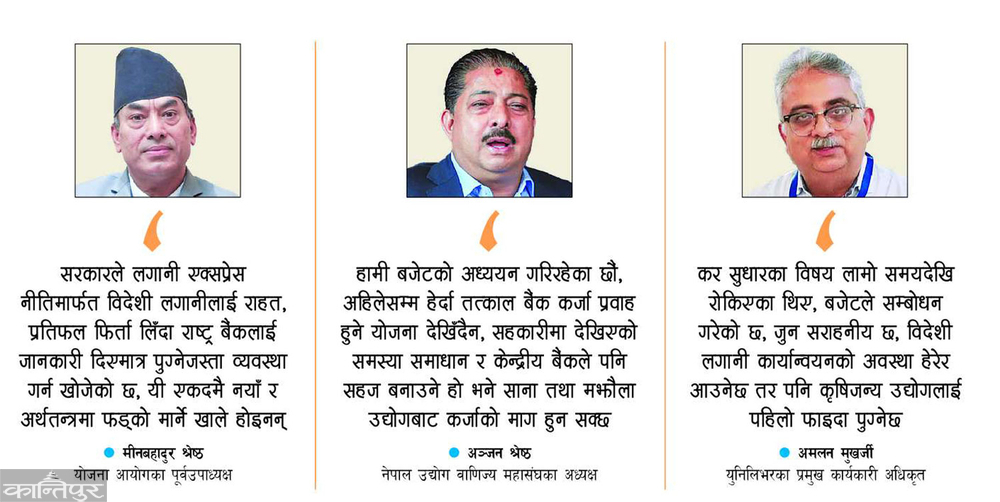
Multinational companies operating in Nepal have responded that the budget will increase demand in the market and that will drive the economy. ‘Tax reform issues were on hold for a long time, the budget has addressed them, which is commendable,’ says Unilever CEO Amlan Mukherjee, ‘Foreign investment will come depending on the implementation status, but the agricultural industry will benefit first.’
Similarly, experts say that the government should also try to raise investment in large projects. Economist and former executive director of the Nepal Rastra Bank, Nar Bahadur Thapa, said that the project itself should raise investment from the market (outside the budget system) and additional projects should be brought into the budget on the model of the Tamokoshi Hydropower Project. ‘When the project itself raises investment, investment is generated for the construction of the project and the burden on the state treasury is not increased,’ he said. ‘The government should have brought in the budget a plan to build return-generating projects like Budhi Gandaki, Paschim Seti, Nijgadh Airport, etc.’
We are studying the budget, so far there is no immediate plan to provide bank loans, if the problems seen in cooperatives are resolved and the central bank also facilitates, there may be demand for loans from small and medium industries: Anjan Shrestha, President of the Federation of Nepalese Chambers of Commerce and Industry He says that such a policy would, on the one hand, raise investment for the project, and on the other hand, the excess liquidity in the market would also be utilized. ‘The budget mentions raising investment for projects from outside the budget system, but it would have been better if the project had been specified,’ Thapa said, ‘The government has made a commitment through the budget to increase investment and boost the morale of the private sector, the main question is how it will be implemented.’
The National Bank has set a target of 12 percent credit expansion for the private sector in the current fiscal year. Till last Sunday (10 Jestha), while deposits of Rs 692 billion have been collected, only Rs 291 billion has been provided as loans. Similarly, Finance Minister Wagle said that appropriate policy and legal arrangements will be made through the upcoming budget for investment promotion, economic reform and smooth service delivery.
‘We will make the company dissolution process easier by amending the company law and maintaining clarity on issues such as conflict of interest and disclosure of details. We will conclude foreign investment protection and double taxation relief agreements with more countries,’ the budget states. ‘We will amend the Securities Act, 2063 BS, and formulate a limited liability partnership law to solve financial problems of consumers, micro, small and medium industries and promote investment.’ The government claims that this will encourage angel investment to invest in venture capital and private equity funds.
The government has said that it will make it easier for Nepali citizens to invest abroad. ‘We will amend the Industrial Business Act to make it easier for the Department of Industry to increase the capacity of industries, change ownership, increase capital, and amend the Foreign Investment and Technology Transfer Act to make it easier for the Department of Industry to withdraw investments and to provide information,’ the budget states.
Tax reform issues were pending for a long time, the budget has addressed it, which is commendable, it will come after looking at the implementation status of foreign investment, but still the agricultural industry will benefit first: Amlan Mukherjee, CEO of Unilever The government has announced that it will include convertible instruments, project-linked funding and other hybrid instruments within the scope of foreign investment and remove the provision of prior approval in the automatic approval process of investment. The government has announced that it will simplify the process of sending money for service fees, royalties and technology abroad.
‘To enable non-resident Nepalis to participate in the secondary market of securities, amendments will be made to the legal provisions related to foreign investment approval, accounting of investment, return of profit and capital gains tax,’ the budget states, ‘We will make arrangements to allow foreign investors, international organizations, branches of multinational companies investing in Nepal, or branches of multinational companies or apartments in residential areas or places designated by the government to be leased on a long-term basis, not exceeding 25 percent of the total unit.’ We will secure loans with ‘first loss recovery’ to ensure financial access to small and medium industrialists.
Similarly, to encourage and protect investment, the government has given a 50 percent tax exemption on income earned from the export of such services through the budget to advance the information technology industry as the new economic engine of the nation. The government has imposed a 100% exemption on the amount of sweat equity received by the workforce working in the information technology sector in calculating taxable income, and a 'domestic production promotion fee' on some items imported into Nepal.
The government has made arrangements to exempt interest earned by development finance institutions wholly owned by friendly countries from investing in loans in Nepal, which are established to make no profit, and to provide complete income tax exemption for the first ten years to those establishing new movie theaters in areas other than metropolitan cities and sub-metropolitan cities.
The government has also put forward a policy to mobilize a certain percentage of the amount as a 'Sovereign Wealth Fund' in the current situation where there is a convenient reserve of foreign currency. 'We will establish a 'Motherland Fund' to invest in projects of strategic importance, including fuel storage for at least three months, AI factories,' the budget states. 'To reduce the exchange rate risk in foreign loans or investment projects, arrangements will be made to provide hedging services at appropriate premiums from the coming fiscal year.'

