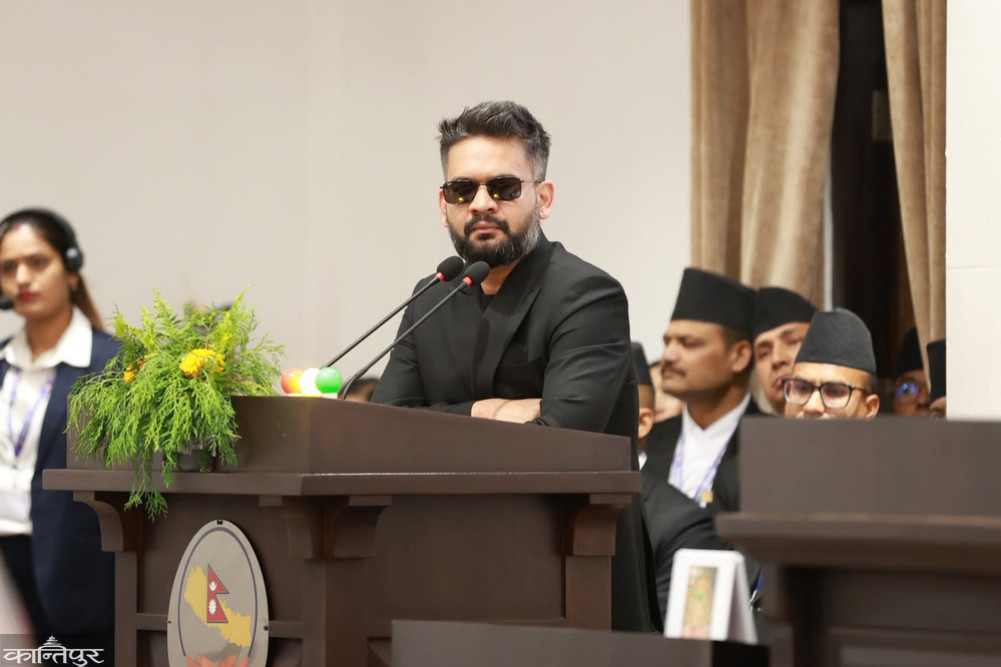
Prime Minister Shah said that the VAT on 100 rupees is only 5 rupees, which is not a huge amount.
We use Google Cloud Translation Services. Google requires we provide the following disclaimer relating to use of this service:
This service may contain translations powered by Google. Google disclaims all warranties related to the translations, expressed or implied, including any warranties of accuracy, reliability, and any implied warranties of merchantability, fitness for a particular purpose, and noninfringement.
Prime Minister Balendra Shah has said that the country is not in a position to immediately move into the electric age.
While answering a question from Rastriya Prajatantra Party MP Khushbu Oli in the House of Representatives on Sunday, Prime Minister Shah said that if electric stoves are used in every kitchen in the country, all transformers and substations will explode.
'Indeed, if electric cooking/induction cooking is used in every kitchen in the country, all transformers and substations will explode. It does not have the capacity. Money is needed to develop that capacity,' he said. 'For that money, the Finance Minister has brought a provision to impose 5 percent value-added tax (VAT) on more than 50 units. It is not a very large amount. It is 5 rupees on one hundred rupees.'
He said that the amount raised for VAT will be used to upgrade transformers, transmission lines and substations across the country. 'Only then can we truly move into the electric age.' He said.'
Finance Minister Swarnim Wagle has introduced a system to levy VAT at a concessional rate on electricity consumption of more than 50 units per month sold to end-users through the budget for the coming fiscal year.'
The government has introduced double taxation on VAT by adding sub-sections (1A) and (1B) after sub-section 1 of Section 7 of the Value Added Tax Act through the Finance Bill 2083. 'The Government of Nepal may, by publishing a notification in the Nepal Gazette, establish multiple rates without increasing the tax rate and specify the goods and services subject to tax accordingly,' Sub-section (1A) states.
Sub-section 1B states that a 5 percent value added tax will be imposed on ride sharing and electricity services. It states, 'When a person operating a ride-sharing service (ride-sharing operator) provides transportation and transportation services to a person affiliated with a platform, the person operating the ride-sharing service and the person providing electricity to the end consumer will have to determine and collect tax at the rate of five percent on the taxable value.'
Service recipients who consume more than 50 units of electricity per month will have to pay 5 percent VAT. If a person consumes 200 units of electricity per month, they will have to pay 5 percent VAT only on the price of 150 units of electricity, said Shiva Sharma, Director of the Internal Revenue Department. 'Although VAT is refundable in the case of a businessman or company, the individual will not get a refund,' he said.