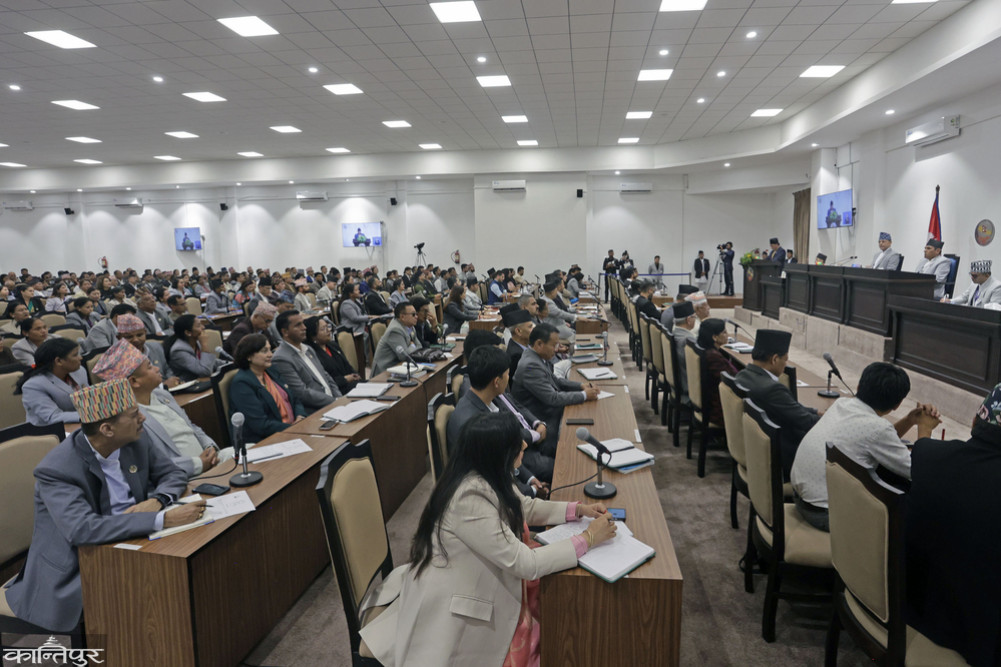
The government has adopted policies through the budget ranging from reducing customs duties on raw materials and eliminating excise duties, to promoting investment, from company liquidation, foreign investment protection, and double taxation relief to simplifying the process of paying service fees, royalties, and sending money for technology abroad.
We use Google Cloud Translation Services. Google requires we provide the following disclaimer relating to use of this service:
This service may contain translations powered by Google. Google disclaims all warranties related to the translations, expressed or implied, including any warranties of accuracy, reliability, and any implied warranties of merchantability, fitness for a particular purpose, and noninfringement.
The budget for the fiscal year 2083/84 has been presented with issues including facilitation of foreign investment, reduction in customs duty on raw materials, abolition of a large number of excise duties, promotion of startups and small enterprises. The budget presented by Finance Minister Swarnim Wagle in the joint house of parliament on Friday has encouraged the private sector for the time being, but entrepreneurs have said that whether to promote investment or not can be determined only by looking at the implementation status.
The government has adopted policies ranging from reducing customs duty on raw materials and eliminating excise duty through the budget for the upcoming fiscal year. At the same time, the government has adopted policies ranging from company liquidation, foreign investment protection and double taxation relief to simplifying the process of paying service fees abroad, royalties and sending money for technology.
Finance Minister Swarnim Wagle, while presenting the budget in the joint house of parliament on Friday, said that the customs duty on industrial raw materials will be at least one level lower than that on finished goods, and the customs duty on 273 types of raw materials has been reduced. He said that the existing 11 levels of customs duty have been reduced to seven levels. Entrepreneurs had been commenting on the same customs duty on raw materials and finished goods in Nepal.
Investors had also been saying that while in other countries the customs duty on raw materials is low and the customs duty on finished goods is high, the opposite is happening in Nepal. To address this issue, the government has said that the customs duty on raw materials will now be one level lower than the tax on finished goods. The government has also abolished the excise duty on 360 items.
Anjan Shrestha, President of the Federation of Nepalese Chambers of Commerce and Industry, said that the special scheme related to tax exemptions and concessions is welcome to create a business environment by resolving tax disputes that have been created for a long time due to legal ambiguity and taxpayer ignorance. ‘The existing 11-tier customs rate has been reduced to seven tiers. These are based on the suggestions we have given,’ he said. He said that efforts have been made to address issues such as taxes, excise duty, SAFTA, etc. raised by the private sector. Shrestha said that the government’s policy of making tax compliance a companion of development, not a punishment, is positive.
Birendra Raj Pandey, President of the Confederation of Nepalese Industries (CNI), said that the decision to reduce customs duty on 273 items to make one tier different in customs duty on finished goods and raw materials for manufacturing industries will make domestic products competitive and accelerate the pace of industrialization. He said that the abolition of excise duty on 360 items will reduce the cost of doing business in Nepal.
He believes that raising the personal income tax limit to one million and reducing the maximum rate by 10 percent is a bold step in the economy. ‘This will increase the purchasing power of consumers, improve aggregate demand and make the economy dynamic,’ he said.
The government has announced that it will make appropriate policy and legal arrangements for investment promotion, economic reform and smooth service delivery. For this, Finance Minister Wagle has also announced that dozens of acts, rules, procedures and guidelines will be created, replaced or amended. He said that some Nepal Act Amendment Bills will be presented in Parliament to immediately repeal the 15 laws announced earlier.
Finance Minister Wagle said that the company law will be amended to ensure clarity on issues such as conflict of interest and disclosure of details and to facilitate the company dissolution process. He also announced that he will sign foreign investment protection and double taxation relief agreements with additional countries. The Deposit Act, 2063 has been amended to resolve the financial problems of consumers, micro, small and medium industries.
The Industrial Business Act is being amended to provide information to the Department of Industry on issues such as capacity increase, ownership change, capital increase, etc. The government has amended the Foreign Investment and Technology Transfer Act to provide information to the Department of Industry. Finance Minister Wagle has said that convertible instruments, project-linked funding and other hybrid instruments will be included within the scope of foreign investment.
Wagle says that the pre-approval system will be removed from the automatic approval process for foreign investment and the process of sending service fee payments, royalties and technology payments abroad will be simplified. Domestic and foreign investors have been saying that they will invest only based on how easy the exit process is. Therefore, they comment that it is more difficult to exit than to enter Nepal, which is why investors have not been attracted.
The government has also announced to establish a separate tribunal for the speedy resolution of commercial disputes and to amend the Conciliation Act for that purpose. Finance Minister Wagle has announced to amend the legal provisions related to foreign investment approval, investment accounting, profit repatriation and capital gains tax to allow non-resident Nepalis to participate in the secondary securities market.
Pandey says that the announcement to facilitate profit repatriation and royalty refund will attract foreign investment and play an important role in creating an investment-friendly environment. The budget statement mentions that the Civil Code, 2074, will be amended to allow foreign investors, international organizations, branches of multinational companies investing in Nepal to take apartments on long-term lease in buildings in the residential sector or at a location designated by the government, not exceeding 25 percent of the total unit for housing purposes.
This is not the first plan of the government. Earlier, the government had announced for the first time in the budget statement of the fiscal year 2072/73 that it would allow foreign citizens to purchase apartments in Nepal. The government had also mentioned in the budget for the fiscal year 2079/80 that it would make legal provisions to allow the private sector to sell a maximum of 20 percent of apartments with more than 100 units to foreign citizens in foreign currency. But it has not been implemented so far.
Overall, this budget has been introduced to encourage the private sector and attract foreign investment, said MP Vidushi Rana. She commented that the budget has been introduced as a starting point to give a new dimension to the country's economy and enter a new era. She said that the provision of concessions in electricity tariffs to manufacturing industries is more positive.
The government has announced that the system for refunding value-added tax (VAT) will be automated. Finance Minister Wagle has also said that a high-level suggestion committee will be formed to study the relevance of multiple rates in VAT and submit suggestions. The government has stated that it will make start-ups, innovation and entrepreneurship a strong basis for economic transformation. The government has announced that it will strengthen the startup operating system by adapting startups to their identity, skills, market and financial access through profit-related tax incentives, preferential access to public procurement, digital registration and regulatory facilitation.
It has been stated that startup financing will not be limited to a debt-based model but will provide grants at the initial stage, concessional loans for proven ventures and growth capital at the expansion stage, and will encourage co-investment from the private sector and non-resident Nepalis.
The government has announced the establishment of the Nepal Enterprise Facility as a platform to connect startups, small and medium enterprises to the national enterprise ecosystem.