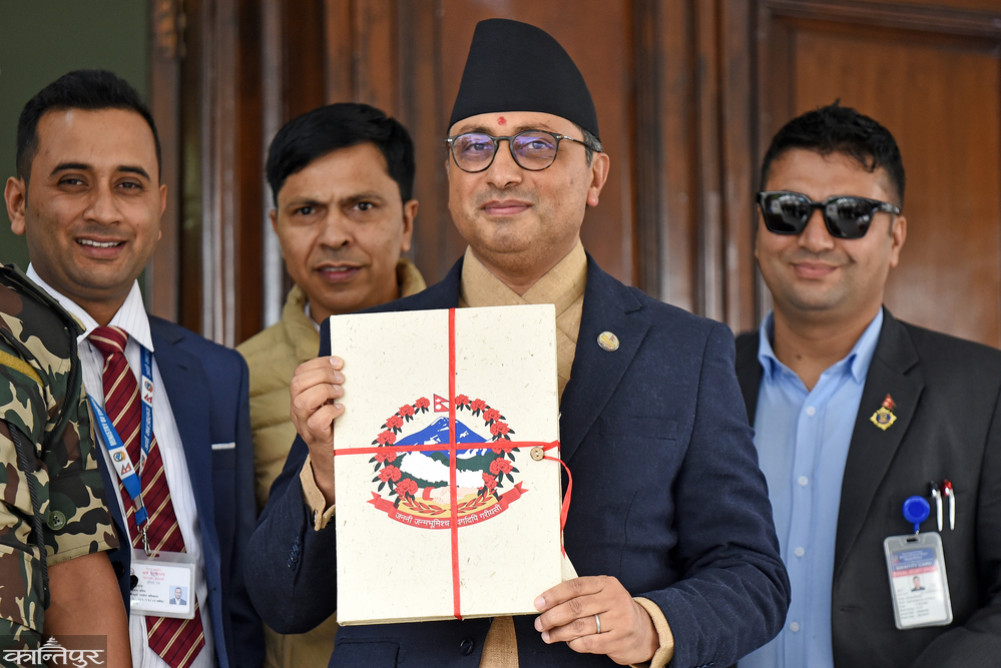
Finance Minister Wagle has sought to appeal to the middle class, especially through the budget, by expanding private sector investment, creating jobs, reforming policies, and allocating significant funds for infrastructure.
We use Google Cloud Translation Services. Google requires we provide the following disclaimer relating to use of this service:
This service may contain translations powered by Google. Google disclaims all warranties related to the translations, expressed or implied, including any warranties of accuracy, reliability, and any implied warranties of merchantability, fitness for a particular purpose, and noninfringement.
The government has announced tax exemptions, salary increases, and a policy environment for entrepreneurship in the budget for the coming fiscal year to provide relief to the middle class, but has only brought limited programs for the lower class.
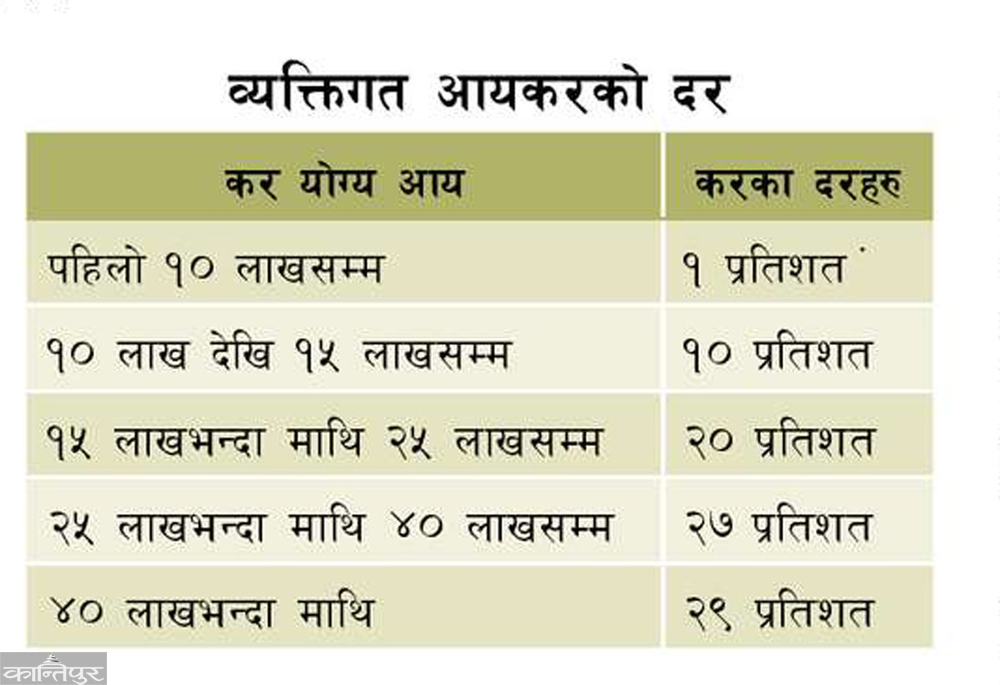
Finance Minister Swarnim Wagle, while presenting the budget in the federal parliament on Friday, has doubled the personal income tax exemption limit to Rs 1 million to appease the middle class, while the maximum income tax limit has been reduced by 10 percentage points from 39 percent to 29 percent. This means that those earning up to Rs 1 million will have to pay only 1 percent social security tax, while those earning more will no longer have to pay more than 29 percent tax. Earlier, such a limit was Rs 500,000 for singles and Rs 600,000 for married people. Now there is no distinction between married and unmarried people. On the other hand, since the salary of government employees has been increased by about 21 percent, its benefits will also reach the middle class.
Both these arrangements will increase the prices of various items in the market, from house rent to house rent. The general public with low income will be hit the hardest. Tax expert Roop Khadka says that reducing the maximum income tax rate and increasing the tax-free limit from Rs 5 lakh to Rs 1 million will provide relief to the middle class. ‘On the one hand, due to high tax rates, revenue collection was not as expected, and on the other hand, it also created a bad image in the international community,’ he said. ‘Reducing the tax limit and rate increases the purchasing power of citizens, so consumption in the market increases. This indirectly generates revenue for the government.’
Soon after becoming the Finance Minister, Wagle had said that the country will not rise if the middle class is not secure. ‘We have said that our objective is all-round social upliftment and expansion of the middle class. When the middle class is secure, stable and economically empowered, then both the overall development of the country and democracy can be sustainable,’ Finance Minister Wagle had said at the Kantipur Economic Summit, ‘Otherwise, this country can never rise. For democracy to be institutionalized, the size of the middle class must also increase. The expansion of the middle class is also necessary for improving traditional standards of development.' Along with expanding private sector investment, job creation, policy reforms, and significant budget allocation for infrastructure, Finance Minister Wagle's budget seems to be trying to please the middle class in particular. Economists and former finance ministers have commented that although this is positive, the programs targeted at the lower class are few. Former Prime Minister and Finance Minister Baburam Bhattarai argues that the impact of the budget will be on the lower class citizens. 'Programs should have been introduced to protect farmers and the working class.' Although the budget was appealing to the ears, it did not address the lower class,' Bhattarai said. 'Our economy is still dependent on agriculture. Therefore, a comprehensive program to commercialize agriculture should have been introduced.' He said that since the people (ministers) in the government are from the middle class, the budget may have been focused on that class. 'The state should especially look after the basic class.' The basic class should have been included in the programs related to rapid economic growth,' he said. Finance Minister Wagle, on the other hand, has said that the income tax exemption limit should have been doubled to reduce the tax burden.
The government has continued the dearness allowance currently received by the employees and increased the salary by 10 percent in the starting scale. Similarly, the government has made arrangements for a monthly incentive allowance of 10 percent of the new salary scale to start the performance-based remuneration system. Finance Minister Wagle said that the salary increase was made because the salary of government employees has not increased for the last four years, the price increase based on the Consumer Price Index has been 17.3 percent during this period, and the salary facilities need to be reviewed for a decent living. ‘This will increase the current salary by about 21 percent, and the minimum salary including grades will be around 40,000 to over 100,000,’ said Finance Minister Wagle. Currently, the minimum salary of an employee (office assistant) was around 24,500 and the maximum (chief secretary) was 77,500. The government claims that this arrangement will also provide relief to the middle class. Soon after becoming the Finance Minister, Swarnim Wagle had been saying that the country would not rise if the middle class was not protected. He has tried to please the middle class especially through the budget by expanding private sector investment, creating jobs, making policy reforms, and distributing significant amounts in infrastructure.
The budget includes some limited programs targeting the lower classes. The child nutrition allowance provided to Dalit children across the country has been doubled to 1,000 rupees per month. It seems that an attempt has been made to include the lower classes by increasing the child nutrition allowance. The nutrition allowance received by children from 25 districts of Madhesh, Karnali and Sudurpaschim provinces, which are facing high poverty and lag behind in the human development index, has been continued.
In the previous year's budget, programs targeting the lower classes such as loan waiver, subsidy on electricity used for irrigation by farmers, Prime Minister's Employment Program, direct subsidy in agriculture, maternity allowance were included. The budget did not include programs targeting meter interest victims, Dalits, farmers, laborers, and small farmers. Another former Finance Minister Yubaraj Khatiwada also said that the budget had forgotten the issues of the lower classes. 'Yesterday, we spoke in the policy and program that we would extend free education up to the secondary level.' This government has also spoken,' he said, 'However, it seems that Finance Minister Wagle has forgotten that this is not enough for economic growth, poverty alleviation, proportional growth, and coordinated growth.' 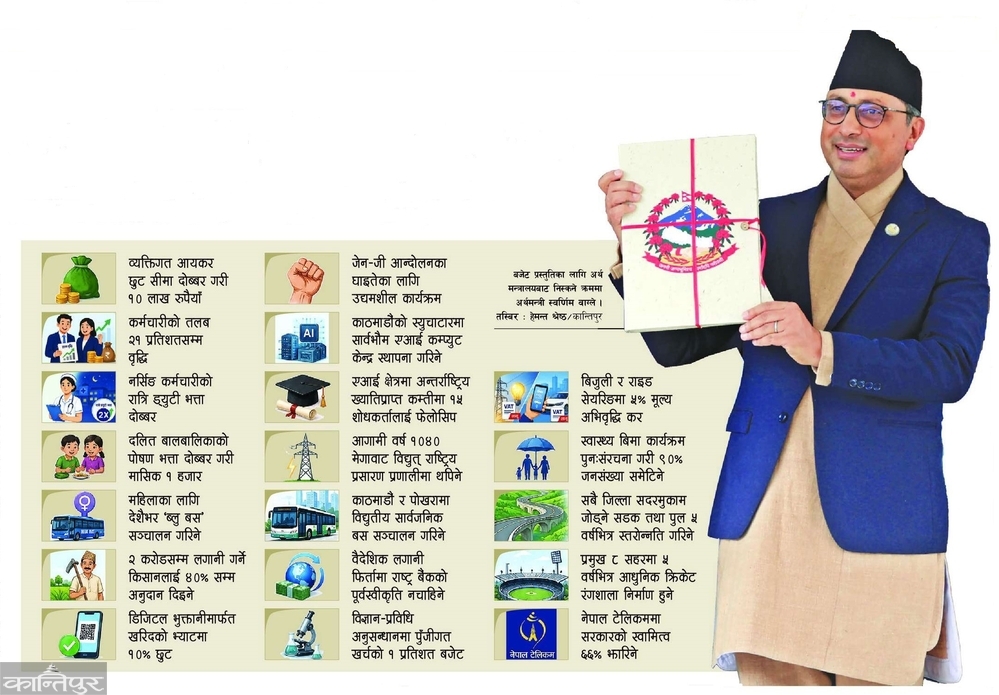
Programs targeting the private sector are sufficient. The government has made arrangements to finalize the capital gains tax levied on the sale of securities of listed companies in share trading. Earlier, even though it was said that capital gains tax would be final, revenue offices had been pressuring to collect the tax. The government has raised the capital gains tax limit after removing the confusion over whether or not capital gains tax would be final. Even if the rate increases, the provision that capital gains tax will be final seems to provide relief to the middle class.
The government has announced that it will operate a ‘Remittance-Investment Matching Fund’ to encourage ‘reverse migration’ and convert remittances from consumption to productive purposes. ‘We will implement the Returnee Migrant Program to utilize the knowledge, skills and competence of those who have returned from foreign employment,’ said Finance Minister Wagle. ‘We will conduct short-term and workplace-based training on various topics to make the youth skilled, review labor agreements and sign more agreements with new destination countries to make foreign employment more secure and dignified.’
The government has stated that arrangements will be made to rescue Nepali citizens stranded abroad and to bring back the bodies of deceased workers easily, and to make arrangements for going for foreign employment only after learning skills. ‘Foreign employment will be made dignified, transparent and automated by arranging unsecured loans and installment payments from employers, and service fees will be made worker-friendly by encouraging zero cost while going for foreign employment,’ the budget states. ‘To further encourage remittances coming in through formal channels, a lottery program based on each receipt of remittance inflow will be launched.’ Economists and former finance ministers have commented that although the budget is positive, programs targeting the lower classes are lacking.
The government has made arrangements for consumers to get an immediate 10 percent VAT discount when purchasing through digital payment. This arrangement also seems to provide relief to the middle class. The government has reduced the customs duty on 273 types of raw materials, making the customs duty on industrial raw materials at least one level lower than that of finished goods. The existing eleven-level customs duty has been reduced to seven levels. This system will make imported goods cheaper and citizens will be able to purchase goods and services at lower prices. 'Currently, the excise duty levied on 360 items has been abolished. I have integrated scattered taxes such as infrastructure development tax, road maintenance and improvement fees collected at customs points and included them in the green tax,' said Finance Minister Wagle.