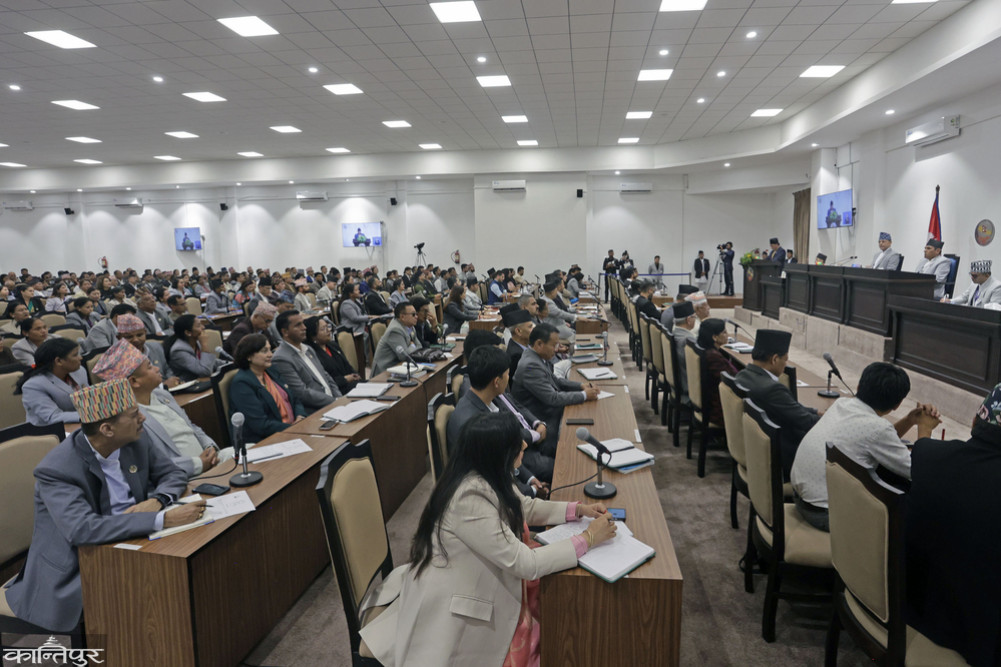
The Balendra Shah-led government has brought its first budget. Finance Minister Swarnim Wagle presented the budget for the fiscal year 2083/84 in a joint meeting of the Federal Parliament on Friday. What are the reactions of ministers, MPs and political party leaders to the budget?
We use Google Cloud Translation Services. Google requires we provide the following disclaimer relating to use of this service:
This service may contain translations powered by Google. Google disclaims all warranties related to the translations, expressed or implied, including any warranties of accuracy, reliability, and any implied warranties of merchantability, fitness for a particular purpose, and noninfringement.
The government led by Balendra Shah has brought its first budget. Finance Minister Swarnim Wagle presented the budget for the fiscal year 2083/84 in the joint meeting of the federal parliament on Friday. The reaction of ministers, MPs and political party leaders on the budget is as follows:
Minister for Energy, Water Resources and Irrigation Biraj Bhakta Shrestha
There were problems with transmission lines in Nepal's energy sector, but now they will be resolved. In many places, supply is not being provided smoothly and work is being done. They will be constructed within this year. We have also prepared for implementation and have kept it according to our capacity. Everyone will have to work hard on it. The government will implement the budget. We have set a target of 15 main transmission lines to be completed within this year. Whether the budget is ambitious or practical depends on the perspective. As we see it, this budget has been brought according to the needs and to make Nepal relevant to the 21st century.
Ramkumari Jhankri, UML MP
There are not many new programs . Except for innovation, they have not talked about anything . They have talked a little bit in the field of AI, it can be expected that it will do some work in the field of innovation . They have brought some exemption schemes to promote the private sector . It is not a big scheme, but there was so much hassle to resolve the state's responsibility to pay old taxes , they have given some schemes to solve those hassles .
The decision to lower customs duty on raw materials is a good thing . That gives domestic industry an opportunity to promote . They have also given some schemes in exports . It is like a one-stop center for foreign investment . The thing about creating an environment so that there is no hassle was new . The budget has brought this issue, which was there before but needed to be addressed in many places, in the right way. It has opened the door for Nepalis to invest abroad. The government has set a target of collecting around Rs 1.4 trillion in revenue, but in today's situation, how likely is it to do so without using other methods? If tax administration is to be streamlined and encouraged, it is not impossible to collect it. Loans should be invested in the productive sector, but that is not visible. The state also has a liability of Rs 450 billion in financial management. Due to all these things, it does not look very new in terms of investment. The target of achieving 7 percent economic growth with a capital expenditure of Rs 1 trillion is still tricky. Manish Jha, Rashtriya Swayamsevak Sangh (RSS) spokesperson and MP
This budget has given high priority to Madhesh, Karnali and Sudurpaschim. Bridges, roads, entrepreneurs, information, technology sectors, foreign investment and Nepalis working abroad in various fields seem to have been given special priority.
Barshaman Pun, NCP MP and former Finance Minister
This budget looks mixed. It is too big in size and does not look realistic. The ceiling set by the Planning Commission was around 20 billion. It has been increased by about 1.5 trillion. It has been increased unnaturally in size. The Finance Minister also knows that this is not realistic.
In the past, 18/19 trillion was brought and later it was evaluated and came to 16/17. Now, after increasing it to 21.5 billion, it is not realistic. The Finance Minister also knows that this is not realistic. This has become a slightly inflated budget. You have talked about giving discounts and grants everywhere. This is not bad, but can our economy sustain it? It does not seem to be able to sustain it.
In the past, when accusing a communist or leftist finance minister, it was said that it was distribution-oriented. The current finance minister used to say many times that the budget was popular and a way to spread money. Now his budget seems to be distribution-oriented. What is their psychology here? Local elections are coming up. The current popularity may not always be public opinion against established parties. It has to be done through work. Therefore, it seems that the psychology of whether public opinion can be formed at the local level by distributing money now has worked.
Two-thirds of the population is in the agricultural sector. There has been no significant program to improve that sector. The party that came to power by talking about creating employment for the youth and providing employment within the country to those who have gone for foreign employment has not seen any significant program to make the youth self-employed and entrepreneurial.
The middle class may be a little happy with this budget, but the internal debt is more than four trillion rupees. In the past, established parties took loans and looted and ate, but now it is like taking loans and eating ghee. The budget for distribution came with loans.
Basana Thapa, Congress Chief Whip
It seemed ambitious. It did not seem practical. It says 61 billion in foreign grants, but there is no mention of where it will come from. The economic aspect is the backbone of the country. When the government brought the budget, it was said that it would come in a new form, but it did not. Insurance and social security issues did not come. What did the common people get? What did it bring into the homes of the common people? What did the people in rural areas get?
Anand Chand, Rashtriya Swayamsevak Sangh MP
The budget has covered all sectors overall and there has been a new breakthrough. The Far West has also been prioritized. The demands of the MPs have been included. The Finance Minister has said that internal loans will be raised and external loans will be taken, which is factual. There are some challenges but solutions will emerge. Since capital expenditure has been announced since Shrawan this year, there is no need to raise any questions about the size of the budget. It is believed that the implementation of this budget will be completed.
Khushbu Oli, RPP Whip
Politically speaking, the budget is attractive. But in practice, impossible promises have also been made. We should give the benefit of the doubt. What this budget will do to the ruling party tomorrow is that it will be very difficult to deliver these things in the near future. I am afraid that the budget will then create distrust in the state among the people. Let that environment not be created, let the budget be implemented. There is a possibility that the budget may become a document of political demonstration rather than a tool for development. It is only a question of whether the budget will be pushed only for short-term popularity. The Nepali people are looking for long-term reforms, not short-term popularity. It seems that this budget has been prepared without assessing the realistic resource generation, institutional capacity and without rigorous selection of priorities. Such an exercise increases public expectations. It sounded appealing when we heard it, but if it does not yield results, it can cause great disappointment among the people.
Baburam Bhattarai, former Prime Minister
It was a very exciting experience to sit in the courtyard of the village and listen to the budget speech of the learned Finance Minister. The words and presentation are very new and attractive.
In terms of policy, it is also more attractive to the new technology-friendly generation, the private sector, Nepalis living abroad, employees, etc.
Personally, I am also satisfied that the Budhi Gandaki project will be constructed through an 'authorized authority' as I proposed in the beginning after a long period of confusion and suspicion. But if we look deeper into the overall structural framework of the budget (income-expenditure ratio, revenue sources, sectoral allocation, fiscal federalism, etc.), the disruption in continuity is not very visible. So how can the 'new phase of structural reforms' as stated in the budget statement be completed in such a short time?