The report concludes that the current problem has arisen because cooperatives, despite not being institutionally capable, have accumulated billions in savings instead of regularly collecting small amounts and given loans worth millions of rupees to a limited number of individuals without analysis and collateral.
We use Google Cloud Translation Services. Google requires we provide the following disclaimer relating to use of this service:
This service may contain translations powered by Google. Google disclaims all warranties related to the translations, expressed or implied, including any warranties of accuracy, reliability, and any implied warranties of merchantability, fitness for a particular purpose, and noninfringement.
A government study report has pointed out that the cooperative sector has been facing problems due to the arbitrary mobilization of savings due to lack of regulation. The report prepared by the Inquiry Commission has shown that the problems in cooperatives are due to the lack of limits on savings collection and loan investment, insurance of small savings, and sources of savings (limits, insurance, and sources). The commission's chairman was Binod Prasad Sharma, members were Nawaraj Sapkota and Punya Prasad Dangal, and expert members were Dr. Nawaraj Sinkhara and Basanta Bahadur Shakya.
The report concludes that the current problem has arisen due to the fact that cooperatives are not institutionally capable, but instead of regularly collecting small amounts, they are collecting billions in savings and giving crores of rupees in loans to limited individuals without analysis and collateral. 'The government has ignored the activities of cooperatives by saying that they are autonomous. The district, central, and national cooperative associations have only made speeches saying that only good things can happen in cooperatives, which is why today's problems are visible,' said Nawaraj Sinkhara, an expert member of the commission.
He said that recommendations have been made to solve the structural, managerial, financial and regulatory problems seen in the cooperative sector, including the structure and classification of cooperatives, control and integration of the number of cooperatives, management of problematic cooperatives, classification and regulation system of cooperatives, capacity building and good governance, information systems and technology, savings and credit management, audit and action.
It has been recommended not to expand the registered scope and service centers of cooperatives unnecessarily. The report mentions that the classification of cooperatives is recommended only as producer and service business cooperatives, consumer cooperatives and financial cooperatives, while there are currently 18 types of organizations that are meaningless. Since many associations are inactive at the district and provincial levels, it has been suggested that a single association of all types of cooperatives be formed. It is mentioned that the responsibility of auditing, general meetings and monitoring should be given to the association by mandatorily attaching the initial cooperative organizations to the association.
At present, there are about 33 thousand cooperative organizations and since effective regulation of so many organizations is difficult, it has been recommended to integrate cooperatives of similar nature and sector. The report emphasizes that organizations that do not meet the minimum capital, software, skilled employees, and service standards should be encouraged towards integration without providing government facilities. The report suggests that organizations that do not conduct audits and general meetings for three consecutive years should be deregistered or dissolved. It also says that the number of cooperatives should be reduced.
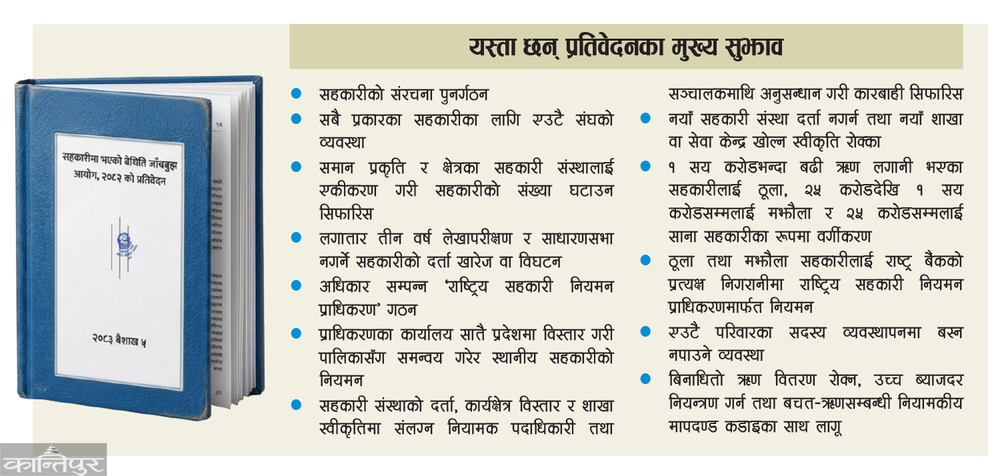
Concluding that self-regulation in cooperatives is not effective, it has been recommended to form a powerful 'National Cooperative Regulatory Authority'. The report mentions that the authority should be given quasi-judicial powers to withhold passports, freeze bank accounts, confiscate assets, and auction them.
The report also suggests that after the reorganization of the authority at the central level, its offices should be gradually expanded to all seven provincial levels. The report also says that the provincial office of the authority should make arrangements to regulate local-level cooperatives in coordination with municipalities.
The commission's report also mentions that loans of up to 140 million rupees were given to a single person. The commission's report mentions that during the monitoring, it was found that there were complaints ranging from loans of up to Rs 140 million to a single person to more than Rs 10 million to a single person in a single day. The commission, formed in accordance with the decision of the Council of Ministers meeting held on 2 Magh 2082, also mentioned that more than 49 percent of the board of directors' officers were taking loans from the organization. In the report made public by the Ministry of Land Management, Cooperatives, Federal Affairs and General Administration on Thursday, the commission concluded that the main reasons for the crisis in the cooperative sector are weak regulation, political interference and opaque operation. It is stated that the ministry is committed to effectively implementing the suggestions and recommendations given by the commission to end the current situation in cooperatives.
The report mentions that there were complaints such as savings collection and loan flow outside the designated area, office bearers of the organization giving loans to themselves and their family members and close relatives, and keeping the records of the organization's transactions separately in two software. The report also considers lack of coordination among multiple regulatory bodies, lack of effective information systems, financial indiscipline, weak governance and lack of skilled manpower as the main reasons for the problems in the cooperative sector. The report mentions that officials in regulatory bodies including the District Cooperative Office, Division Cooperative Office and Cooperative Department and activists involved in cooperatives have helped in misusing cooperative principles and business.
It is stated that while registering a cooperative organization, approval for its scope of work was given nationwide without any analysis of feasibility, need, financial capacity and infrastructure preparation, and approval was obtained from the regulatory body on the basis of hesitation even for expanding the scope of work of the organization and opening service centers and branch offices. The report mentions that the cooperative operators, out of vested interests, have considered cooperatives as a fraudulent business instead of working for the benefit of their members through a sacred task like cooperative business.
The report also suggests conducting a detailed investigation into the officials of the regulatory bodies involved in registering cooperatives, expanding their scope of work, granting approval to open and add service centers and branch offices, and merging cooperatives, and recommending action.
The report also mentions that due to the lure of cooperatives and the lack of skilled employees, the Department of Cooperatives and its subordinate cooperative offices have not been able to carry out effective inspection and monitoring. The report mentions that cooperatives have also been recognized as a major pillar of Nepal's three-pillar economic policy, but the commission has concluded that cooperatives have not been operating according to their core values and principles. The report states that the commission has concluded that agricultural cooperatives have deviated from their original objectives and focused on savings and loan transactions. ‘Overall, the problems seen in the cooperative sector appear to be a combined result of weak regulation, legal ambiguity, lack of information systems, lack of good governance and weaknesses in the implementation side,’ the report concludes. ‘Therefore, an effective regulatory structure, reliable information systems, strong good governance arrangements and actual implementation of past suggestions seem indispensable for strengthening the cooperative sector.’
The report suggests abolishing the current Department of Cooperatives. The report urges to make the role of the National Cooperative Authority effective for regulating savings and credit cooperatives. The report suggests maintaining a small-sized ‘Cooperative Division’ for policy and legal work in the Ministry of Cooperatives for the remaining cooperatives.
The report also suggests making arrangements to bring the amount of the Cooperative Promotion Fund under the National Cooperative Regulatory Authority and spend it on inspection of cooperatives, capacity development and other cooperative promotion-related activities. The report also emphasizes the need to bring cooperative training centers under the authority and conduct capacity development training for directors, employees and members on financial literacy, cooperative management, loan management and financial analysis.
The report recommends not registering new cooperatives and blocking approval for branch additions. The report also recommends not registering new cooperatives, not granting approval for opening branches or service centers, and requiring cooperatives operating with more than one branch to close their branches and settle accounts.
The report states that the approval for expanding the scope of work/service centers across Nepal was granted as a result of the regulatory body officials and campaigners aiding in the misuse of cooperative principles and business. The report also states that having more than one regulatory body have jurisdiction over a single cooperative has created regulatory ambiguity.
The report also states that to make regulation effective, those with loans of more than 100 million should be classified as large cooperatives, those with investments of up to 250 million should be classified as medium cooperatives, and those with investments of up to 250 million should be classified as small cooperatives. It has also been said that large and medium cooperatives should be directly regulated by the National Cooperative Regulatory Authority under the direct supervision of the National Bank, and small cooperatives should be monitored through municipalities, associations, and wholesale credit providers.

