Government announces to hold broad political debate on granting grants, opposition suggests addressing citizens' issues rather than granting grants to parties
We use Google Cloud Translation Services. Google requires we provide the following disclaimer relating to use of this service:
This service may contain translations powered by Google. Google disclaims all warranties related to the translations, expressed or implied, including any warranties of accuracy, reliability, and any implied warranties of merchantability, fitness for a particular purpose, and noninfringement.
Ganga BC
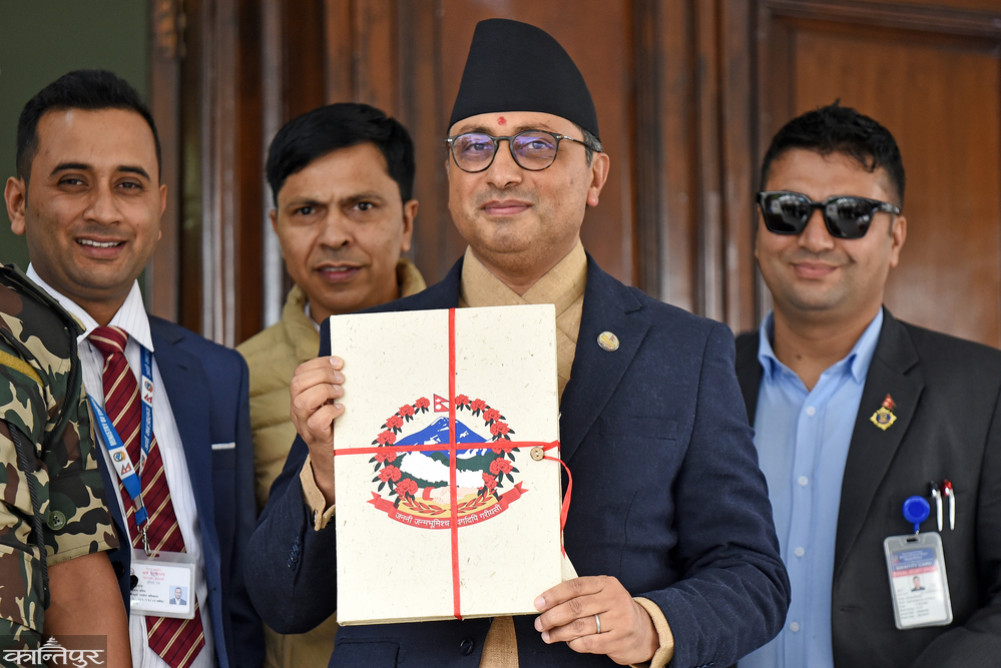
The government has adopted a policy of providing government grants to nationally recognized parties . For this, Finance Minister Swarnim Wagle, who will hold a broad political debate, has mentioned it in the budget for the upcoming fiscal year . If the issue of providing grants is finalized, the nationally recognized parties, the Rashtriya Swayamsevak Sanskriti Party, the Congress, the UML, the NCP, the Labor Culture Party and the RPP, will receive grants based on the votes they received in the last election .
However, the opposition parties have suggested that it would be more appropriate to address the daily concerns of the citizens than providing grants to the current priority parties . Although providing grants to political parties to make them transparent and accountable is theoretically appropriate, they say that it is not practical when the country's economy is weak .
'We will build a strong foundation of transparency and accountability in the political system . "To institutionalize healthy democratic competition, we will hold a broad political debate on providing government grants to nationally recognized political parties based on the votes they received in the last general election," the budget statement said. "The Auditor General will make arrangements to audit the grants that may be available in this way." The Election Commission had also been suggesting that the political party law be amended to provide grants to parties from government funds.
000
Discussion on providing grants to parties from government funds is not relevant when emphasis should be placed on education, health and employment - Pradeep Poudel, General Secretary, Nepali Congress
000
Giving grants to parties can further increase the distance between the party and the voters, the current priority is the issues of the common people - Pradeep Gyawali, UML leader
000
It is generally right for the government to provide grants to parties, an act should be made to specify how and how much to provide - Narayan Kaji Shrestha, Senior Leader, Nepali Congress
000
It is positive that the government is trying to move forward with the issue of giving grants to parties, it can only be implemented by making a law - Dinesh Thapaliya, former Chief Election Commissioner
000
Congress General Secretary Pradeep Poudel said that giving grants to parties is not relevant when emphasis should be placed on education, health and employment. ‘Discussion on giving grants to parties from government funds is not relevant at this time,’ he said. Former Minister of State for Finance and Congress Joint General Secretary Udaya Shamsher Rana says that making arrangements to give grants to parties when the state is burdened with internal and external debt will put an additional burden on the state. ‘Giving grants to parties in a way that puts an additional burden on the state is not financially appropriate,’ he said.
Although it is theoretically right for the government to give grants to discourage political parties from relying on donations, UML leader Pradeep Gyawali said that it is not a priority at the moment. ‘Giving grants to parties can further widen the gap between the party and the voters,’ he said, ‘The priority now is to address the issues of the common people.’
Senior NCP leader Narayan Kaji Shrestha said that the issue of giving government grants to make parties transparent has been raised before, but has not progressed. ‘We have discussed it to control the opaque activities of parties. It is generally right for the government to give grants to parties,’ he said, ‘An act should be made to specify how and how much to give. A conclusion can only be reached after discussing from all sides.’ Former Finance Minister Ram Sharan Mahat mentioned giving grants to parties in the 2070/71 budget, but the process had not progressed.
Former Chief Commissioner of the Election Commission Dinesh Thapaliya said that four grounds were presented in the draft bill on political parties for giving grants to political parties. He said that the draft prepared by the commission is with the Home Ministry. The commission has concluded that since parties and their candidates spend large amounts of money in every election in an opaque manner, such activities should be discouraged by giving grants to political parties.
‘We had taken four bases for giving government grants to parties.’ The aim was to provide equal opportunities to national parties, discourage the tendency of collecting donations indiscriminately, make political parties and candidates financially transparent, and make arrangements for auditing by government bodies,’ he said. ‘It is positive that this time’s budget is trying to take this forward.’ It can only be implemented by making a law.’ He said that the provision of giving grants to parties should be included while passing the bill related to political parties.
Similarly, in 2081 Chaitra, the draft bill prepared by the Election Commission to amend the Political Parties Act, 2073 BS, also included this issue. The draft had a provision that to be recognized as a national party, a party must have won at least three percent of the votes cast in the proportional election system in the election to the House of Representatives, and at least 70 percent of the seats in the direct election to the House of Representatives. Similarly, it had a provision that it must have won at least one seat in each of the three provinces.
The High-Level Economic Reforms Suggestion Commission, chaired by former Finance Minister Rameshwor Khanal, formed by the government in 2005, had suggested that parties should be given grants from the state treasury. The report submitted by the commission to the government suggested that parties should be given grants from the state treasury and that candidates should not be allowed to spend their assets in the election. The commission suggested that the grants be given after questions began to be raised about the governance system due to election expenses.