Industrialists and businessmen have suggested amending the constitution to address economic reform, investment security, legal clarity, good governance, and a change in the approach towards the private sector, not just political issues.
We use Google Cloud Translation Services. Google requires we provide the following disclaimer relating to use of this service:
This service may contain translations powered by Google. Google disclaims all warranties related to the translations, expressed or implied, including any warranties of accuracy, reliability, and any implied warranties of merchantability, fitness for a particular purpose, and noninfringement.
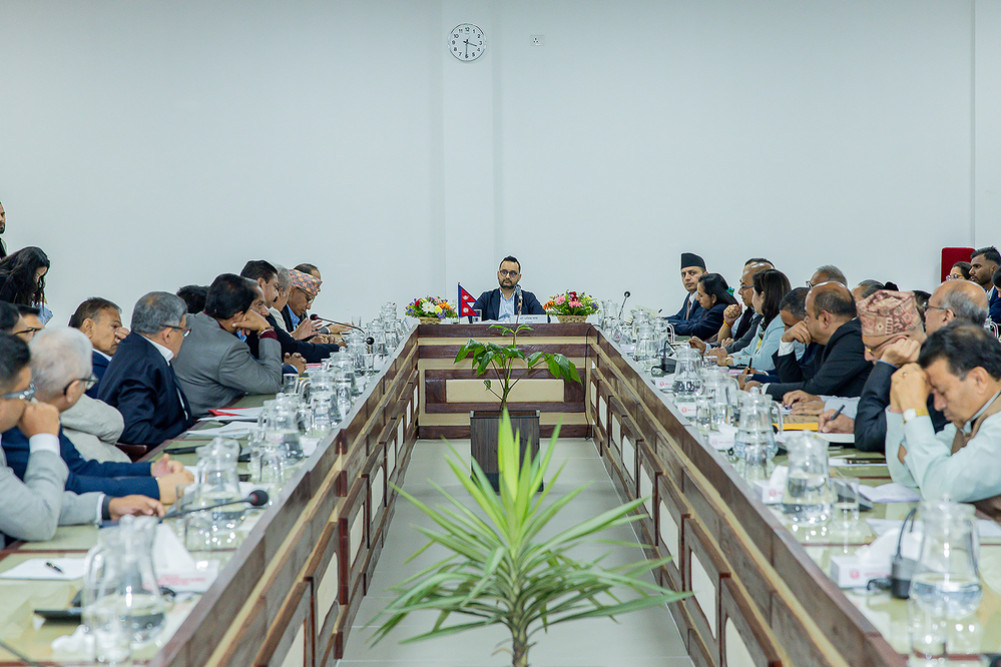
Industrialists and businessmen have suggested to the government-formed Constitution Amendment Task Force that the constitution amendment should not be just a political issue but should be done in a way that addresses economic reform, investment security, legal clarity, good governance and a change in the approach towards the private sector.
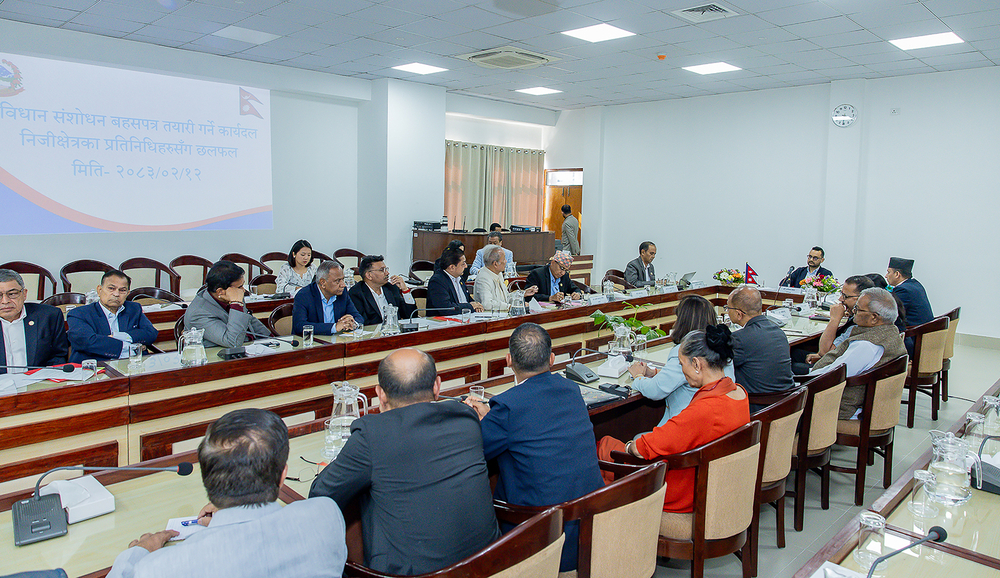
The ‘Constitution Amendment Discussion Paper Preparation Task Force-2082’ led by the Prime Minister’s Political Advisor Asim Shah visited the Office of the Prime Minister and Council of Ministers, Singha Durbar and suggested that economic stability, investment-friendly environment, legal clarity, good governance and a respectful approach towards the private sector are necessary.
Representatives of industry, commerce and private sectors, including Divyamani Bhandari, Anjan Shrestha, Arun Chaudhary, Dr. Upendra Mahato, Ravi KC, Shivratan Sharda, Deepak Malhotra, Rajesh Kaji Shrestha, Rajubabu Shrestha, Suresh Lal Shrestha, Vijay Rajbhandari, Anand Bagaria, Pradeep Shrestha, Kush Kumar Joshi, Bhavani Rana, Suraj Vaidya, Shashi Agarwal, Surahit Jyoti, Prakash Dotel, Satish Sharma, Sudeep Acharya, Rajendra KC, Yogendra Shakya, Sher Singh Shrestha, Suman Pandey, Hemant Golchha, Deepak Dahal, Shankar Ghimire, Cabinet Shrestha, Hemraj Dhakal, Sangita Shrestha, Jyotsna Shrestha, Birendra Raj Pandey and Haribhakta Sharma were the participants.
The industrialists also presented suggestions related to constitutional amendment and economic reforms.
Their demand was that the constitution should define the private sector as a partner in nation building and an 'engine of growth' rather than a 'profit-making' perspective.
Similarly, since the term ‘socialist-oriented system’ in the preamble of the constitution is unclear, they suggested that it should be written as ‘competitive, open and innovation-oriented market economy’.
The participants shared the common opinion that the private sector should be given constitutional recognition as the main economic partner of the state. Businessmen also suggested reforms in the tax system and federal structure. They complained about double taxation and double regulation at the federal, provincial and local levels and demanded clarity in tax administration.
Businessmen suggested that contradictory provisions such as not issuing income tax payment certificates if VAT is not cleared should be removed.
Complaining that businessmen are insecure due to different interpretations of the law and the manipulation of government agencies, they argued that the trend of bringing up ten-fifteen-year-old tax, VAT or banking cases that are causing trouble to businessmen should be ended.
Businessmen had presented the view that the investment approval, land, environment, forest and other processes should be fast and clear, demanding to eliminate the hassle of obtaining permits from multiple agencies for operating industries or projects.
Entrepreneurs and businessmen pointed out that legal stability and quick decisions are necessary for attracting foreign investment. Demanding a legal arrangement to regulate the situation of character assassination or insult of businessmen on social media, they believed that the issue of protecting the honor and reputation of businessmen should be included in the constitution or law.
Who said what?
President of the Federation of Nepalese Chambers of Commerce and Industry Anjan Shrestha said that since the main expectation from the current political change is economic prosperity, the government should make the constitution and laws accordingly to address it.
He said that the economy should be kept at the center in the 'departure point' of the amendment and that complete economic freedom should be mentioned in the constitution. He said that since economic progress is indispensable for social progress, legal arrangements are necessary for the investment environment and investment security.
Former NRNA President Upendra Mahato said that since every country has its own development model, Nepal should also be able to clearly mention its development model in the constitution. He opined that the morale, respect and trust of the private sector should be increased.
Former Federation President Bhawani Rana said that the issue of economic prosperity should be included in the constitutional amendment. She said that since the current constitution gives the right to impose taxes to all three levels of government - central, provincial and local - there is a practice of double taxation and this has caused inconvenience to businessmen and demanded a clear provision in the constitution.
She said that the issue of sustaining the youth in the country should also be included with priority. She said that the issue of economic prosperity in the second phase should be addressed through constitutional amendment.
Similarly, she pointed out the need for a commercial court and suggested that the government should make arrangements for it. She suggested that meaningful participation of women and gender-responsive budgets should be brought at all levels of the state. She also urged that the private sector be viewed with respect.
Hemraj Dhakal of the Federation of Nepalese Chambers of Commerce and Industry said that the audit system should be developed through a one-door system and the issue of right to information should be further clarified.
Former President Suraj Baidya said that the issue of how candidates and parties will raise expenses in the election and how much donations entrepreneurs can make should be clarified in the constitution. His argument was that the root cause of corruption should be identified and addressed in the constitution.
Businessman Shashi Agrawal urged to create a private sector-friendly law and make the business environment easier.
Businessman Anand Bagaria said that he was a businessman, not a constitutional expert, and was looking for a provision in the constitution to promote business. He suggested that the division of powers between the union and the local level should be clarified and that provisions should be made in the constitution to control corruption and encourage entrepreneurs.
He said that complaints were being misused and that anonymous complaints were causing problems for entrepreneurs, and that this should be controlled. He was of the opinion that there should also be a provision for punishment for employees who hurt entrepreneurs with bad intentions.
Businessman Arun Kumar Chaudhary said that honest entrepreneurs, investors and 'wealth creators' should be respected and encouraged. He suggested developing a 'single window' and one-stop service system with energy and tourism as the main issues.
Businessman Rajesh Kaji Shrestha said that a comfortable environment is necessary for the rights and interests of the private sector and said that there should be a constitutional guarantee for investment-friendly economic development.
Businessman Deepak Malhotra demanded that the audit period be limited to one or two years instead of four years by reforming the tax system. His argument was that the constitutional guarantee of investment security and an investment-friendly environment should be included in the constitution.
He said that there are many problems in the industry and land-related sectors and that unnecessary government intervention should be removed and the private sector should be accepted as an economic partner. He said that double taxation between all three levels of government should be removed and a system to protect industry and business from bandhs and strikes should be included in the constitution.
Businessman Pradeep Shrestha said that clarity is needed in the area of jurisdiction and suggested that the government should move forward with full confidence in the private sector.
Businessman Kush Kumar Joshi said that a liberal economy with social justice should be ensured in the constitution. He believed that public-private partnership (PPP) should be given priority instead of the three-pillar policy and a respectful environment should be provided to the private sector.
Businessman Atish Sharma suggested that new entrepreneurship, new businesses and entrepreneurs should be promoted. He said that domestic production should be encouraged as much as possible and that skills and capital coming from abroad should be utilized in Nepal.
Businessman Yogendra Shakya shared his experience that despite going through four constitutions, the interests of entrepreneurs have not been adequately addressed and said that the upcoming amendment should address it. He demanded an end to the situation where political access and restrictions are required to do business.
Hemant Golchha said that land-related problems have been affecting entrepreneurs for a long time and that their solution is necessary.
Sangita Shrestha suggested that the work of a housewife should be linked to economic production and that arrangements should be made to connect citizenship and non-resident Nepalis with the private sector.
Jyotsna Shrestha suggested that the constitution should create a non-resident Nepali-friendly environment while maintaining Nepal's national identity and unity and encourage investment, skills, tourism and innovation.
After listening to the businessmen, Shah, the Prime Minister's political advisor and coordinator of the task force formed to prepare the constitutional amendment debate paper, clarified that the government is moving forward with a private sector-friendly policy and urged businessmen to operate their businesses with confidence.
While the task force was taking suggestions from people related to industry, commerce and the private sector on the issue of constitutional amendment, Coordinator Shah clarified that the country's economic development is not possible without cooperation with the private sector.
Claiming that the government has not targeted any businessmen and arrested them, he clarified that legal action is being taken only against those involved in serious criminal activities and acts that damage the state.
'There is no instruction from the Prime Minister's Office, the Home Ministry or any other body to arrest or not arrest anyone. The system is doing its job impartially,' he said, 'Entrepreneurs and businessmen do not have to donate to anyone to run their businesses. If you come under such pressure from any party or government official, let us know. Work honestly and confidently.'
Shah, the Prime Minister's political advisor and coordinator of the task force, said that the current government has adopted a 'zero tolerance' policy as it was formed with an agenda of good governance and ending corruption.
Informing that the government is preparing to bring a private sector-friendly budget, he said that the upcoming budget will make the environment for doing business easier.
He also informed that the government is preparing to reduce cumbersome administrative procedures through the 'single door policy'. Stating that policies related to production, investment, industry and business are being improved, he expressed the view that the private sector will be involved in every project.
He informed that the government is preparing to adopt BOT and PPP models to increase private sector participation in large projects. Pointing out that private sector participation in projects is inevitable, he said that the government is always ready to cooperate for this.
Admitting that in the past, businessmen have faced problems due to government policies, instability or other reasons, he indicated that tax exemptions, concessions and relief programs can be introduced.
But for that, he said that the private sector should also cooperate with the government. He also urged businessmen to help make the government system transparent and trustworthy without trying to corrupt it.
He said that the suggestions received from the industrialists and businessmen participating in the discussion would be included with priority during the preparation of the discussion paper.
Earlier, the task force has collected written suggestions from various political parties and discussed them. The task force has discussed and collected suggestions with constitutional experts, legal experts, senior advocates, former administrators, former diplomats, media persons and political figures at various times.
Similarly, the general public has also been asked for their opinions and suggestions for the preparation of the constitutional amendment debate paper. The task force has stated that discussions will continue with experts and stakeholders from various fields to collect suggestions.