As of the third quarter of the current fiscal year, 11 out of 74 private sector-related items have yet to be implemented.
We use Google Cloud Translation Services. Google requires we provide the following disclaimer relating to use of this service:
This service may contain translations powered by Google. Google disclaims all warranties related to the translations, expressed or implied, including any warranties of accuracy, reliability, and any implied warranties of merchantability, fitness for a particular purpose, and noninfringement.
In the third quarter of the current fiscal year, 11 of the 74 points related to the private sector have not been implemented so far. 44 points have been partially implemented and 19 points have been fully implemented.
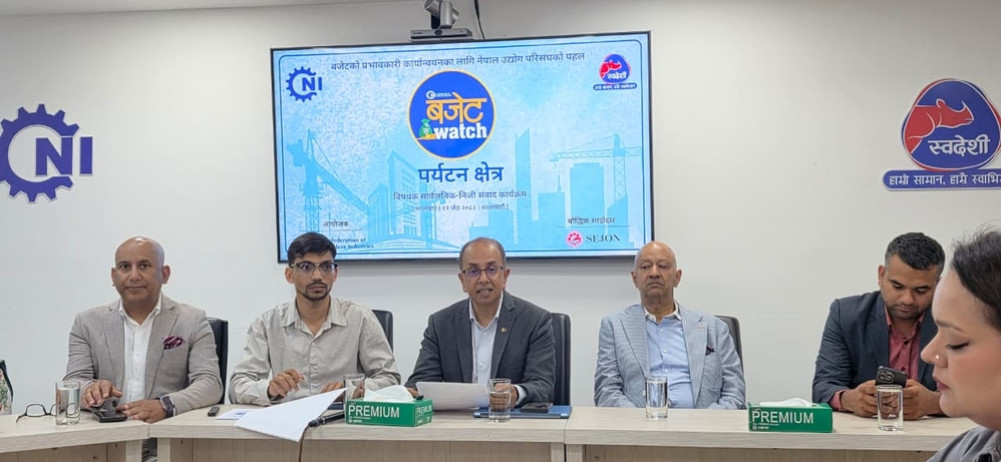
The public report in the 'Budget Watch' program organized by the Confederation of Nepalese Industries in collaboration with the Society of Economic Journalists of Nepal (SEJON) as a public-private dialogue has shown that the budget implementation is not expected by the third quarter.
The budget for the current fiscal year included 74 points, including 27 in the industry sector, 14 in energy, infrastructure, and urban development, 9 in tourism, 8 in investment and financial sectors, 7 in agriculture and herbs, 6 in information technology and innovation, and 3 in education and employment.
The report mentions that 5 points related to industry, 3 in energy, infrastructure, and urban development, 2 in tourism, and one point in the financial sector have not been implemented so far. The report states that 26 percent of the points related to the private sector have been implemented so far, 59 percent have been partially implemented, and 15 percent have not been implemented.
In the budget for the current fiscal year, it was mentioned that the Civil Aviation Authority of Nepal will be institutionally strengthened by separating it into a regulatory and service provider body, that urgent work will be done to remove Nepal from the air flight safety list within the next fiscal year, and that domestic air services will be made safer and more accessible. However, this point has not been implemented so far.
The budget mentions that an alternative use plan will be made for domestic airports with low flight pressure, that such airports will be used for aviation training and adventure tourism such as paragliding, parachute, ultraline, and skydiving in partnership with the private sector, and that economic and commercial potential will be made the main basis for the construction and expansion of new domestic airports. However, the government has not been able to implement it so far.
Out of 7 points related to agriculture and herbal sector, 2 points have been fully implemented and 5 are partially implemented . Out of a total of 27 points related to industry sector, 7 have been fully implemented, 15 have been partially implemented and 5 have had zero progress . At the program, SEJON President Bhagwat Bhattarai informed about how many of the points related to the private sector in the budget have been implemented/not implemented in terms of implementation . At the program, Federation President Birendra Prasad Pandey said that he has been holding public-private dialogues for the effective implementation of the budget . ‘The government’s fiscal policy is the most important for the development of the overall economy . Fiscal policy, i.e. other policies should be supportive to achieve the goals specified by the budget,’ he said . He said that private sector-related programs are included in the budget but implementation is weak .
A session on ‘Status of the Tourism Sector and Budget Implementation’ was conducted at the quarterly review program . In the session, Hotel Association of Nepal Chief Executive Officer (CEO) Tek Bahadur Mahat said that although the demand for electricity tariff exemption and income tax exemption similar to that of manufacturing industries was announced in the budget, they did not get it. ‘It is written in the budget but there is delay in implementation, there is no substance in writing in the budget but not implementing it,’ he said, ‘That is why this kind of budget should not come now. The government should emphasize twice as much on implementation.’ He also said that the tourism industry has to invest the most in utilities. ‘To reduce utility costs, the government should give exemptions on tariffs and other things,’ he said. Therefore, he said that tourism should go towards the amount, not the number of tourists. ‘The government cannot provide everything. The government should pay attention to some issues, he said, ‘We should emphasize on the investment environment and job creation.’
Pampha Dhamala, the president of the tourism committee under the federation, said that they are lobbying for tourism-related policies. She said that the number of ships carrying international tourists should be increased. She said that tourists coming from India are now focusing on cheap destinations and cheap spending. She said that even though there is an airport in places like Pokhara, hotels have had to close down when it is not operational. She said that the government budget should be emphasized in promoting tourism and the production of human resources to deal with foreigners.
In the session, Yeti Airlines Chief Executive Officer (CEO) Subash Sapkota said that the demand from the private sector, from budget preparation to implementation, is the same ten years ago and now. He also said that tourism is limited to one line in the policy and program and that it can be lost in the budget. He also said that the burden of Value Added Tax (VAT) has been piling up in the airline sector. ‘It doesn’t seem like the government has collected much revenue from VAT, so tourism is suffering from VAT,’ he said, ‘VAT has also been a problem.’
He said that if the government and CAN’s policy remains the same, there will be no new aircraft in the next 5 years. He said that with the increase in fuel prices, it is better to be happy when there are no flights than when there are. He said that an environment should be created to buy aircraft to increase international connectivity. He said that with the increase in aircraft, the number of tourists will also increase.
In the discussion, outgoing CEO of Nepal Tourism Board Deepak Raj Joshi said that more than 60 percent of tourists come to the country through travel agents. He said that tourism runs in a large ecosystem and contributes to the economy. He said that although there are 53 to 54 domestic airports in the country, 20 to 22 are not operational. ‘Even though the budget mentioned the need to bring the airports that have not been operational into operation by focusing on adventure tourism, it could not be implemented,’ he said.
If hotel occupancy were above 80 percent, it would have been comfortable for them, but now it is only 40 percent, he said, and the tourism sector is in a sluggish state. He said that new investors have also not been attracted due to the lack of a good environment. He estimated that although the government has set a target of 1.5 million tourists, only 1.35 million may enter this year.