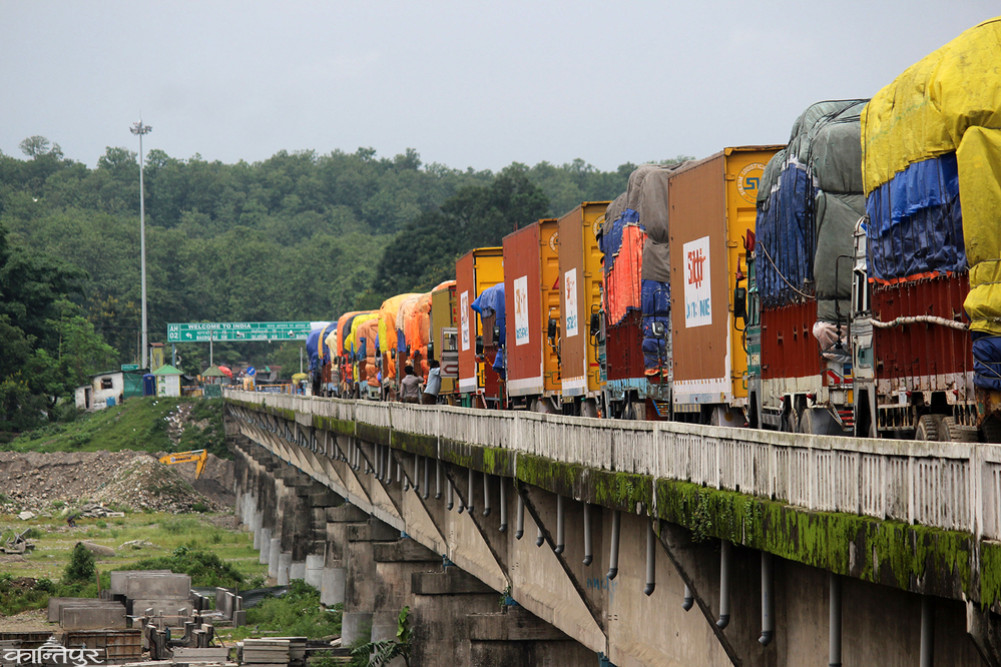
In recent years, the same pattern of problems has been recurring - sometimes quality issues, sometimes testing regulations, sometimes quantitative control, sometimes labeling, and sometimes paperwork.
We use Google Cloud Translation Services. Google requires we provide the following disclaimer relating to use of this service:
This service may contain translations powered by Google. Google disclaims all warranties related to the translations, expressed or implied, including any warranties of accuracy, reliability, and any implied warranties of merchantability, fitness for a particular purpose, and noninfringement.
In July 2017, the then President of India, Pranab Mukherjee, visited Darjeeling in reference to Bhanu Jayanti. In the same meeting, the Darjeeling Tea Association had arranged a special meeting with the President and submitted a memorandum. The Tea Association's one-point demand in the memorandum was - 'Import of Nepali tea should be stopped.' The President returned after understanding the memorandum.
Two years later, the same demand was raised in the West Bengal government's house. In 2019, the then MP of the West Bengal Legislative Assembly, Shanta Chhetri, strongly raised the issue in the house, 'Nepali tea is of poor quality. Its import should be stopped immediately.' On April 10, 2024, the Bengal government started implementing it in practice. Saying that doubts had arisen about the quality of Nepali tea, the Indian Customs insisted on allowing the tea to enter only after collecting a 100% sample.
Surveillance on Nepali tea was increased on the verbal order of the Commissioner of the West Bengal Customs Department. In June 2025, the West Bengal government itself decided to ban Nepali tea. The then Chief Minister Mamata Banerjee, while commenting on Nepali tea in an administrative review meeting, claimed that tea coming from Nepal without any duty had affected the brand and reputation of Darjeeling tea.
Indian media reported that Banerjee had directed the Tea Board of India and the central government to draw their attention to the protection of Darjeeling tea. After Banerjee's statement, the West Bengal government wrote a letter to the central government requesting it to review or remove the tax exemption given to Nepali tea under the Nepal-India Trade Treaty.
'The entry of Nepali tea has affected the identity and market reputation of Darjeeling tea, which has posed a risk to the local industry,' Banerjee said. The Indian side has long been raising allegations that Nepali tea is being re-branded and sold as Darjeeling tea, which has weakened the originality of Darjeeling tea.
Not only tea from Nepal, but also ginger, cardamom and cloves have been facing similar obstacles, but tea has been stopped the most. Recently, India had created obstacles on Nepali tea since May 1. India has withdrawn from that obstacle after about 20 days. Tea exports have become easier after India amended the ‘Standard Operating Procedure’ implemented on tea imports and relaxed the strictness regarding mandatory laboratory testing.
Following the instructions of the Indian Ministry of Commerce, the Indian Tea Board issued a new notification on Tuesday, exempting tea sold in the domestic market from mandatory testing for the time being.
According to the revised provision, mandatory testing will not be applicable to tea imported for domestic sale in India. Testing will be mandatory for tea that is re-exported. The Tea Board has maintained the arrangement to conduct random testing.
The obstacles from India are not new for the Nepali tea industry. Nepali agricultural production, especially tea, has been facing obstacles on various pretexts. In recent years, the same pattern of problems has been recurring. Sometimes quality issues, sometimes testing rules, sometimes quantitative control, sometimes labeling, and sometimes paperwork.
Not only tea, but also ginger, cardamom, and cloves have faced similar obstacles through the Nepal-India border. But tea is the most affected because it is a high-value product based on brands. The Nepal-India Commercial Treaty mentions that tea and other goods can be traded freely. But contrary to the treaty, India has repeatedly tried to discourage Nepali trade by creating obstacles. At the center of this dispute is the Darjeeling brand. Darjeeling tea is a premium brand in the world market, but production is limited. Currently, 6,000 to 6,500 tons of tea are being produced annually.
Industrialists allege that Nepali tea is being mixed informally as limited production cannot meet global demand. In November 2021, allegations were made public that India's large company Tata Consumer Products Limited (TCPL) had mixed Nepali tea with its products. After that, India's Union Ministry of Commerce directed the Tea Board to investigate.
According to the allegations, Tata Tea did not clearly disclose the origin of the tea in the packaging and sold branded products mixed with Nepali tea. According to the Tea Board of India's own data, India imported more than 13.3 million kg of tea from Nepal in 2023. Last year, this amount is estimated to have reached about 16 million kg. 'Most of the tea imported from Nepal is exported abroad,' said an official of the Darjeeling Tea Board.
Experienced entrepreneurs and experts in the tea sector say that there are multifaceted reasons behind this, such as market control, protection of the Darjeeling brand, trade competition and regional political pressure. The issue of ‘quality’ used by India is more political and commercial in nature than technical, says tea entrepreneur Uday Chapagain. ‘If it was really a quality concern, India could have built a modern laboratory at the border,’ says Chapagain. ‘But sending samples to Kolkata and stopping the tea for two weeks is a long process and discourages trade.’
Most of the orthodox tea exported from Nepal to India has a taste, aroma and quality similar to Darjeeling. Chapagain claims that the Indian tea industry, especially producers in the Darjeeling region, are under pressure for this reason. ‘The taste of tea produced in the hilly areas is sweeter and of better quality than Darjeeling,’ says Chapagain. ‘They are very worried that the Darjeeling brand will be destroyed.’
The problem is not that Nepali tea is of poor quality, but that Nepali tea is cheap and competitive, said Shiva Kumar Gupta, senior vice-president of the Nepal Tea Producers Association. ‘Darjeeling’s production cost is high . The excuse of quality was made after Nepali tea started challenging the market share,’ says Gupta .
The practice of mixing Nepali tea in the Indian market and re-exporting it as ‘Darjeeling tea’ has been going on for a long time, claims a businessman. ‘On the one hand, using Nepali tea to support the international market, and on the other hand, putting pressure on stopping the same tea, this has become a double standard,’ said another businessman.
Tea expert Prithvi Bikram Rai says that ‘brand politics’ is at the heart of this dispute. Darjeeling tea is an international brand. But production is limited. More than a dozen tea factories in Darjeeling have already closed. This much tea cannot meet the demand of the world market, which is why Nepali tea is mixed . ‘The problem starts there,’ Rai said, ‘The Indian side fears that Nepali tea may create a separate identity and weaken the Darjeeling market.’
Analysts say that the repeated statements by political leaders of West Bengal against Nepali tea are also a sign of this. According to economists, internal political pressure is also involved. Since the economy of the Darjeeling region is largely dependent on the tea industry, industrialists and labor organizations there have been putting pressure on the central government.
Even though India has provided Nepali tea with an open market, it seems to be trying to maintain control in practice, said Aditya Parajuli, president of the Nepal Tea Producers Association. ‘Nepal has become highly dependent on India. At first, it provided easy access, but later that dependence was used as a means of pressure,’ he said.
Economist Dr. Bedraj Acharya says that such obstacles are likely to continue until Nepal develops its own brand, expands the packaging industry, and finds alternative markets such as China, Europe, and the Middle East. According to the Tea and Coffee Development Board, Nepal produces about 27.5 million kilograms of tea annually. Tea is cultivated in more than 20,000 hectares across the country, which has provided employment to about 60,000 people.
‘India is the market for 80 percent of the tea produced in Jhapa and Ilam,’ said Indra Adhikari, Agricultural Development Officer at the board’s regional office. ‘Only 20 percent is consumed domestically.’
The Adhikari says that Nepal produces 19 million kilograms of CTC tea annually. Out of that, 10 million kilograms of tea is exported to the Indian market. CTC tea is produced the most in Jhapa. Of the 7 million kilograms of orthodox tea produced annually, 60 million kilograms reach the Indian market. 1 million kilograms go to countries including Europe, America, Japan.
Orthodox tea is produced in hilly districts including Ilam, Panchthar, Dhankuta. According to the Mechi Customs Office, tea worth about 4 to 5 billion is exported to India annually. But Nepali tea farmers and businessmen are frustrated due to repeated Indian obstructions.