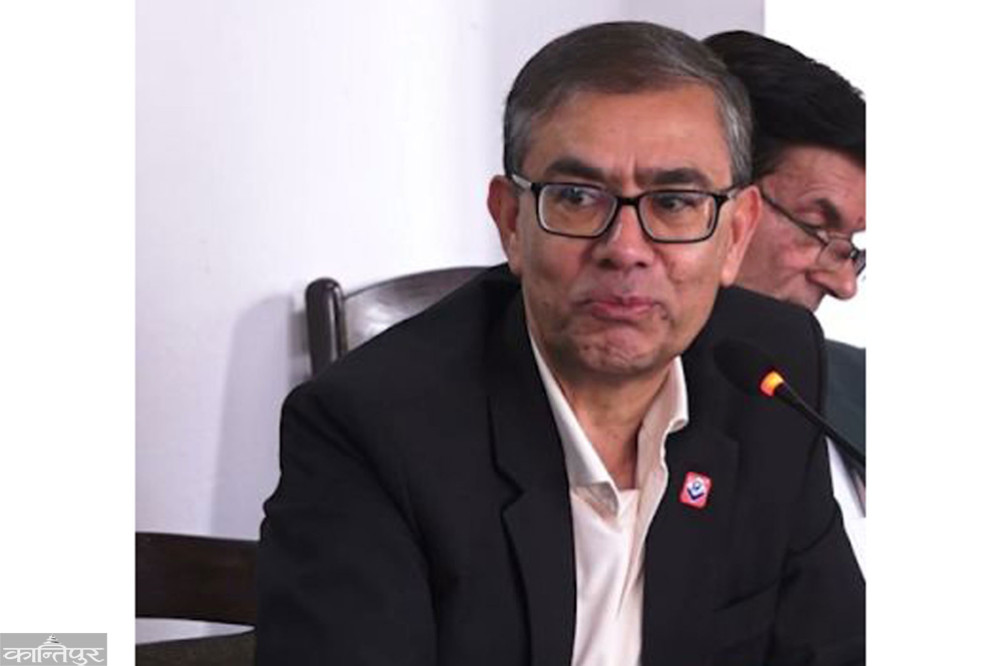
Industrialists complain about the government's promise to create an investment-friendly environment.
We use Google Cloud Translation Services. Google requires we provide the following disclaimer relating to use of this service:
This service may contain translations powered by Google. Google disclaims all warranties related to the translations, expressed or implied, including any warranties of accuracy, reliability, and any implied warranties of merchantability, fitness for a particular purpose, and noninfringement.
‘We have committed great sins in our previous lives and have opened industries in this life. Now we have done nothing, we have looted the land in our previous lives and are now running industries.’
This statement, which is currently being discussed everywhere, was made by Haribhakta Sharma, Executive Director of Deurali Janata Pharmaceuticals and former President of the Confederation of Nepal Industries, in the Finance Committee of Parliament. Sharma, who has been operating manufacturing industries for three decades and is constantly working to improve the economy, made this statement almost 50 days after the formation of the current government with a two-thirds majority.
‘In this life, nothing bad has been done, but in our previous lives, we may have looted the land and now we are suffering from having to run industries in this life,’ he had told the committee. Sharma’s statement reflects the problems in Nepal’s manufacturing sector. The share of manufacturing industries in the economy is continuously decreasing. In the last 30 years, this share has decreased from 10 to less than 6 percent. This is one of the few in South Asia.
‘The Nepali industry has been mired in problems since its establishment. There is an act to promote industry in Nepal. But the provisions in the act are only controlling more than promoting the industry,’ Sharma told Kantipur, ‘I am running a pharmaceutical manufacturing industry. It takes ten years to license another drug, while the ‘patent rights’ I received expires during that period.’
Nepal is a country where excise duty is imposed on industries due to low revenue, while in other countries such fees are levied only on harmful goods or services: Anjan Shrestha, President, Federation of Nepalese Chambers of Commerce and Industry Sharma comments that such problems in the industry are not just current but have been entrenched for decades. ‘We have been urging the government for ten years to formulate an industry-friendly policy to reform the industrial sector. But nothing has been heard,’ he added, ‘Now a new government has come with a two-thirds majority. Now, they can make policy changes if they want, so we have suggested reforms again.'
This is after the liberalization of 2048 BS, when the private sector was allowed to do business freely. During this period, while the overall economy expanded by an average of 4.2 percent, the average expansion of the manufacturing industry is only 2.9 percent. Lack of capital, high dependence on imported raw materials, low adoption of innovation and advanced technology, and high production costs have weakened the country's industrialization, and the country's industrialization is in a shambles.
The average contribution of the manufacturing sector to the gross domestic product (GDP) in the world is 16 percent. In India, manufacturing industries contribute 17 percent to the gross domestic product, 25 percent in China, 25.7 in Bangladesh, 24.7 in Vietnam, and 27.8 percent in Cambodia. Industrialists say that the morale of the private sector has further declined due to not only policy instability, raw material problems, low productivity, but also the recent increase in the number of industrialists being taken into custody. ‘What sin has the industrialist committed by opening an industry that they should be imprisoned? What kind of policy is this to imprison him when he says he will earn some profit by running an industry and contribute to the economy?’ Sharma retorted, ‘In other countries, industry is initially promoted and facilitated when it is established. But in Nepal, it is discouraged.’
Anjan Shrestha, President of the Federation of Nepalese Chambers of Commerce and Industry, is also of the opinion that the situation of having to go to jail for any commercial or financial problem or for opening an industry should be improved. Recently, the Federation, the Confederation and others are protesting after businessmen have been detained one after another and taken into custody. ‘If industrialists make mistakes, there is a practice of imposing financial fines all over the world, but ironically in Nepal, industrialists and businessmen are arrested and detained,’ added Chairman Shrestha. ‘When this happens, not only the person concerned but the entire industry and business sector is discouraged.’
Nepal’s economy has expanded from agriculture to the service sector without industrialization. While the contribution of industry and agriculture to the economy is shrinking, the contribution of the service sector is expanding. In the fiscal year 2072/73, the contribution of the agriculture sector was 28.4 percent, but in 2081/82, it was 25.2 percent. The contribution of the service sector has increased from 57.5 percent to 62.0 percent. However, during the same period, the contribution of the overall industry sector has shrunk from 14.1 to 12.8 percent. Government data has shown that structural changes are necessary to increase income and productivity.
What sin has the industrialist committed by opening an industry and will he be arrested? What kind of policy is this to arrest him for earning some profit by running an industry and contributing to the economy? : Haribhakta Sharma Former President, Confederation of Nepal Industries Federation Chairman Shrestha says that the state should differentiate between industrialists and businessmen in Nepal and encourage them by making different policies accordingly. ‘Currently, about 70 percent of the goods we consume are imported. Out of that, about 30 percent is related to energy and petroleum products. The remaining 50 percent can be produced in Nepal,’ he said, ‘For that, it is essential for the state to come up with a special policy to promote industry.’
Chairman Shrestha said that the government has no policy for promoting industry in Nepal. ‘Nepal is a country where excise duty is imposed on industries because of low revenue, whereas in other countries excise duty is imposed only on harmful goods and services,’ he said, ‘Here, one year the government brings a flexible policy to establish an industry in a certain area, based on that, industrialists open an industry, but before that industry can operate properly, the government revises the policy. How can an industrialist run an industry in such a situation?’
Ravi KC, Vice Chairman of Surya Nepal Pvt. Ltd., said that investment has not been able to enter the country due to the land policy. He said that the same limit has been imposed on ordinary people and industrialists. ‘There is a limit of 11 bighas for an individual. An industry investing Rs 2.3 billion has also been set at 11 bighas,’ he said, ‘Those bringing in big investments do not want to be limited to 2.3 bighas of land. We do not care if small investments come. Therefore, our policy is not right.’
KC said that a policy that hinders someone when they are doing well will be problematic for doing business. ‘If someone is making progress, there is more of a sense of revenge in it than satisfaction,’ he said, ‘That is why the process of how to bring them down and what to do begins.’ He warned that the government should formulate a stable policy to strengthen business. ‘There is a new government with two-thirds majority. New ordinances have come, I hope that many of the issues we raised will be addressed,’ he said.
Since Prime Minister Balendra Shah and Finance Minister Swarnim Wagle have been encouraging domestic production, the upcoming budget seems to adopt a production-oriented policy: Vidushi Rana, MP and Executive Director of Goldstar Stride Limited KC also raised serious questions about the government's tax assessment policy. He said that the reassessment of taxes through various taxes, including the Health Risk Tax, the Consumer Act, etc. is a big problem. 'There is a practice of doing it again by another body because it has not been assessed,' he said. 'This creates a frightening environment. Individual interpretations do not create an environment for industrialization in the industry.'
Even though the government has said that it will encourage industry in the past, it has been encouraging a business-friendly policy, said Vidushi Rana, MP and Executive Director of Goldstar Stride Limited. But she said that the current government will emphasize industrialization. 'Nepal is the only country where the customs duty on raw materials is more expensive than finished (final) goods. Due to the lack of a policy to encourage industry, many old industries have been rapidly converted into trade. Because it is easier to do business than to run an industry,' she said.
Rana said that she has suggested bringing a production-oriented policy in the upcoming budget. 'Since Prime Minister Balendra Shah and Finance Minister Swarnim Wagle have also been encouraging domestic production, it seems that a production-oriented policy will be introduced in the upcoming budget as well,' she said, 'The government should adopt an industry-friendly policy. For that, a policy should be adopted to encourage industry by separating industry and trade.'
She suggested that the Nepal Rastra Bank should become flexible in its policies including working capital loans along with the budget. The shrinking industrial sector in Nepal has had a direct impact on employment. Although about 500,000 people enter the labor market in Nepal every year, new jobs have not been created in the country in that proportion. This is why the process of young people going abroad in search of work has intensified.
The number of Nepali workers going abroad for foreign employment is still high. The number of Nepalis who have obtained labor permits for the first time, institutionally and individually, has reached 294,186. The number of those who have re-obtained work permits is 293,259.
Although the number of those who have obtained work permits for the first time has decreased slightly compared to the previous year, the number of those who have re-obtained work permits has increased significantly. This indicates the continuity and stability of foreign employment of existing workers. Experts say that foreign employment has become an option due to the lack of decent employment in the country.