Tourism professionals say the tourism industry is currently in crisis due to high tax burdens, weak infrastructure, international competition, aviation policy issues, and financial complications.
We use Google Cloud Translation Services. Google requires we provide the following disclaimer relating to use of this service:
This service may contain translations powered by Google. Google disclaims all warranties related to the translations, expressed or implied, including any warranties of accuracy, reliability, and any implied warranties of merchantability, fitness for a particular purpose, and noninfringement.
Tourism entrepreneurs have said that the budget for the upcoming fiscal year 2083/84 should include tax exemptions, reforms in aviation policy, expansion of tourism infrastructure and professional security programs to revive Nepal's tourism industry. They say that the tourism industry is currently in crisis due to high tax burden, weak infrastructure, international competition, aviation policy problems and financial complications.
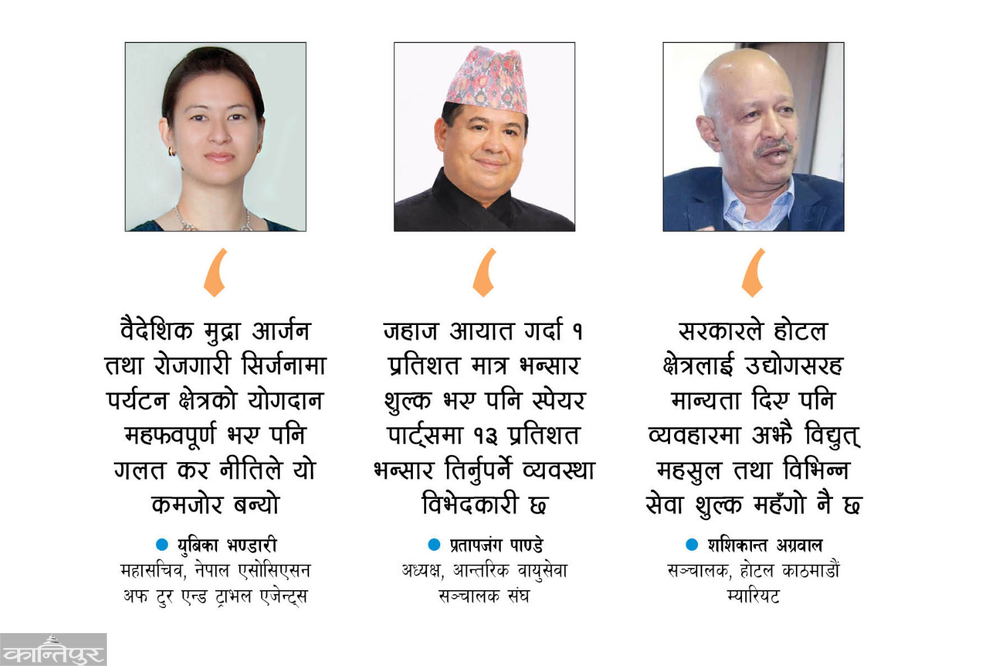
Although the tourism sector has made a significant contribution to Nepal's GDP, foreign exchange earnings and job creation, the industry has been weakening in recent years due to wrong tax policies and structural problems, said Yubika Bhandari, general secretary of the Nepal Association of Tour and Travel Agents (NATTA). "NATTA has also conveyed to the Ministry of Finance through a detailed suggestion letter that 'Nepal has become an expensive destination'," she said.
She claims that the value-added tax (VAT) imposed on international air tickets in particular has made Nepal an expensive destination compared to regional competitors. NATTA emphasizes that countries including India, Sri Lanka and Thailand do not impose VAT on international air tickets and that Nepal should also remove VAT. "In Nepal, taxes have been imposed contrary to the international practices of the International Civil Aviation Organization (ICAO) and the International Air Transport Association (IATA),' Bhandari said. 'This has had a direct impact on foreign tourists visiting Nepal and Nepali passengers going for foreign employment.'
Businessmen say that if the tourism sector adopts a policy of concessions and incentives rather than imposing additional taxes, Nepal can earn many times more foreign exchange than its traditional export industry. They say that a program should be introduced to bring the international airports built in Bhairahawa and Pokhara into full commercial operation through the next budget.
Stating that Nepal has still not been removed from the European Union's 'Aviation Safety List' and that climate change is having a negative impact on Himalayan tourism, businessmen have urged the government to improve international-level air safety, increase investment in policies to attract foreign airlines and promote destinations, and also clarify the tax policy applied to domestic flights.
Businessmen are demanding that special customs concessions be given when importing tourist-carrying vehicles as tourist bus services have become expensive due to high customs duties, that a 'one door tax system' be implemented for the tourism industry by ending double taxation at the local, provincial and federal levels, that multi-day entry passes be arranged for national parks and conservation areas to increase tourist stays, and that a single fee be paid to allow entry for at least 4 to 7 days.
NATTA has stated that there are also problems with foreign exchange and digital transactions, and that travel agencies are not able to access foreign exchange easily for international digital marketing, hotel bookings and payments to foreign service providers. For this, a demand has been made through Nepal Rastra Bank to provide corporate debit or credit cards that can be used for foreign exchange with a certain limit to travel agencies. Businessmen have also proposed to the government to establish a tourism relief and revolving fund. Businessmen are demanding that the government establish a special 'tourism relief and revolving fund' to protect the tourism industry during epidemics or natural disasters like Covid. It has been said that a permanent mechanism is needed to provide interest concessions, loan rescheduling and relief packages to businesses during the crisis and this should be addressed through the budget.
As Nepali travel agencies are becoming weaker due to the increasing influence of foreign online travel agencies, NATTA has demanded a policy to secure the role of local agencies in the sale and management of international air tickets issued from Nepal. NATTA has demanded a separate budget allocation for the construction of international-standard public toilets, rest areas and tourist bus terminals on major tourist highways and destinations.
It has been suggested that a legal arrangement should be made to transparently spend the collected 'tourist service fee' on tourism promotion and infrastructure development. Travel agencies and tourism entrepreneurs have said that Nepal needs to rebuild large conference infrastructure and partner with the private sector to make it a hub for MICE (Meeting, Incentive, Conference and Exhibition) tourism, especially in effective management and re-upgrading of structures like the International Convention Center (BICC) and Godavari Convention Center.
It has also been suggested that tourism statistics and information systems should be developed in a public-private partnership (PPP) model to make them scientific and digital. Tourism entrepreneurs believe that Nepal's tourism sector will grow rapidly again if the upcoming budget brings policies focused on relief for the industry, competitive capacity, and infrastructure development rather than increasing taxes.
Pratap Jung Pandey, President of the Domestic Airline Operators Association, says that Nepali airlines have been seriously affected by the government's policy arrangements and tax structure. He said that although only 1 percent customs duty is levied on importing aircraft, the system of paying 13 percent customs duty on spare parts is discriminatory.
Although Nepal is allowed to lease aircraft, the system of charging 10 percent tax is too expensive and he demands that it be reduced to 3 percent. Pandey said that the 13 percent value-added tax (VAT) on aircraft purchases implemented two years ago has also put additional pressure on the airline sector and that such a tax on capital goods is not appropriate.
In recent years, airlines have been under great financial pressure due to the US dollar exchange rate and fuel price hike. Pandey comments that it is unfair for the Civil Aviation Authority of Nepal to charge service fees in dollars from domestic airlines. Although the dollar exchange rate was around Rs 103 when the system was implemented, it has now exceeded Rs 153, so he emphasizes that all fees should now be determined in Nepali rupees. Shashikant Agrawal, operator of Hotel Kathmandu Marriott, said that the government's policy to increase tourism in Nepal has not yet become practical. He says that even though the government has recognized the hotel sector as an industry, electricity tariffs and various service fees are still being implemented at high rates in practice. This has put an additional burden on businessmen.
Agrawal suggested that a policy of waiving visa fees like Thailand should be adopted to increase tourist arrivals in Nepal. He said that it is necessary to waiving service fees for at least one to two years to make Bhairahawa and Pokhara international airports effective and bring regular flights into operation. He comments that despite the capacity to attract at least 10 million tourists annually to Pashupatinath Temple, there has not been enough publicity.
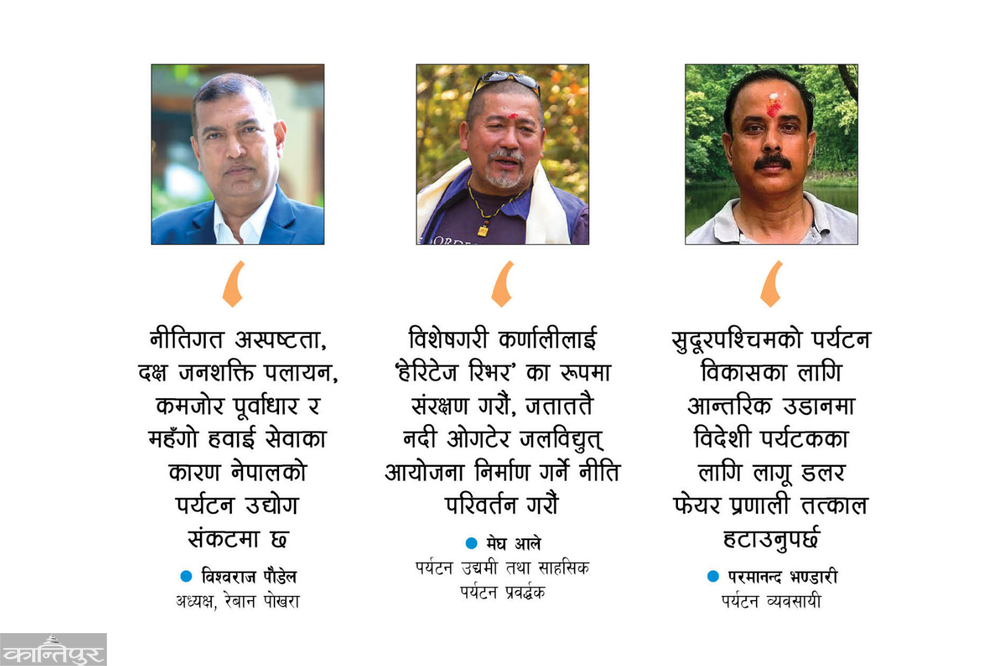
Nepal Restaurant and Bar Association (REBAN), established in 1998, has been playing an important role in promoting tourism, hospitality and catering businesses in Pokhara's lakeside for the past 25 years. According to REBAN Pokhara President Bishwaraj Poudel, Nepal's tourism industry is in crisis due to policy ambiguity, skilled manpower outflow, weak infrastructure, expensive air services and lack of investment.
Poudel said that it is necessary to stop manpower outflow through job creation within the country, attractive service facilities and long-term human resource development plans. He complains that even though the government has recognized tourism as an industry, it has not been implemented practically.
REBAN has also said that the organization should prioritize the tourism sector like agriculture and provide tax exemptions, concessions, grants and investment-friendly facilities. Reban stated that Nepal's poor air safety image and expensive air fares have directly affected the arrival of foreign tourists. Reban demands that the number of national flag-carrying international flights should be increased from the state level and regular international flights should be operated from Pokhara Regional International Airport and Bhairahawa Airport immediately. Reban also emphasizes the need to ensure adequate supply of clean drinking water in the tourism sector.
Tourism entrepreneur and adventure tourism promoter Megh Ale has urged Nepal to change the policy of building hydroelectric projects by encroaching on rivers everywhere. He says that Karnali in particular should be protected as a 'heritage river' and developed by linking it with water tourism, cultural heritage and natural beauty instead of producing hydroelectricity in its main stream.
Karnali is not just a river but also a historical and cultural heritage linked to the Kailash civilization, Khas civilization and Ganga civilization. He says that Karnali, which connects from Tibet to the Ganges in India, should be developed as an international tourism destination while preserving its natural beauty. 'Nepal can generate electricity from tributaries. But a main stream river like Karnali should be protected by linking it with tourism and heritage,' he said.
Although about 90 percent of foreign tourists visiting Nepal visit the Trishuli River region, Ale notes that the natural beauty of the river has been deteriorating in recent years due to infrastructure construction and unplanned development. Although commercial rafting tourism has been started in Nepal since 1975, this area has been shrinking in recent years despite having sufficient potential, he says. Far-West tourism entrepreneur Paramananda Bhandari is demanding the removal of the dollar fare system for tourists on domestic flights for the development of tourism in the Far-West. Bhandari, who has been active for a long time in promoting tourism in the Khaptad, Badimalika, Ramaroshan, Api and Saipal regions of western Nepal, stressed that the upcoming budget should prioritize the tourism infrastructure of the Far-West.
Bhandari said that there is a possibility that areas like Khaptad, Badimalika and Shuklaphanta can be established in the world tourism market. He said that areas like Api Himal, Saipal and Ramaroshan are very attractive for mountain views, trekking and natural beauty. He commented that even though the private sector is increasing investment in star hotels and tourism infrastructure in the Far West, the government has not been able to continue with roads, trekking routes and basic infrastructure. "It seems like budget is allocated every year, but the work does not continue. Tourism cannot be developed with a budget that scatters the seeds," Bhandari said. He stressed the need to end the tendency to keep multi-year plans stretched for a long time. He mentioned that the work of the guest house that was supposed to be built in the Khaptad area has not been completed even after a decade. Bhandari said that the number of domestic tourists has started increasing after Prime Minister Balendra Shah's publicity about the tourism potential of the Far West during his election campaign. However, he said that road access, trekking routes, rest areas and hotel infrastructure are still weak for tourists going to the hilly and mountainous areas.