At basic prices, the annual economic growth rate of Koshi is 2.96 percent, Madhesh is 1.13 percent, Bagmati is 5.23 percent, Gandaki is 4.83 percent, Lumbini is 2.80 percent, Karnali is 2.77 percent, and Sudurpaschim is 3.11 percent.
We use Google Cloud Translation Services. Google requires we provide the following disclaimer relating to use of this service:
This service may contain translations powered by Google. Google disclaims all warranties related to the translations, expressed or implied, including any warranties of accuracy, reliability, and any implied warranties of merchantability, fitness for a particular purpose, and noninfringement.
Madhesh has been seen as the weakest in terms of the country's economic growth rate and per capita gross domestic product (GDP) in the current fiscal year. Compared to other provinces, agricultural production in Madhesh has decreased significantly and government expenditure has also been low, so this province has been seen as the weakest in terms of economic growth and per capita GDP this year. The report on provincial accounting statistics for the fiscal year 2082/83, released by the National Statistics Office on Wednesday, has shown Madhesh as comparatively weak.
The initial projection of provincial GDP shows that Bagmati will have the highest economic growth of 5.40 percent in consumer prices and 5.01 percent in Gandaki in the current fiscal year. The growth rate of both provinces is higher than the national average growth rate. The Statistics Office has estimated that the country's economic growth rate this year will be 3.65 percent in basic prices and 3.85 percent in consumer prices. This year, the growth rate of Koshi in consumer prices is 3.13 percent, Madhesh is 1.31 percent, Lumbini is 2.87 percent, Karnali is 2.94 percent, and Sudurpaschim is 3.28 percent.
The National Statistics Office has preliminary estimates that the economic growth rate in Koshi in basic prices is 2.96 percent, Madhesh is 1.13 percent, Bagmati is 5.23 percent, Gandaki is 4.83 percent, Lumbini is 2.70 percent, Karnali is 2.77 percent, and Sudurpaschim is 3.11 percent. According to Deputy Chief Statistics Officer and Spokesperson Dhundiraj Lamichhane, the situation in this province appears weak due to the decrease in rice crop production in Madhesh by about 11 percent and low government expenditure.
‘In the fiscal year 2082/83, except for agriculture in Madhesh, public administration and defense in Lumbini and Sudurpaschim provinces, the growth rate of all other activities in all provinces appears to be positive,’ Lamichhane said. ‘In the current fiscal year, the annual growth rate of gross value added will be the highest in electricity and gas (20.93 percent) at the national level.’ Accordingly, Lamichhane said that the initial estimate is that the growth rate of electricity and gas will be the highest in Koshi, Madhesh, Bagmati, Gandaki and Lumbini, and the growth rate of financial and insurance services will be the highest in Karnali and Sudurpaschim.
‘In the fiscal year 2082/83, the annual growth rate of water supply and waste management is expected to be the lowest in Koshi Province,’ the report says, ‘The annual growth rate of public administration and defense is expected to be the lowest in Bagmati, Gandaki, and Karnali Provinces.’ However, the office estimates that the annual growth rate of public administration and defense in Lumbini and Sudurpaschim and agriculture in Madhesh will be negative.
Based on per capita gross domestic product (GDP), Bagmati is also seen as the richest and Madhesh the poorest in the fiscal year 2082/83. Accordingly, the preliminary estimate of the statistics office is that in the current fiscal year, Bagmati’s per capita GDP will be 2,644 US dollars, Gandaki’s 1,651, Koshi’s 1,410, Lumbini’s 1,208, Sudurpaschim’s 1,170, Karnali’s 1,108, and Madhesh’s 934 US dollars.
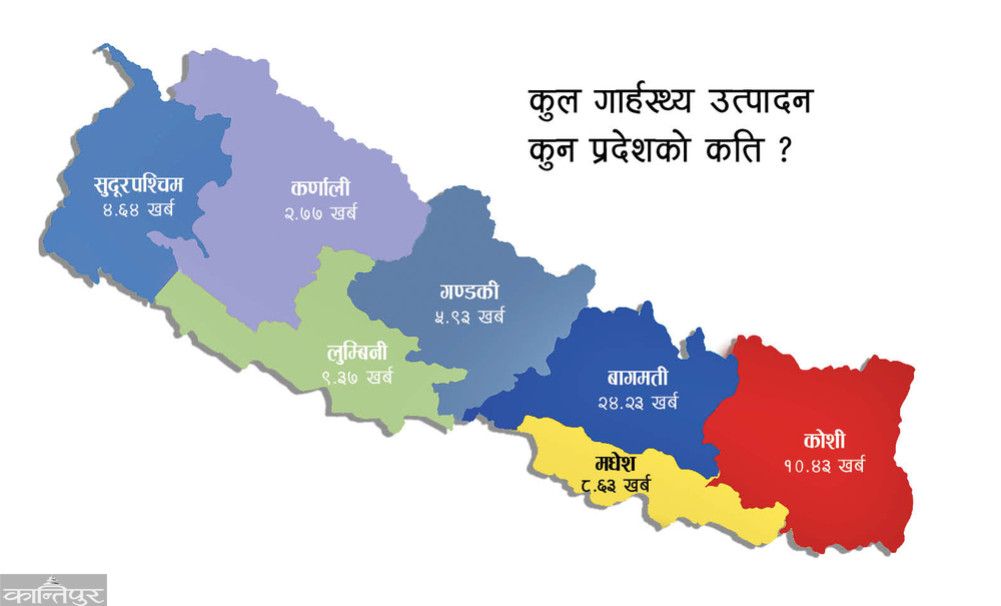
At the national level, the initial estimate is that the per capita GDP in the current fiscal year will be 1,513 US dollars. In this regard, the per capita GDP of other provinces, except Bagmati and Gandaki, appears to be lower than the national average. The office estimates that the national annual gross domestic product (GDP) in the current fiscal year will be 6.6 trillion at consumer prices. This is the highest of the total GDP, about 36.7 percent. In terms of regional comparison, the size of the economy (GDP) of Bagmati is 2423 billion (36.7 percent), Koshi is 1043 billion (15.8 percent), Lumbini is 937 billion (14.2 percent), Madhesh is 863 billion (13.1 percent), Gandaki is 593 billion (9.0 percent), Sudurpaschim is 464 billion (7 percent) and Karnali is 277 billion (4.2 percent). Thus, based on the size of the economy, Karnali is the smallest.
Looking at economic activities, agriculture has the highest contribution in all provinces except Bagmati in the fiscal years 2081/82 and 2082/83. The office's data shows that the contribution of wholesale and retail trade is the highest in Bagmati. 'In the fiscal year 2082/83, trade, which occupied the second place at the national level, also occupied the second place in Koshi and Madhesh,' the office said. 'In Bagmati, the share of real estate-related transaction services is in second place.'
The contribution of public administration and defense is seen in second place in Gandaki and Karnali provinces. The office stated that the contribution of education is in second place in Lumbini and Sudurpaschim. On the other hand, the report states that the contribution of administrative support services is the lowest in Koshi, Gandaki, Lumbini and Sudurpaschim and the contribution of mining and quarrying activities is in the lowest in Madhes, Bagmati and Karnali provinces.
The office has already projected that Nepal's economic growth rate will be lower than the target this year due to heavy rains, floods and landslides in the first month of the current fiscal year. It is said that the economic growth rate has contracted due to heavy rains, floods and landslides affecting agricultural production and reduced government spending.
Gross Domestic Product: How much for which province?