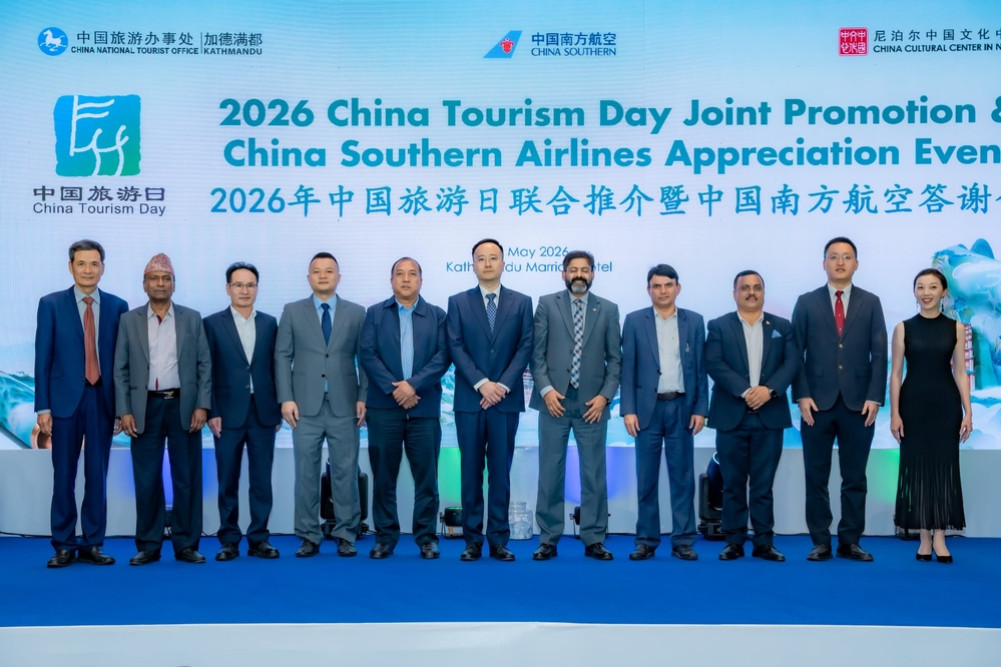
The 16th China Tourism Day celebrated in Kathmandu featured detailed discussions on cooperation in tourism promotion, cultural exchange, and expansion of air connectivity.
We use Google Cloud Translation Services. Google requires we provide the following disclaimer relating to use of this service:
This service may contain translations powered by Google. Google disclaims all warranties related to the translations, expressed or implied, including any warranties of accuracy, reliability, and any implied warranties of merchantability, fitness for a particular purpose, and noninfringement.
The 16th ‘China Tourism Day’ has been celebrated in Kathmandu with the aim of further strengthening tourism and air connectivity between Nepal and China.
The program, jointly organized by China Southern Airlines, China National Tourism Office (Kathmandu) and China Cultural Center (Nepal) and in collaboration with the Nepal Tourism Board, discussed the possibilities of tourism promotion, cultural exchange and expansion of air connectivity between Nepal and China on Wednesday.
The program was attended by tourism entrepreneurs, travel trade partners, representatives of diplomatic missions, aviation officials and stakeholders from both countries.
Addressing the program, Deputy Director of China Cultural Center (Nepal) Liu Zhanping said that tourism is not just about travel but also an important means of exploration, lifestyle and cultural exchange and friendship between nations.
He stressed that there are many areas where tourism cooperation between Nepal and China can be further expanded, emphasizing the need to prioritize air connectivity, destination promotion and cultural exchange.
The fact that Chinese tourists constitute the second largest source market among tourists coming to Nepal was also mentioned in the program. Participants said that expanding air services would be crucial to make the flow of tourists coming to Nepal from China more convenient and sustainable.
The program mentioned that air connectivity between Nepal and China is directly contributing to tourism development. Currently, Kathmandu is connected to various cities in China such as Guangzhou, Chengdu, Xi'an, etc. through direct flights.
China Southern Airlines has been operating flights to Kathmandu since 2007 and has completed 19 years in Nepal. The company has been providing connectivity to Asia, Europe, North America, Oceania, the Middle East and Africa, including China, through the Kathmandu-Guangzhou route.
The airline is currently operating flights to Kathmandu using modern A320 Neo aircraft and plans to expand the number of flights and capacity as per market demand.
According to participants in the program, Chinese airlines can play a role in expanding Nepal-China tourism relations by increasing the number of direct flights to facilitate tourist movement, connecting Kathmandu with more regional cities in China, expanding connectivity with third countries through transit hubs (especially Guangzhou), increasing tourist attraction through cheap and competitive fares, and managing the tourism season through charter and seasonal flights.
China is considered one of the major development partners in the infrastructure and tourism sectors between Nepal and China. However, the trade imbalance persists. Nepal imports machinery, electronics, textiles and construction materials from China, while Nepal exports herbs, handicrafts and agricultural products.
Initiatives are being taken to strengthen both air and land routes as part of efforts to expand trans-Himalayan connectivity. It is expected to further strengthen tourism, trade, investment and people-to-people ties.
According to China Southern Airlines, the company operates more than 3,000 flights daily to 224 destinations in 40 countries around the world. The company has more than 973 aircraft. The program honored the top 10 travel agencies in Nepal that sold the best packages in 2025, the statement said.
The organizers expressed their confidence in making China-Nepal cooperation more institutionalized and effective, promoting tourism, expanding air services and advancing cultural understanding in the long term.