Kanika Chharai: The new city project has not been able to gain momentum due to the budget, there is not enough budget and manpower to move the work forward.
We use Google Cloud Translation Services. Google requires we provide the following disclaimer relating to use of this service:
This service may contain translations powered by Google. Google disclaims all warranties related to the translations, expressed or implied, including any warranties of accuracy, reliability, and any implied warranties of merchantability, fitness for a particular purpose, and noninfringement.
It has been more than a decade and a half since the construction of new cities began in various districts along the Pushpalal (Mid-Hill) Highway with the aim of stopping the migration of hilly districts. So far, the work on all the cities is in the initial stage. Initially, 10 cities were allocated, but now it has been increased to 54.
Kanika Chharai The new city project has not been able to gain momentum due to the budget. The budget and manpower are not sufficient to move the work forward. The work on the city has been moved forward with limited manpower.
Initially, the government estimated that it would cost 3.5 trillion rupees in 20 years to build 10 cities. So far, 8.29 billion rupees have been spent on 10 cities. Initially, there were 10 cities along the Mid-Hill Highway: Phidim (Panchathar), Basantapur (Tehrathum), Khurkot (Sindhuli), Baireni-Galchhi (Dhading), Dumre-Bhansar (Tanahun), Burtibang (Baglung), Chaurjahari (Rukum), Rakam-Karnali (Dailekh), Sanfebagar (Achham), Patan (Baitadi). Two cities on this route, Bheriganga (Surkhet) and Bhingri (Pyuthan), have been added. The New City Project Coordination Office has stated that work is being focused on 12 out of 54. Currently, the project office is focused on these cities.
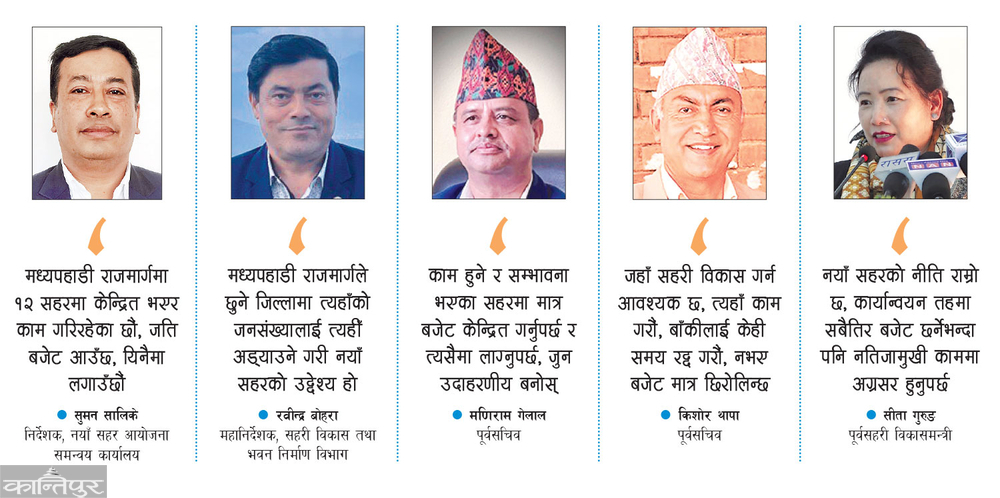
Although the number of cities is large, work has not been done in all of them, said Suman Salike, Project Director of the New City Project Coordination Office. ‘We are working by focusing on 12 cities in the mid-hills,’ he said, ‘We will spend whatever budget comes in these cities.’ He said that even though new cities are being announced and budgets are allocated for all of them accordingly, the budget ceiling has not increased.
Salike said that since the projects have already been selected, work will be done on those. He said that he has received a budget ceiling of 2 billion for the upcoming fiscal year and will work within that. ‘First, we will work on 12 cities, only then will work on additional cities move forward,’ he said, ‘Land development work is underway, it costs from 500 million to 1 billion rupees, and the annual budget comes to only 3/4 million. The land development work has not been completed due to insufficient budget.'
The concept of a new city was conceived with the aim of stopping the migration of 100,000 people to the hills by building a city in the district touched by the Mid-Hill Highway, says Rabindra Bohara, Director General of the Department of Urban Development and Building Construction. 'We are moving forward based on that,' he said.
In 2067/68, the construction of new cities was started by selecting two cities from each development zone. The cities were selected based on factors such as the population growth there and whether the geography is suitable for city expansion. The cities were selected in accordance with the idea of developing and building a new city in the Mid-Hill region. Meanwhile, the question arose why cities should be built only in the Mid-Hills and why not elsewhere. MPs and ministers took an interest in this. And, they started pressuring their respective districts to add cities. After that, the number of cities was increased as usual. While the number kept increasing, the budget could not be increased.
Former Secretary Maniram Gelal says that work should be done by prioritizing new cities. ‘It takes a long time to approve land for land development work, it is necessary to speed it up,’ Gelal said, ‘The issue of establishing cities is not only about building infrastructure. Land had to be arranged for settlement, and locals had to be ready to live.’
Postal Highways, Himalayan footpaths, and unorganized settlements in the Terai Madhesh have been declared new cities. The postal highway includes Gaurigunj (Jhapa), Rangeli (Morang), Manara (Mahottari), Brahmapuri (Sarlahi), Maulapur (Rautahat), Mahagadhimai (Bara), Bardaghat (Nawalparasi), Rajapur (Bardiya), Bhajani (Kailali) and Belauri (Kanchanpur), Shambhunath (Saptari), Balwa (Mahottari), Ishworpur (Sarlahi), Kataharia (Rautahat) and Gadhawa (Dang).
The settlements along the Himalayan trekking route include Lukla (Solukhumbu), Phungling (Taplejung), Kimathanka (Sankhuwasabha), Syafrubensi (Rasuwa), Jomsom (Mustang), Chame (Manang), Simkot (Humla), Martadi (Bajura) and Kolti (Bajura), Dunai (Dolpa).
The number of smart cities is 17. They include Lumbini (Rupandehi), Nijgadh (Bara), Palungtar (Gorkha), Dhankuta (Dhankuta), Mirchaiya (Sirha), Chandrapur (Rautahat), Kavre (Kavre), Bharatpur (Chitwan), Waling (Syangja), Tulsipur (Dang), Dullu (Dailekh), Tikapur (Kailali), Amargadhi (Dadeldhura), Gundu (Bhaktapur), Bhimdatta (Mahendranagar), Gaurigunj (Jhapa) and Maulapur (Rautahat).
Former Secretary Kishore Thapa says that the number of new cities has increased due to political pressure without any feasibility study or consideration of whether it is possible or not. 'There was no budget allocation for new cities.' "We should reconsider and review the new city project and work on the areas where urbanization is taking place and urban development is needed," he said. "The remaining cities could be canceled for a while, and it is the right time for the current government to do this." He said that investing in places where it is not feasible would be a waste of investment. "Where investment helps in urban development, employment promotion and income generation, cities should be built there, and the rest should be canceled," he said.
The construction of the project has been started with the aim of building and developing cities with state-of-the-art infrastructure and services that can accommodate at least 100,000 people in each city by the fiscal year 2086/87.
Former Urban Development Minister Sita Gurung said that the objective of building new cities is good. "Budget allocation and infrastructure development have not been carried out according to the vision with which it was started," she said. "The migration of people from the Himalayas and hilly regions has increased, and the economy has grown focused on economic prosperity." She said that she had tried when she was the Urban Development Minister to select a limited number of cities to work on rather than spreading the budget.

