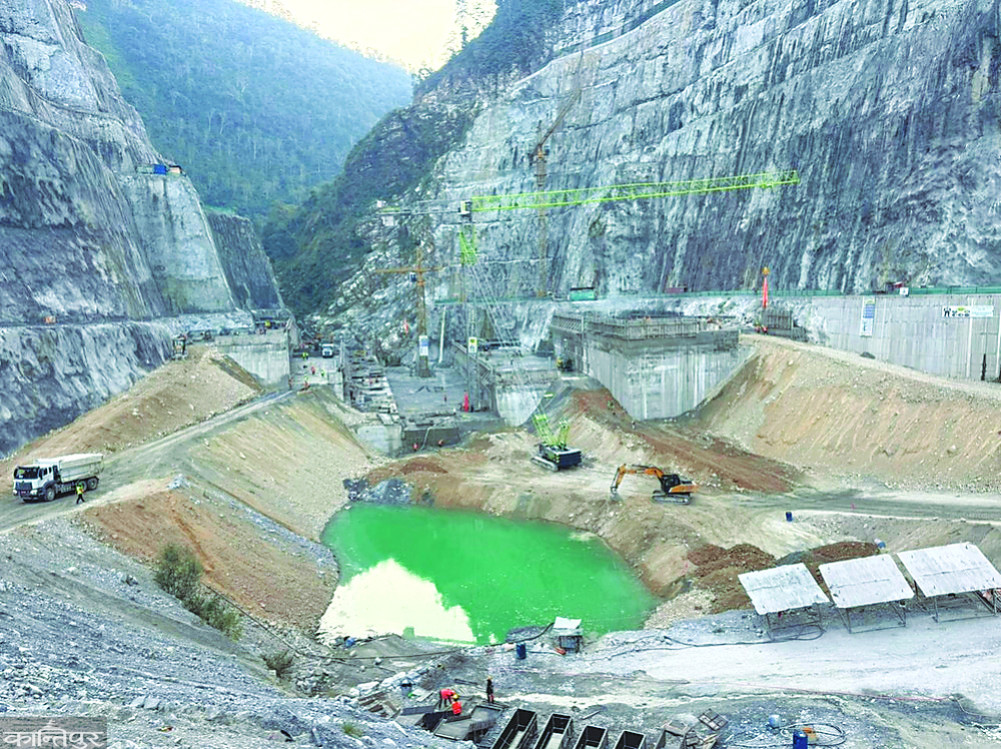
The government has announced in its policies and programs for the upcoming fiscal year that it will implement a single-door system by amending laws related to energy, forests, land, and the environment to achieve the 30,000 megawatt electricity generation target.
We use Google Cloud Translation Services. Google requires we provide the following disclaimer relating to use of this service:
This service may contain translations powered by Google. Google disclaims all warranties related to the translations, expressed or implied, including any warranties of accuracy, reliability, and any implied warranties of merchantability, fitness for a particular purpose, and noninfringement.
The government has set a target of generating 30,000 megawatts of electricity in the coming decade through its policies and programs. Stakeholders say that the government cannot achieve this target without opening a power purchase agreement (PPA). The government has announced in its policies and programs for the coming fiscal year that it will implement a single-door system by amending the laws related to energy, forest, land and environment to achieve the target of generating 30,000 megawatts.
Ganesh Karki, President of Independent Power Producers Association of Nepal (IPPAN), said that the private sector will achieve the target set by the government if the PPA is opened. ‘We also had to emphasize implementation to meet the target set by the government,’ he said, ‘for that, the modalities of 30,000 megawatts should be clarified.’ Karki said that if the government builds roads and transmission lines, they will meet the government’s target by building the project.
Karki said that 23 government agencies had to visit to build a hydropower project and they have been demanding the implementation of a single-door system. Former Secretary Madhu Prasad Bhetuwal also says that without a PPA to meet the government's target, the project will not be built and the target will not be met. 'It means sending 15,000 MW to India and Bangladesh, and consuming 15,000 MW internally,' he said, 'Big projects like Arun-3 and Lower Arun are also under construction.' Bhetuwal argues that the NEA and the ministry should decide how much PPA to do, keeping in mind the market risks.
The government's announcement of 30,000 MW of production is not new. The previous government had announced to produce 28,500 MW by 2035. The private sector has been complaining that the government has not taken any steps to implement the target even though it has set a target.
'The target for electricity production has been changing with every change of government, says IPPAN Deputy Secretary General Prakash Chandra Dulal. But he says that there is no investigation into whether it has been implemented or not. 'The problems during implementation are not solved, what happened is not seen. "Only announcements are made," he said, "The current government is two-thirds. It is easy to coordinate between ministries. Even though the target of 30,000 MW was set, the private sector was not involved."
It is mentioned that the government will make inter-country energy trade agreements a means of attracting long-term investment. The promoters say that the same point indicates that PPA will be opened. But they also said what will come in the budget now. The authority is also in a 'wait and see' situation. In point 227 of the budget for the current fiscal year, it is stated that 'power purchase agreements will be made in accordance with the take and pay concept of run-of-river projects.' After the provision in the budget, the PPAs for semi-reservoir projects including 'run-of-river-flowing' have been stopped. After the provision for PPAs in accordance with 'take and pay' was made in the budget, energy promoters had put all-out pressure to remove such a provision. Even the ruling Congress MPs had objected to 'take and pay'. After the threat of failing the budget, the then Prime Minister KP Sharma Oli had met with former Nepali Congress President Sher Bahadur Deuba on 28 Ashad and held discussions. Oli and Deuba had agreed to remove the provision.
On the same basis, the Prime Minister had clarified on 28 Ashad that the provision of ‘take and pay’ had been removed from the budget statement. The then Finance Minister Bishnu Poudel had said in Parliament, ‘Power Purchase Agreements (PPA) can be made for projects that are certain to consume and export energy based on financial risk assessment and that the Nepal Electricity Authority can pay its obligations.’ Poudel did not mention anything about the amendment of the ‘take and pay’ provision in the budget.
Last December, the Ministry of Energy had sought the agreement of the Ministry of Finance to take a proposal to the Council of Ministers to change ‘take and pay’ to ‘take or pay’. The Ministry of Finance had sent a letter on 28 December stating that the Ministry of Energy and the Authority could make a PPA as per the prevailing law based on an analysis of demand, export and existing PPAs. "It would be appropriate to resolve the issue of PPAs made so far by the Nepal Electricity Authority, taking into account the demand for energy and the potential for export, and to ensure that there will be no problems in electricity consumption in the future, by ensuring that PPAs are made in accordance with the prevailing laws," the letter sent by Artha states.
After the provision in the budget, PPAs for run-of-river hydropower projects up to 10 megawatts have also been stopped. On 10 Magh 2080, the then Energy Minister Shakti Basnet had opened PPAs for run-of-river hydropower projects up to 10 megawatts. Since then, all PPAs for hydropower projects up to 10 megawatts have been stopped.
Immediately after that, the then Energy Minister Deepak Khadka removed Kulman Ghising from the Executive Director of the Authority and appointed Hitendra Dev Shakya. Immediately after that, the decision to open PPAs was taken at the meeting of the Authority's Board of Directors held on 12 Chaitra 2081. The Authority had asked hydropower projects that had grid connection agreements by 12 Chaitra 2081 to submit updated documents within 30 days of the issuance of the notice to conduct PPA.
The Authority had asked 1,858 MW run-of-river (ROR) and 3,177 MW semi-reservoir (PROR) hydropower projects to update their PPA documents. However, after the provision in the budget, the government asked for and submitted the documents, but the PPA of the PROR project was also stopped, said IPPAN Deputy Secretary General Dulal. The PPA process that the Authority had initiated before the budget was also stopped.
While the government is setting a production target, the private sector has been demanding the opening of PPA. According to promoters, PPA has not been conducted regularly in the country since 2075. In 2079, the then Energy Minister Rajendra Lingden opened a PPA of 1,500 MW. Since then, PPAs have been continuously being made for hydropower projects up to 10 MW and for PROR and reservoir projects. But most of the private sector projects are RORs.
The government led by Prime Minister Balendra Shah has mentioned in its ‘100 Agenda’ on governance reforms that the decision on PPAs and licenses for projects will be made within 180 days. ‘In order to develop the country’s energy sector as a major basis for economic transformation, and to ensure development by immediately removing obstacles related to electricity generation, transmission, distribution and export, the government has mentioned in its agenda that all pending PPAs and licenses will be decided within a maximum of 180 days.
In the same agenda, it is mentioned that the government will prepare an energy export strategy within a month. The draft of the strategy has been prepared and suggestions have been collected from stakeholders. However, it is yet to be implemented. The agenda also mentions an ambitious plan to increase the annual per capita electricity consumption to 1,500 kilowatt hours by 2035. Currently, per capita electricity consumption has reached 450 kilowatt hours.
Energy Minister Biraj Bhakta Shrestha has formed a high-level committee under the coordination of Joint Secretary Sagar Raj Gautam on 19 Chaitra 2082 to study the approval of PPAs and energy-related projects. The committee has also been given the responsibility of analyzing the current status of PPAs issued by the NEA, identifying policy, technical, economic and legal obstacles in the PPA process, and recommending necessary reforms to make the PPA process more transparent, competitive and in line with national interest in the coming days. The committee is also responsible for analyzing the errors, weaknesses and possible irregularities in the PPA process and recommending necessary action. Therefore, the committee is focused on digging into past problems rather than conducting PPA, according to ministry sources.
So far, the NEA has stated that 835.5 MW of PPAs have been issued by 56 solar projects and 11,988 MW of PPAs have been issued by 547 companies. According to the Ministry of Energy, 4,296 MW of electricity has been connected to the national grid so far. The NEA has stated that 124.5 MW of PPAs are yet to be issued by the Solar 7 project. In the hydropower sector, 126 projects with connection agreements have 7,617.45 MW and 138 projects without connection agreements have 8,134.16 MW, leaving 264 projects with 15,751 MW of PPAs pending.
Bhetuwal also suggested that both the government and the private sector should move forward by allowing the private sector to trade electricity, with the risk being borne by both the government and the private sector. The 63rd report of the Office of the Auditor General states that 16,277 MW of purchase agreements are in the process of being signed with 253 energy producers as of the fiscal year 2081/82.