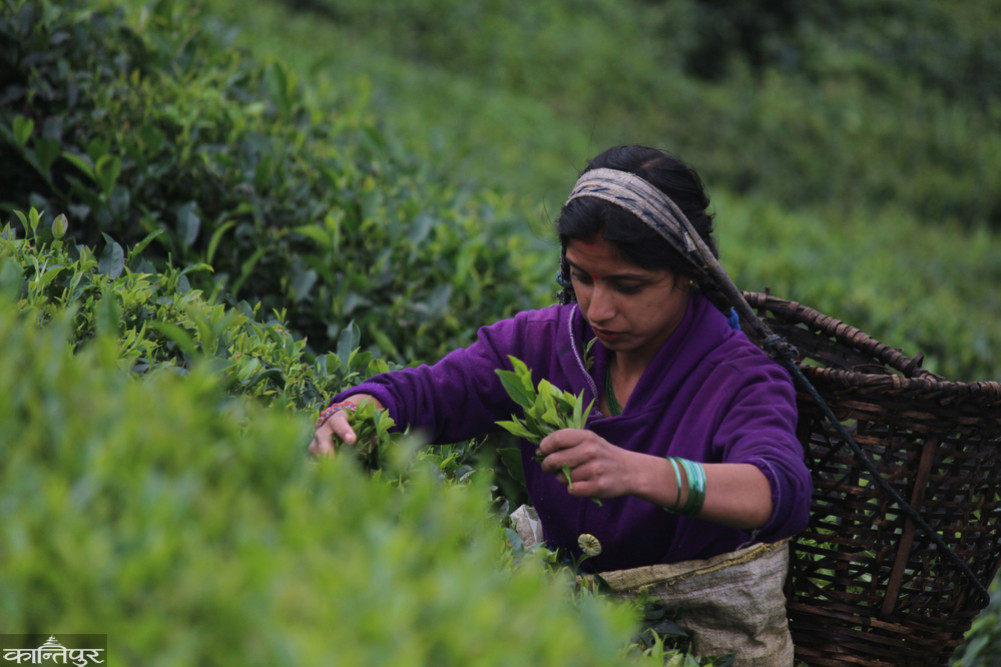
Under normal circumstances, 2 to 3 trucks of tea would be exported to India daily from the Kakadbhitta border crossing in the east, but the export process has been disrupted since April 18.
We use Google Cloud Translation Services. Google requires we provide the following disclaimer relating to use of this service:
This service may contain translations powered by Google. Google disclaims all warranties related to the translations, expressed or implied, including any warranties of accuracy, reliability, and any implied warranties of merchantability, fitness for a particular purpose, and noninfringement.
Nepali tea exports have been hampered for the past two weeks due to the new Standard Operating Procedure (SOP) implemented by the Tea Board of India since May 1. As a result, millions of kilos of Nepali tea ready for export have been stuck in warehouses.
Normally, 2 to 3 trucks of tea were exported to India from the eastern Kakadbhitta border crossing. But since April 18, the export process has been blocked, and the tea has been stuck in the warehouse. ‘Production in industries has come to a standstill,’ says Buddha Tamang, the operator of Barju Tea Estate in Ilam, ‘tea has not been picked from the gardens.’
According to the new rules implemented by the Tea Board of India, now detailed details of every tea consignment entering India from Nepal must be registered in advance on an online portal. Laboratory testing will be mandatory and it will have to be ‘held’ in the warehouse until the test report arrives.
Earlier, the trucks used to go directly to the warehouse after customs clearance, says Shivakumar Gupta, senior vice-president of the Nepal Tea Producers Association. Now, even after customs clearance, the board reopens them, takes samples, and the trucks are stopped for 14 to 20 days. ‘This is not called trade, it is an undeclared blockade,’ said Gupta. Due to unnecessary delays in each truck, not only the transportation cost but also the banking charges and interest have increased. He says that the cumbersome process will double to triple the export time.
Businessmen claim that the transportation process has been further delayed after the Indian side made it mandatory to open each bag and take a sample. ‘Indian customs usually takes a sample once in a few trucks. But now the Tea Board opens each bag. This not only affects the time, but also the packaging and quality of the tea,’ said Jhapa-based tea entrepreneur Sachin Niraula.
About 15,000 farmers are directly dependent on tea cultivation in Ilam, Jhapa, Panchthar and Dhankuta, and green leaves have not been picked from the plantations after exports were disrupted. Niraula says that such a practice has violated the general norms of international trade. About 15,000 farmers are directly dependent on tea cultivation in Ilam, Jhapa, Panchthar and Dhankuta. Green leaves have not been picked from the plantations after exports were disrupted. Ramesh Limbu, a farmer from Ilam, says that due to the halt in exports, farmers are unable to even cover the cost of production.
About 60,000 workers are directly and indirectly dependent on the tea industry. Industrialists say that work in the processing industry has decreased after exports were halted and daily wage workers have been affected. ‘Earlier, there was even overtime during the season.’ Now, work has decreased. Some industries have started reducing shifts,’ said Krishna Urau, a worker from Jhapa. Small and medium processing industries have been hit the hardest, said the entrepreneur.
Nepal exports about 12.5 million kg of tea to India annually. This is more than 90 percent of Nepalese tea exports. Although India's tea market is huge, the share of Nepalese tea is very small. Tea entrepreneur Uday Chapagain, who produces more than 1 billion kg of tea annually in India, said.
The share going from Nepal is less than one percent. Chapagain says that it is not right to impose strict restrictions in such a situation. 'Even if it was just a paper process, it could have been resolved through discussion.' But suddenly implementing new rules without consultation is a big problem,' Chapagain said.
According to the new rules, the testing fee for each sample is about 11,000 Indian rupees (about 17,800 Nepalese rupees). If the first test fails, there is a provision to pay an additional fee for re-testing. The rule that the tea must be destroyed or returned if it fails for the second time has increased the risk.
Businessmen and farmers have expressed dissatisfaction, saying that the government has not played any role even though there are problems in tea exports. Businessmen and farmers have expressed dissatisfaction, saying that the government has not played any role even though there have been problems in tea exports for two weeks. According to them, there does not seem to be any concrete diplomatic initiative even though exports have been halted for two weeks. 'We have informed about the problem repeatedly.' However, there has been no concrete dialogue from the government level yet, said Aditya Parajuli, president of the Tea Producers Association.
Farmers and businessmen complain that even though this issue has been raised in Parliament, no practical solution has been found. On Wednesday, UML MP Suhang Nembang, elected from Ilam, drew the government's attention to the tea blockade from the House. The tea industry is the main cash crop in eastern Nepal. This industry does an annual turnover of more than Rs 4 billion. "If the withdrawal restrictions continue for a long time, there is a possibility that banking loans, employment, and the rural economy will all be directly affected," said economist Bedraj Acharya.