Urges investment incentives to create high-wage jobs and self-employment to keep the economy moving.
We use Google Cloud Translation Services. Google requires we provide the following disclaimer relating to use of this service:
This service may contain translations powered by Google. Google disclaims all warranties related to the translations, expressed or implied, including any warranties of accuracy, reliability, and any implied warranties of merchantability, fitness for a particular purpose, and noninfringement.
Stakeholders have emphasized that there should be a business-friendly policy arrangement in the budget for the coming fiscal year to provide relief to the middle class and increase investment. They say that investment should be encouraged to create high-wage employment and self-employment to keep the economy moving.
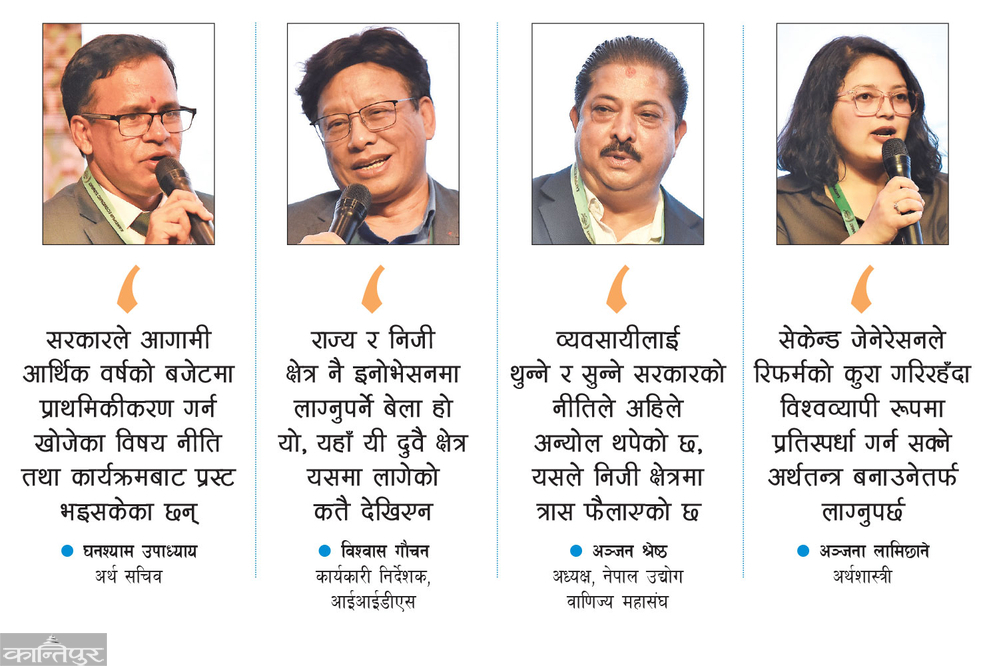
At the second session of the Kantipur Economic Summit 2026, 'Search for meaning, not numbers in the budget' organized by Kantipur Media Group in Kathmandu on Wednesday, Finance Secretary Ghanshyam Upadhyay said that the issues the government is trying to prioritize in the budget for the coming fiscal year have been made clear from the policies and programs. 'Economic reforms and infrastructure development are being prioritized,' he said, 'The pillar of this is investment. With the policies taken by the government in the past, we are becoming self-reliant in cement production. We can make a big leap in hydropower in the next 10 years.'
Upadhyay said that in the current situation, it is necessary to boost the self-confidence of the private sector. ‘The private sector is looking for a guarantee of security, that security is for property and individuals,’ he said, ‘It is necessary to adopt a policy that will involve the private sector in public infrastructure development and advance the private sector in profitable projects. He stressed that the entire society should work to raise the morale of the private sector, which has been damaged by attacks and sabotage during various movements.
‘We are also under pressure, if the revenue collection in the current fiscal year is around Rs. 1.3 trillion, then about Rs. 1.3 trillion will be spent on running the government normally,’ Upadhyay said, ‘After that, we should focus on development activities.’ He said that the government is in a situation where it needs to manage development by mobilizing other components of the economy and financial resources and fulfill the growing aspirations of the people.
Finance Secretary Upadhyay said that the budget will pay special attention to completing unfinished projects. ‘It is important to be clear in the policy,’ he said, ‘The upcoming budget will address all issues such as tax and subsidy policies.’ He also said that it is necessary to improve the industrial environment.
‘It is important to see how many jobs have been created in the assembly industry. We need to collectively address the line of people who go in search of jobs, which is 2,000 every day,’ Upadhyay said, ‘The budget does the work of creating a business environment. It is necessary to develop business ethics in the bureaucracy, politics and the private sector.’ Upadhyay commented that it is necessary to think about how many jobs have been created by those who get a huge revenue discount for assembling the sole of a shoe in one vehicle and the upper part of a shoe in another vehicle.
Biswas Gauchan, Executive Director of the Center for Comprehensive Development Studies (IIDS), said that it is time for the state and the private sector to engage in innovation. ‘Here, both the state and the private sector do not seem to be involved in innovation,’ he said.
While the second generation is talking about reforms, economist Anjana Lamichhane pointed out that we need to work towards creating an economy that can compete globally.
‘We examine the data on how much budget has been allocated so far, how many people have received training, and who has benefited,’ she said. ‘It is necessary to see whether that budget has improved the living standards of women, whether jobs have been created, and whether the businesses started have been operated in the long term.’ She said that foreign employment has become a compulsion instead of an opportunity, and the overall economy has been affected by the weakness of the production and industrial sectors.
She said that economic activity, employment, and entrepreneurship are important for the development of the social sector. ‘Foreign employment has now become an economic compulsion, it should have been developed as an opportunity,’ she said. ‘Although the external indicators of our economy appear positive, this is only a short-term stability. Because it is based on remittances, not production.’
Lamichhane expressed concern over the declining contribution of the industrial sector to the gross domestic product (GDP). Lamichhane said that it is necessary to take the industry towards a long-term economic transformation. ‘Our production and industrial sector are weak, and private investment is also low,’ she said, ‘Although there is liquidity in the banks, investors lack confidence. This has not been able to increase investment.’
Despite decades of reform efforts, Lamichhane analyzed that women are still lagging behind due to the burden of housework, childcare, and discrimination in the labor market. She said that the future policy should be ‘result-based’ rather than ‘number-based’. ‘Although it may sound small, programs that support community day-care centers or childcare should be introduced for the economic empowerment of women,’ she said. ‘If we pay attention to such basic issues, women’s economic freedom and opportunities will increase.’ She said that the actual impact should be looked at in this year’s budget, not the number of beneficiaries.
The morale of businessmen has remained low after the COVID-19 pandemic, said Anjan Shrestha, president of the Federation of Nepalese Chambers of Commerce and Industry. He said that the government's policies to control imports and reduce bank interest rates to accumulate foreign exchange during the COVID-19 pandemic have caused problems in the economy and reduced the morale of businessmen.
He claims that although the external sector appears strong in the current situation, the internal sector is in trouble. He said that the construction industry is in further trouble due to the ongoing conflict in West Asia, including fuel price hikes, supply disruptions, and increased transportation costs. He said that the government's policy of detaining and questioning businessmen has added to the confusion.

