Emphasis is placed on the need for the government to come up with concrete policies to keep economic activity moving at a time when the private sector has been unable to develop a business approach due to the lack of a stable policy.
We use Google Cloud Translation Services. Google requires we provide the following disclaimer relating to use of this service:
This service may contain translations powered by Google. Google disclaims all warranties related to the translations, expressed or implied, including any warranties of accuracy, reliability, and any implied warranties of merchantability, fitness for a particular purpose, and noninfringement.
Stakeholders have pointed out that good governance along with stable policies is essential for improving the sluggish economy and achieving targeted economic growth. They say that due to the lack of stable policies, the private sector has not been able to develop a business approach, and in a time of sluggish economy, the new government needs to remove all these obstacles and come up with a concrete policy to keep economic activities moving.
At the first session of the Kantipur Economic Summit 2026, ‘Stable Policies to Accelerate the Private Sector’ organized by Kantipur Media Group in Kathmandu on Wednesday, stakeholders said that investment inflow and industrialization in the country have not been possible due to various reasons including policy instability, land restrictions.
Surya Nepal Pvt. Ltd. Vice President Ravi KC says that no country’s economy can be developed unless there is a partnership between the government and the private sector. He says that the development work should be done by the private sector and the government should be the mediator. He also said that there is a risk of the government, which is currently formed with high enthusiasm to work, losing its enthusiasm. ‘The state cannot do industry. This is a job that the people or businessmen can do. The government should take the lead in this as a guardian,' he said.
He said that the government's work of imprisoning businessmen is wrong. 'No businessman works for loss. He works for profit, if a policy is made that prevents business from moving here and there, the businessman should not be imprisoned,' KC said, 'Even if the issue of tax management is a crime, I don't think he should be imprisoned.' KC said that if he takes money out and invests and only does business here and has no basis in Nepal, he can be investigated to see if he can escape.
Nepal Automobile Importers and Manufacturers Association (NAIMA) President and Voith Group Managing Director Ritu Singh Vaidya said that there is a problem with the change of policy after the change of government. 'Instability in policy is the main problem, no matter which party comes, there should be a national consensus,' she said, 'No matter which government comes, a stable policy should be adopted to achieve economic progress.'
Ritu said that all industries have become victims of instability. She said that the upcoming budget should cover all sectors such as new industries and new technologies. She said that there is a practical problem in mentioning the mandatory maximum retail price (MRP) at the customs point. “No one can import goods without applying MRP. We have a practical problem. It is not that we do not want it. Let us fix the process,” she said.
Businessmen had been protesting that the system of importers affixing MRP labels on each unit at the customs point was not practical. They argued that if the goods are unloaded and the price is affixed to each packet, the cost and time will increase significantly and the customs process will be unorganized.
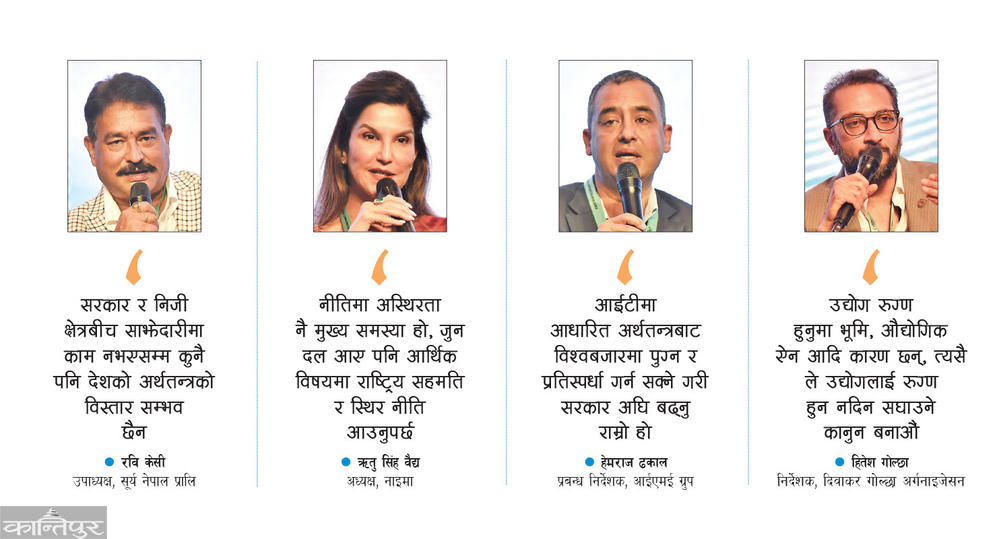
Nepal can reach the global market and compete through an information technology or knowledge-based economy. Hemraj Dhakal, co-founder and managing director of IME Group, said that the government’s current focus on the IT sector is positive. ‘Considering our young workforce and English-speaking population, this is a very opportune time for this sector,’ he said. ‘Looking at the data of the past two to three years, it seems that Nepal is exporting IT services worth around Rs 20 billion annually.’
Although the government has praised this rapidly expanding sector before, Dhakal complains that problems are arising due to changes in policies as soon as the government changes in Nepal. ‘The tax on IT exports was sometimes set at 1 percent, sometimes 10 percent, sometimes 5 percent,’ he said. ‘If the current government can maintain policy stability, it will increase the confidence of investors in the IT sector.’
Dhakal said that there is a possibility that the IT sector’s contribution to Nepal’s gross domestic product (GDP) can be increased to more than 2 percent. For this, he pointed out that basic infrastructure such as connectivity should be ready. He said that the government also needs to invest and take initiatives in the construction and expansion of digital infrastructure. He said that so far, the private sector has been working on expanding such infrastructure.
He mentioned that the government should now come to the rescue of digital basic infrastructure. ‘Although the private sector should play a leading role in this, the government should prepare the basic infrastructure,’ said Dhakal. ‘In India, the government has invested heavily in basic infrastructure. The private sector has been investing more in it. In the case of Nepal, the private sector has also invested heavily in basic areas such as connectivity, international bandwidth and payment gateways.’ Dhakal said that risks are also increasing with the rapid digitalization taking place in Nepal. He believes that startups and investors involved in the digital sector should take special precautions to minimize such risks. ‘In this day and age, maintaining cyber security and skilled manpower has become an expensive and challenging issue,’ he said. ‘The government needs to formulate a clear policy on this.’ He said that the private sector’s sole efforts on cyber security are not enough and the government should also prepare a proper foundation for this.’ KC, Vice Chairman of Surya Nepal Pvt. Ltd., said that investment has not been able to enter the country due to the land policy. He said that the same limit has been imposed on ordinary people and industrialists. ‘There is a limit of 11 bighas for a person. Even industries investing Rs 2/300 crore have been allotted 11 bighas,' he said, 'Whether they invest directly or bring large investments and take 2/3 bighas, they will not come to invest. We do not care if small investments come. Our policy is not right.'
He said that when someone is doing well, a policy that hinders them is problematic for doing business. 'When someone is making progress, there is more of a sense of revenge than satisfaction,' he said, 'That is why the process of how to bring them down begins.' He warned that the government should formulate a stable policy to strengthen business. 'There is a new government with two-thirds majority. New ordinances have come, we hope that many of the issues we raised will be addressed,' he said.
KC also raised serious questions about the government's tax assessment policy. He said that the reassessment of taxes through various taxes, including the Health Risk Tax, the Consumer Act, etc., is a big problem. "There is a practice of having to do it again after one body has already evaluated it," he said. "That creates a scary environment. Individual interpretations do not create an environment for industrialization in the industry." Hitesh Golchha, president and director of the Diwakar Golchha Organization, said that the Land Act and the Industrial Act are among the reasons for the industry's ailing state. "Once it becomes ailing, it is difficult to raise money, shareholders are limited. Banks do not give loans," he said. "According to the current laws, even the land of an ailing industry cannot be sold." He commented that Artificial Intelligence (AI) will make more industries ailing. He said that in other countries, there will be separate laws to bring ailing industries back on track. ‘After applying according to the law, it will be implemented, including closing, restarting and selling everything and exiting,’ said Golchha, ‘The Nepal government should also make a law that will include sick industries in the future.’
Golchha claims that domestic industry has kept the country stable during difficult times like the blockade and Corona. He said that domestic industry is equally important like other sectors. He comments that the industrial sector in Nepal has not flourished due to instability.
‘Policy stability is needed in business. It takes 4-5 years for large industries with an investment of 2.3 billion in the industry to come into operation and become a brand,’ he said, ‘But if the policy changes 5 times in 5 years in Nepal, this is impossible.’ He said that the government’s policy is not focused on large industries. He said that the policy is coming with a focus on small and medium industries. He said that the government’s policy should also be separate since the problems and needs of large industries are different.
Golchha also said that there are different levels of gray markets in Nepal. "In India, there is 5 and 9 percent GST depending on the product, while in Nepal, everyone is charged 13 percent VAT," he said. "The gray market is currently flourishing in Nepal. Whether it is imported or domestically produced goods, the government needs to pay attention to multi-rate VAT."

