At the Kantipur Economic Summit 2026, discussions and debates are being held with experts on various dimensions and issues of the economy.
We use Google Cloud Translation Services. Google requires we provide the following disclaimer relating to use of this service:
This service may contain translations powered by Google. Google disclaims all warranties related to the translations, expressed or implied, including any warranties of accuracy, reliability, and any implied warranties of merchantability, fitness for a particular purpose, and noninfringement.
21 Updates
Finance Minister Swarnim Wagle said that the Ministry of Infrastructure and Urban Development will be merged with the construction sector to form a single ministry. He said that this will emphasize infrastructure and construction. He said that work will be done through a unified ministry. He informed that all work in the information and technology sector will be done from the Prime Minister's Office.
He said that various international studies have shown that Nepal's environmental conditions are very suitable for data centers. He said that all work in the information and technology sector will be done from the Prime Minister's Office.
Anjan Shrestha, president of the Federation of Nepalese Chambers of Commerce and Industry, has said that they are the victims of government policy instability. He said that entrepreneurs are being locked up and innovation cannot be expected. ‘If we keep locking up entrepreneurs and entrepreneurs do not have the freedom to think with an open mind, how can we work towards innovation and exploration,’ he said. He also said that the government's policies are unpredictable. ‘There is a secretary in one ministry, a different minister, one policy is brought. Two years later, the secretary remains the same and a new minister arrives, and the same policy is reversed,’ he said.
Biswas Gauchan, Executive Director of the Center for Integrated Development Studies (IIDS), said that economic growth is not possible due to lack of job creation.
While talking about second generation reforms at the second session of Kantipur Economic Summit-2026: 'Searching for meaning, not numbers in the budget', Gauchan said that efforts should be made to create an economy that can compete globally.
'Both the state and the private sector should engage in innovation. Here, both the state and the private sector do not seem to be involved in innovation,' he said. He said that he has not seen any successful public-private partnership scheme in Nepal. He also said that the private sector has not been able to attract new investment.
Economist Anjana Lamichhane has said that there is a need to take the industry towards a long-term economic transformation. ‘Our production and industrial sector are weak, and private investment is also low,’ she said, ‘Although there is liquidity in the banks, there is no confidence among investors. This has not been able to increase investment.’&nsquo;&nsquo;&nsquo;She suggested that the government should spend the budget in a way that produces effective results rather than scattering the budget on small projects.
Biswas Gauchan, Executive Director of the Center for Integral Development Studies (IIDS), said that at the current economic growth rate, Nepal's economy will not reach $100 billion in the next 5-7 years.
In the second session of Kantipur Economic Summit-2026: 'Searching for Meaning, Not Numbers in Budget', Executive Director Gauchan said that it will take time for Nepal's economy to reach $100 billion.
The government has also set a target of an average economic growth of 7 percent in its policies and programs for the next decade. Similarly, the government aims to upgrade Nepal to a middle-income country in the next decade.
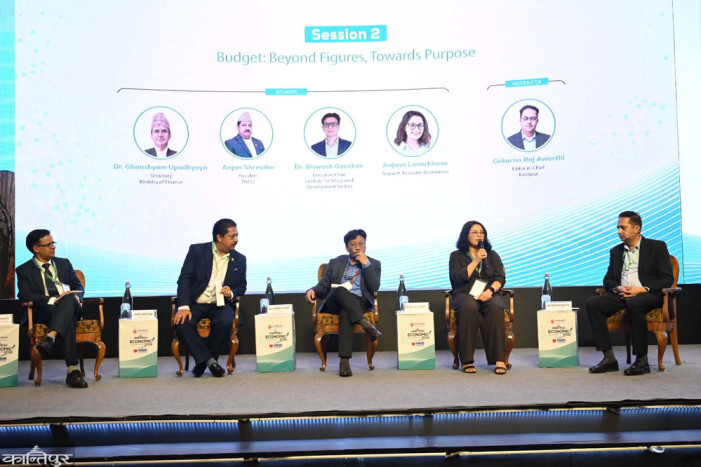
Second Session: The search for meaning, not numbers, in the budget has begun. In the session, Finance Ministry Secretary Ghanshyam Upadhyay, Federation of Nepalese Chambers of Commerce and Industry President Anjan Shrestha, IIDS Executive Director Biswas Gauchan, and economist Anjana Lamichhane are debating with Kantipur Daily Editor-in-Chief Gokarna Awasthi.
Hitesh Golchha, Chairman and Director of Diwakar Golchha Organization, said that the government's policy is not focused on large industries. He said that policies are being implemented to focus on small and medium industries during the Kantipur Economic Summit. He said that land is the main bottleneck of large industries. Stating that the problems and needs of large industries are different, he said that the government's policy should also be different. He said that if those problems can be addressed, one large industry can help many small industries flourish.
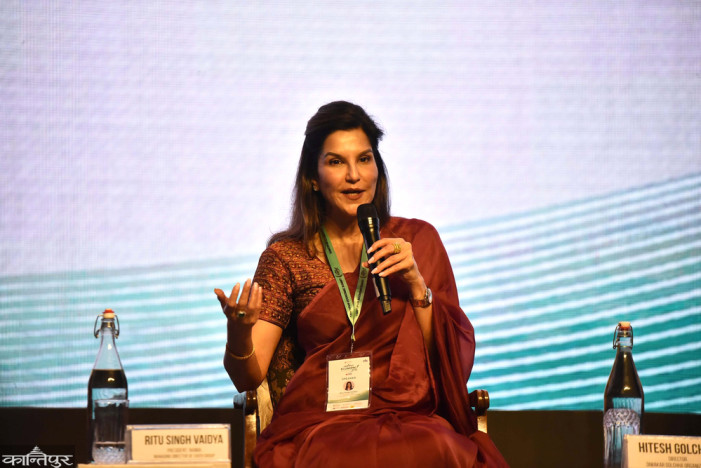
Ritsingh Vaidya, President of NAIMA and Managing Director of Voith Group, has said that there is a practical problem in mentioning the mandatory Maximum Retail Price (MRP) at the customs point.
In the first session of Kantipur Economic Summit-2026, 'A Permanent Policy to Accelerate the Private Sector', Vaidya said, 'No one can import goods without imposing the Maximum Retail Price (MRP). We have a practical problem. It is not that we do not want it. Let's fix the process.'
Businessmen had been protesting, saying that the system of importers affixing MRP labels on each unit at the customs point was not practical. They argued that the cost and time would increase excessively if the goods were unloaded and the price was affixed to each packet, and the customs process would be unorganized.
Hitesh Golchha, Chairman and Director of Diwakar Golchha Organization, also said that the industrial sector in Nepal has not flourished due to political instability. ‘If policy stability is needed in business, it takes 4/5 years for large industries with an investment of 2.3 billion rupees to come into operation, stabilize, and become a brand in the market,’ he said, ‘However, if the policy changes 5 times in 5 years in Nepal, this is impossible. Where can we invest our money safely so that the business can operate.’ He also recalled that even with the same government, the policy changes 2/3 times.&nsbsp;
Ritsingh Vaidya, President of NAIMA and Managing Director of Voith Group, said that the problem is that policies change with each change of government.
In the first session of the Kantipur Economic Summit-2026, 'Stable policies to accelerate the private sector', she said that instability in policies is the main problem. 'No matter which party comes, a national consensus has to be reached. No matter which government comes, a stable policy should be adopted to achieve economic progress,' she said.
Surya Nepal Pvt. Ltd. Vice President Ravi KC has said that investment has not been able to enter the country due to the land policy. In the first session of the Kantipur Economic Summit-2026, 'Permanent Policy to Accelerate the Private Sector', KC says that the same limit has been imposed on ordinary individuals and industrialists.
He says, 'There is a limit of 11 bighas for an individual. Even industries investing Rs 200/300 crore have been set at 11 bighas. ' He further said, 'Whether it is direct foreign investment or bringing large investment and taking 2/3 bighas, they will not come to invest. We do not care if small investments come. Our policy is not right.'
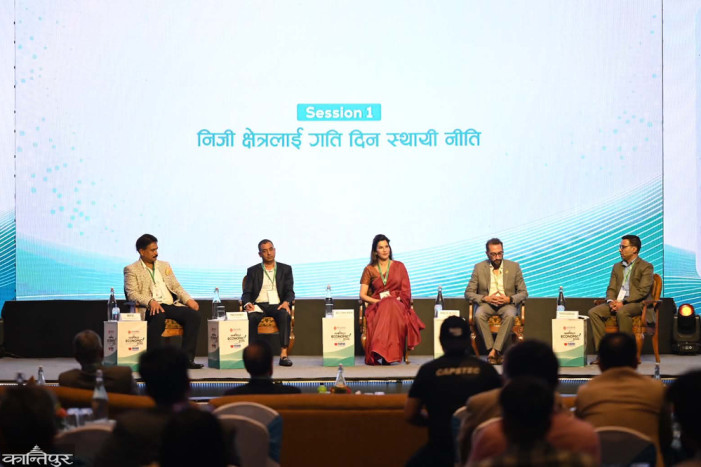
First session: A permanent policy has been launched to boost the private sector. In the session, Kantipur journalist Yagya Banjade is debating with entrepreneurs Ravi KC, Hemraj Dhakal, Ritsingh Vaidya, and Hitesh Golchha.
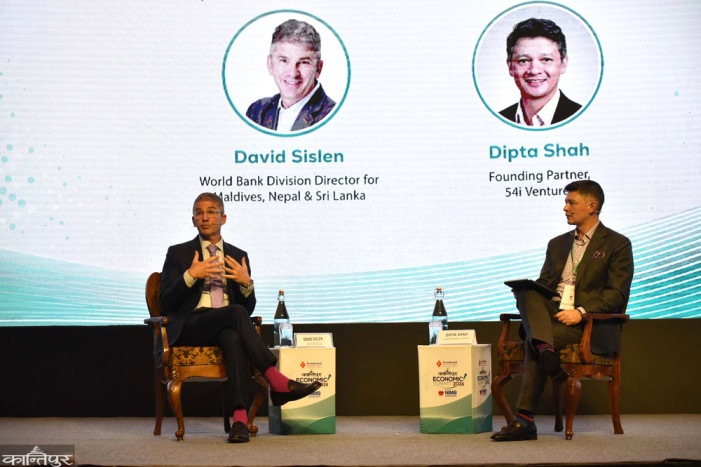
David Sislen, the World Bank's country director for Nepal, Maldives and Sri Lanka, said he believes the new government is clear about where job creation will come from.
In a conversation with Deept Shah, founder of 541 Ventures, Director Sislen said that Nepal can become a powerhouse in the agricultural sector. He said that in the future, the service sector can also be promoted by selling services such as information and technology or tourism.
David Sislen, World Bank Country Director for Nepal, Maldives and Sri Lanka, says: Kathmandu has something that no other city on the continent has. The environment also plays a supporting role in this. I hope Kathmandu can do something special in the field of information technology.
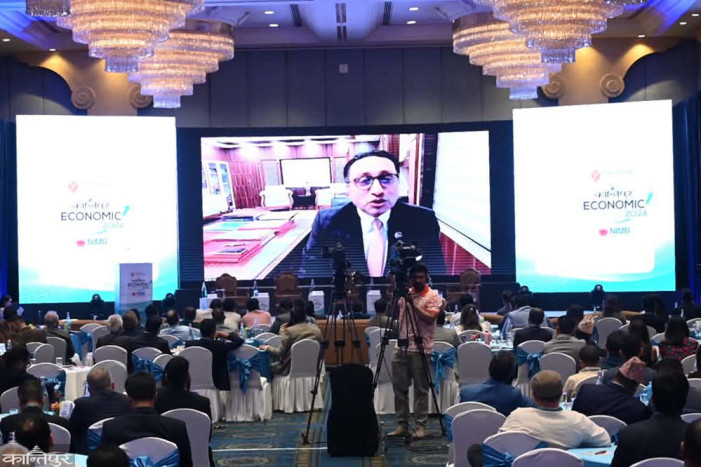
David Sislen, the World Bank's country director for Nepal, Maldives and Sri Lanka, has said that about 2,000 Nepalis go abroad for work every day. He said this at the opening fireside conversation of the Kantipur Economic Summit on Wednesday that the number of people going abroad is increasing due to the lack of jobs. 541 Ventures founder Deept Shah is in conversation with Director Sislen.
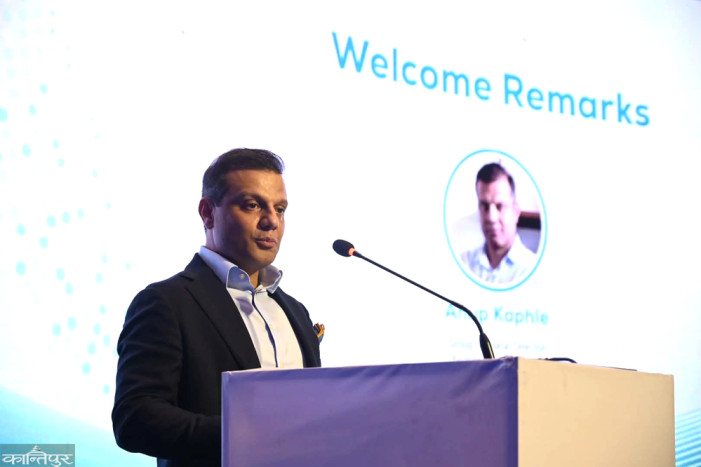
Kantipur Economic Summit 2026 has begun. Kantipur Media Group Editorial Director Anup Kafle delivered the inaugural address. He said that the Rashtriya Swayamsevak Sangh (RSS) government is showing signs of improvement in public service delivery and while that is commendable, good governance alone is not enough to attract private investment. He pointed out that structural reforms are needed and investors are looking for a reliable and stable policy environment. He said that the private sector is trying to move forward as a partner in economic growth with the government.