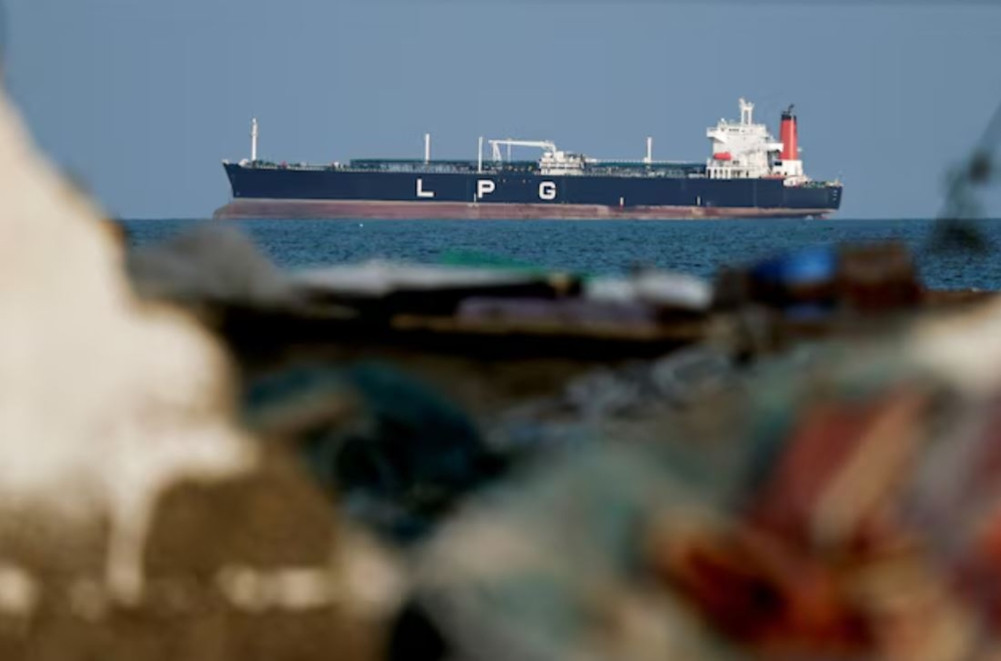
The UNDP has warned that poverty will increase, remittances will decrease, food and fertilizer costs will increase, and economic growth will slow.
We use Google Cloud Translation Services. Google requires we provide the following disclaimer relating to use of this service:
This service may contain translations powered by Google. Google disclaims all warranties related to the translations, expressed or implied, including any warranties of accuracy, reliability, and any implied warranties of merchantability, fitness for a particular purpose, and noninfringement.
The United Nations Development Programme (UNDP) has said that Nepal's achievements in the Human Development Index (HDI) are at risk due to the ongoing tensions in West Asia. Nepal is at risk of conflict in West Asia due to its high dependence on international supply chains, remittance flows and imported materials, according to a study report on the impact of conflicts in West Asia released by the UNDP last month.
The preliminary assessment report titled 'Military Escalation in the Middle East: Human Development Impacts Across Asia and the Pacific' published in mid-April warned that Nepal and Pakistan would suffer the most in terms of human development if the conflict that has been going on since 16 Falgun is prolonged.
The report also stated that as the economies of the Gulf region weaken due to the war, remittance income will decrease, which could reduce the purchasing power of households and put further pressure on food security.
The war has also disrupted the transportation of sulfur, which is needed for phosphate fertilizers widely used in agriculture. The report also states that the war will affect the production of rice, which is a major contributor to Nepal's agricultural sector, due to the increase in the price of sulfur, a co-product of petroleum products.
'The risk of employment in Nepal is closely linked to foreign labor migration.' About 80 percent of migrant workers go to the Gulf countries and Malaysia,' the report says. 'If the blockade continues, the restrictions on labor mobility could reduce the employment and income of many families dependent on remittances.'
The impact on remittances and the agricultural sector will reduce the growth rate of gross domestic product (GDP), which will affect the income-related indicators of the HDI. The report also states that health and education indicators will be affected in the directly affected countries. The report is based on the achievements in human development from 2013 to 2023. In the absence of a strong policy framework to counter external shocks, the impact of the Gulf conflict is expected to be greater in South Asia, while East and Southeast Asia are expected to face relatively less shocks. The report uses three scenarios to assess the regional impact of the conflict. First, after 28 days of war, the situation will return to normal. Second, it will take four months to return to normal after the initial shock. And, third, if the war is prolonged, it is estimated that it will take up to eight months to return to normal. Economist Pushkar Bajracharya analyzes that if the conflict is prolonged, it will affect inflation, economic growth, trade and tourism, and reduce the consumption capacity of households.
 ‘The economic growth rate may fall to about 3 percent, which is lower than Nepal’s 70-year average growth rate of 4 percent,’ Bajracharya said. He warns that economic growth will slow down and poverty will increase in the next two years. ‘A large part of the population is already below the poverty line.’ A single shock can push more people below the poverty line,’ Bajracharya said. He estimates that 25 to 33 percent of the population will be pushed below the poverty line if the conflict continues. The
report mentions that countries like Nepal, India, Pakistan, Bangladesh and the Philippines are at the highest risk. The report concludes that a decrease in remittances will weaken family income and reduce purchasing power. According to Nepal Rastra Bank, about 40 percent of Nepal’s total remittances come from Gulf countries. In the first eight months of the current fiscal year, Nepal has received 188 billion rupees in remittances. In the fiscal year 2081/82, Nepal received a total of 170 billion rupees in remittances, of which 67.3 billion rupees came from Gulf countries. The Gulf region accounts for about 39 percent of remittance inflows.
About 1.9 million Nepali workers are employed in Qatar, Saudi Arabia, Bahrain, Kuwait, the United Arab Emirates and Oman in West Asia. Of the approximately 700,000 Nepalis who go abroad for employment each year, about 450,000 end up in the Gulf countries. The report states that South Asia is particularly vulnerable due to its large population, high expenditure on food and increased prices of remittances and fuel due to the Gulf War. UNDP estimates that the Gulf War could cost the Asia-Pacific region between $97 billion and $299 billion in output, equivalent to 0.3 to 0.8 percent of gross domestic product.
The report states that the Gulf War had a major impact on energy supply. The report states that 33 of the 36 countries studied for its impact on the war are at high risk of rising fossil fuel prices. More than 80 percent of crude oil and liquefied natural gas transported through the Strait of Hormuz are supplied to Asian markets.
Rising fuel prices are putting the poor and near-poor households under greater pressure as the cost of living increases, while rising food and fertilizer prices ahead of the main planting season risk further increasing food insecurity, particularly in South Asia and the Pacific, the UNDP concluded. The report said that employment, the informal sector and micro, small and medium enterprises will be most affected. This will leave women, migrants and low-income households most at risk.