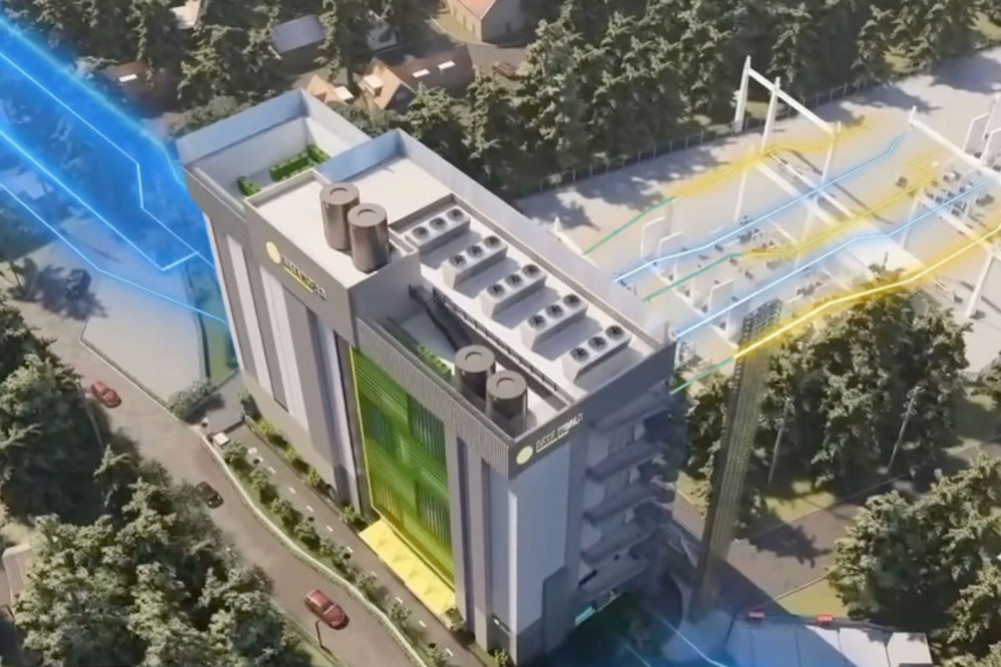
Amid the ambition to make Nepal a 'data hub', the lack of distinction between genuine foreign investment and technical partnerships is creating confusion in the debate between the general public and the technology sector.
We use Google Cloud Translation Services. Google requires we provide the following disclaimer relating to use of this service:
This service may contain translations powered by Google. Google disclaims all warranties related to the translations, expressed or implied, including any warranties of accuracy, reliability, and any implied warranties of merchantability, fitness for a particular purpose, and noninfringement.
Internet service provider Worldlink Communications has said that it has no agreement with Meta to establish a data center in Nepal. If such a large foreign investment is coming, it will announce it by holding a formal program. “No agreement or NDA (non-disclosure agreement) has been signed between Meta and us so far,” said Worldlink CEO Keshav Nepal. Last week, Nepal Khabar reported on the investment of around Rs 5 billion.
The issue is constantly in the news as the newly formed Rashtriya Swayamsevak Sangh (RSS) has prioritized the data center and information technology sector in its manifesto and vision for the initial work. The lack of distinction between real foreign investment and technical partnership amid the ambition to make Nepal a data hub is creating confusion in the debate between the general public and the technology sector.
Nepal said that Worldlink is operating a tier-three level data center through its fully invested company ‘Data World’. He said that he is optimistic about international companies hosting in Nepal in the future. He said that Nepal has potential for data centers due to its cold climate and availability of hydropower, and this can bring the country to the world's radar. 'There is a geographical challenge for Nepal as it is a bit far from the submarine cable,' he said, 'but if Nepal can build a strong infrastructure that does not hinder data connectivity, Nepal can become a data center hub.'
Bichuten Data Vault, on the other hand, organized an event on Thursday and announced that it will develop a data center in collaboration with Google Cloud, AMD, Micron Technology and VVDN. NepalKhabar wrote the news under the headline 'Google's entry into Nepal in strategic partnership with Bichuten' . Bichuten's press release mentions that it will form strategic partnerships with world-renowned companies like VVDN, Google Cloud, MAD and Micron for technology and expertise. 'Google is not going to make financial investments, but to collaborate on technology or services,' said an expert familiar with the data center. Bichuten, formed under the leadership of Naveen Agarwal and Meen Agarwal of Fair Group, Anuj Kiyal of Kiyal Group, along with Vishal Kumar Jatia and Sharad Goyal, has announced that it will build a Tier-4 level hyperscale data center. It aims to ensure 99.995 percent uptime and less than 26 minutes of downtime per year. The company aims to operate the service from Kathmandu and Birgunj with a capacity of 240 kilowatts in the initial phase and expand the capacity to 5 megawatts by 2030. The data center under construction in Chobhar is currently in the final stages and will be operational in the next three months, the company said.
‘This data center will have 100 to 200 racks,’ said Naveen Agrawal of Bichuten in a conversation with the online technology portal Tekpana, ‘Since there will be a primary and backup data center, the data of Nepalis will be completely safe.’ He said that Bichuten’s main goal is not only to provide a data center but also to provide an environment for students and IT manpower to learn skills with world-class technology and partners and an AI Center of Excellence.
The entire infrastructure of this project is being built with Bichuten’s own investment. Experts say that this process is like Ncell using Oracle’s private cloud solution. They pointed out that the investment made in Ncell’s infrastructure cannot be called Oracle’s direct investment. “Nepali companies are partnering with international technology firms to acquire services, and this is being promoted as foreign direct investment here,” said Deept Shah, a digital economy expert. “It can be argued that there is an aspect of technology transfer, but the capital investment appears to be domestic, not foreign. ”
While enthusiastic about Nepal’s ambitions to expand its digital infrastructure, expert Shah suggests being cautious about facts and evidence rather than following rumors. “To establish the long-term commercial potential of hyperscalers in Nepal, a comparative pre-feasibility study of demand and costs with other places is necessary,” he said. “It would be appropriate to move the debate forward with a clear description of exactly what such infrastructure is needed for.”
He pointed out that since large data centers used for AI programs such as language model training consume a lot of electricity, an assessment is also needed on whether Nepal’s existing electricity capacity can support such ambitions. "The country's hydropower potential is real, but potential and availability are not the same thing," Shah said. "Nepal still has to import electricity from India during the winter."