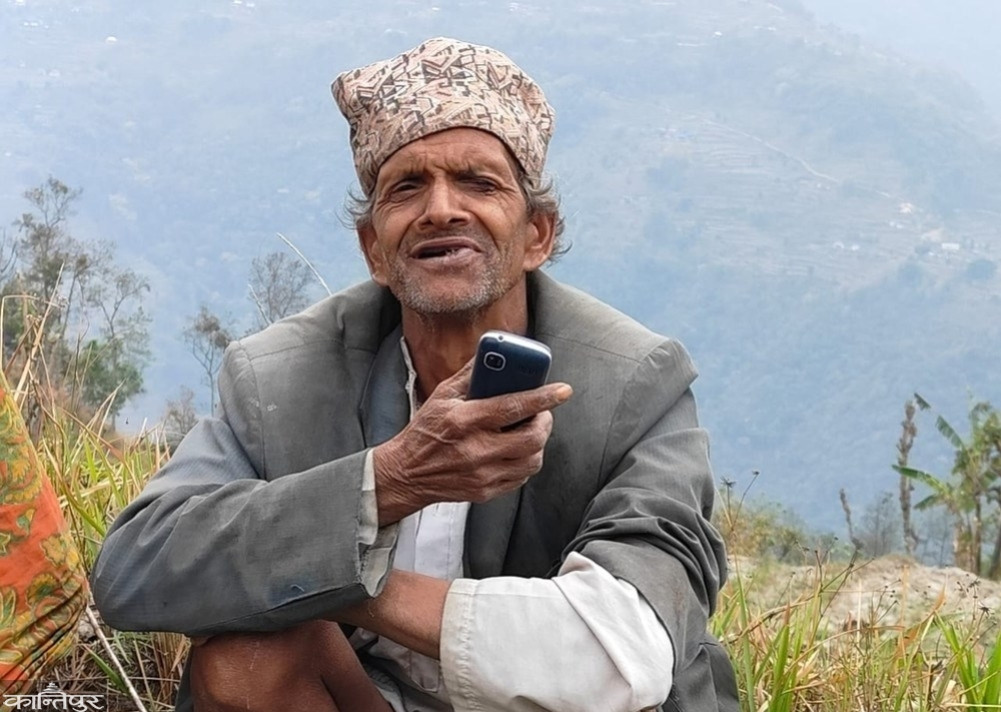
In India, a SIM card can be used for a whole year for just 10 rupees, while in Nepal, the low-income group is burdened by 'validity'.
We use Google Cloud Translation Services. Google requires we provide the following disclaimer relating to use of this service:
This service may contain translations powered by Google. Google disclaims all warranties related to the translations, expressed or implied, including any warranties of accuracy, reliability, and any implied warranties of merchantability, fitness for a particular purpose, and noninfringement.
Ramkumari Rimal, a 63-year-old farmer from Dhading, has not been able to make calls even though she has a balance of Rs 102 on her mobile phone. She said that her daughter, who lives in Chitwan, transferred Rs 200 two to three months ago and the remaining amount is now 'stuck'.
In particular, when she calls her phone, the 'validity' or expiration date of the recharge has expired, and she gets a message saying 'incoming calls are prohibited'. 'There is money in the mobile phone but no date, even when the call comes, it does not come, even when it goes,' Ramkumari complains, 'Even if I have so much money, it says call is prohibited, I cannot use my own property.'
This problem is not only for Ramkumari, but also for many consumers in the low-income group, senior citizens and rural areas of Nepal. Recently, telecom companies have been adopting business strategies such as 'subscription model' or mandatory 'minimum recharge', where customers have to pay a fixed fee to become customers. For a section of society, even a regular recharge of Rs 50 or Rs 100 per month is a financial burden.
‘I recharge Rs 100/50 per month. But when I am not working, I don’t have to call anyone for 10/15 days,’ said Manoj Singh Nepali, who has been working as a porter in Mahaboddha. ‘Sometimes, even though there is balance in the mobile, the phone gets switched off after the expiry of the date. But after recharging Rs 50, it starts working again.’
According to the latest data from the regulatory Nepal Telecommunication Authority, there are currently around 2.744 million 2G users in Nepal. The share of ‘bar phones’ in mobile phone imports is still around 23 percent. The data shows that around 9.4 percent of the total population carries mobile phones only for voice calls and SMS. Telecom companies have not introduced any special concessions or packages targeting such basic users who do not have access to smartphones due to financial reasons or who want the simplicity of technology.
In neighboring India, the Telecom Regulatory Authority of India (TRAI) has issued a new guideline last year to ensure that 150 million low-income and economically weak 2G users are not deprived of telecommunication services. According to this, operators have been required to provide 90 days of validity for a recharge of Rs 20 and 365 days of validity for a recharge of Rs 10 through a special voucher. Due to this, low-income workers and the elderly have been able to keep their SIMs active and receive essential banking alerts or emergency calls even without recharging a large amount.
In Nepal too, SIM cards have become not only a means of communication, but also a person's 'permanent address' and 'identity'. Since mobile numbers are linked to bank accounts, land revenue, and government documents, some believe that companies can take away a person's identity and rights if they deactivate the SIM on the pretext of lack of money or expiry of 'validity'. Indian MP Raghav Chadha recently raised the issue of ‘balance validity’ in Parliament, arguing that SIM cards should be accepted as lifelong identity and that ‘incoming’ calls should not be cut off just because they are not recharged.
In Nepal, the Telecommunications Authority does not have any clear guidelines or guidelines on increasing ‘validity’ for low-income consumers. Operators decide their own ‘validity’ period based on international practice and market competition, says Surya Prasad Lamichhane, Deputy Director of the Authority. ‘Although there has been talk of providing concessions to low-income people using rural telecommunications funds like RTDF, it has not been implemented,’ he said.
Telecom companies argue that a subscription model or fixed ‘validity’ is necessary as revenues are declining and it costs a lot to operate the network and keep the SIM active. According to Ncell sources, it is practical for customers to pay a fixed fee to sustain the companies and invest in technology. ‘Telecom companies have to spend Rs 6 to 8 billion annually in capital to keep their networks active 24 hours a day,’ says an Ncell source. ‘The network operating costs do not decrease whether customers reduce their calls or not. To sustain the company, a fixed fee must be charged from the customers.’
Even if there is balance in the mobile, if the ‘validity’ (date) expires, the customer must recharge, said Nepal Telecom spokesperson Rabindra Manandhar. ‘The ‘validity’ is determined by making scientific calculations based on the company’s investment, operating expenses, and revenue,’ he said. In Nepal Telecom, as soon as the ‘validity’ expires, the SIM immediately goes into one-way mode (calls and SMS come in but not out). This situation remains for 30 days after the ‘validity’ expires. After 30 days after the ‘validity’ expires, the SIM is blocked (barred) in both directions.
In Ncell, outgoing calls are blocked for 14 days after the main balance expires. If you do not recharge even after that, both incoming and external services are blocked. ‘To increase the main balance, prepaid users have to recharge their SIM,’ says Ncell’s website, ‘different time limits have been provided for different recharge amounts.’
The minimum ‘validity’ of the main balance in Nepal Telecom is 7 days for a recharge of Rs 20, while it is valid for 690 days for a recharge of Rs 1,000. In Ncell, ‘validity’ is given for seven days for a recharge of Rs 50 and 730 days for a recharge of Rs 1,000.
Even if there is balance in the mobile, the provision of service inactivity or ‘validity’ after a certain period of time is ‘international practice’ and a natural process, says telecommunications expert Bheshraj Kandel. But to ensure the right to communication, he pointed out that it is equally necessary for the government and service providers to introduce concessional plans targeting low-income groups. ‘In countries like the US, there is a rule that the phones of the elderly and disabled cannot be disconnected,’ he said. ‘This group is allowed to make a certain number of free calls per month, but if that number is exceeded, double charges are charged. While this has provided convenience to the target group, double charging has been adopted to prevent misuse of the discount facility.’
Service providers argue that it is challenging to create special packages, saying that it is not easy to identify poor or low-income customers in Nepal. ‘The government has not been able to identify the poor, how can the operator do it?’ A representative of a service provider said, ‘It would be very expensive for us to design separately which customer has a low income and how much ‘validity’ to give him.’
Telecom expert Kandel suggests that customers can be considered low-income by considering them as a category based on criteria such as ‘not making more than 30 calls per month’ and arranging separate rules or long ‘validity’ for them. ‘If someone does not make more than 30 calls per month throughout the year, they can be given concessions,’ he said. ‘Since telecom companies are commercial organizations, they do not provide such concessions themselves. The government should formulate a clear policy and specify the basis for identifying low-income people.’
Service providers had previously been operating 28-day packages as a strategy to quickly recharge users. In that, customers had to buy packages 13 times a year or pay for 13 months. After the formation of the Rashtriya Swayamsevak Sangh (RSS) government, the Ministry of Communications and Information Technology directed that the package period be made mandatory for 30 days through a 10-point corrective action plan, and now service providers have improved it. However, experts believe that imposing a fixed-term subscription model on all customers under the pretext of declining business is unjustified and risks isolating low-income users from communication facilities.
About 20.27 percent of the population in Nepal is below the poverty line. According to the 'Micro-Area Estimate of Poverty-2023' report released by the National Statistics Office, 18.34 percent of the population in urban areas and 24.66 percent in rural areas are below the poverty line. The government has placed a person who cannot spend Rs 72,908 per person annually (Rs 200 per month) below the poverty line.