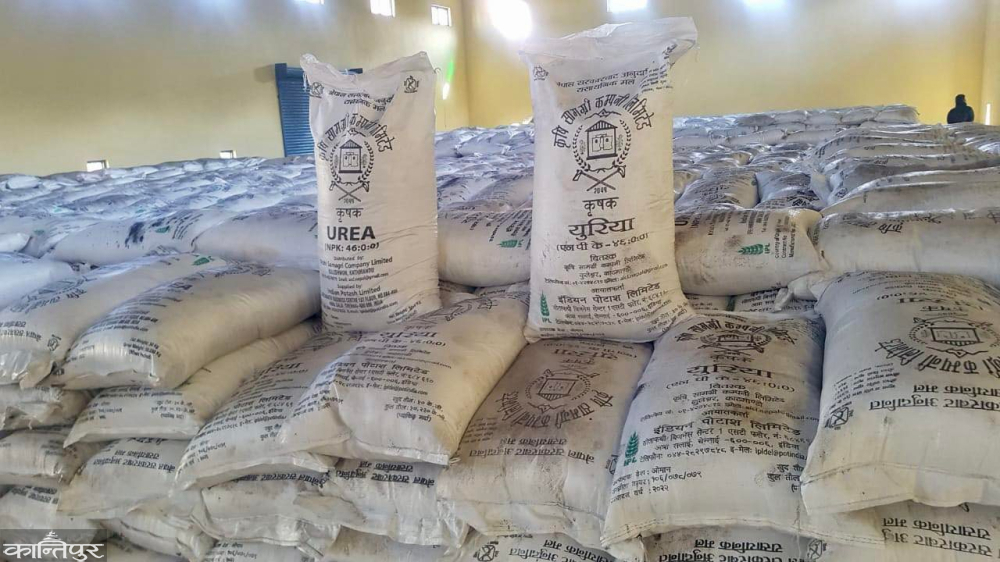
In-principle approval has been given to the Agricultural Materials Company Limited to purchase 60,000 tons of urea and 20,000 tons of DAP fertilizer from India through G2G.
We use Google Cloud Translation Services. Google requires we provide the following disclaimer relating to use of this service:
This service may contain translations powered by Google. Google disclaims all warranties related to the translations, expressed or implied, including any warranties of accuracy, reliability, and any implied warranties of merchantability, fitness for a particular purpose, and noninfringement.
The government is set to purchase 80,000 tons of chemical fertilizers through government-to-government (G2G) channels to address the pressure on chemical fertilizer imports due to disruptions in global supply due to the ongoing conflict in West Asia and rising prices. The cabinet meeting held on Monday decided to give in-principle approval to the Agricultural Materials Company Limited to purchase chemical fertilizers.
The government will purchase 60,000 tons of urea and 20,000 tons of diammonium phosphate (DAP) fertilizer in a one-time transaction as per the G2G understanding framework of 2022. The government had initially requested for the purchase of 150,000 tons of fertilizer. However, since the government has a budget sufficient to import 80,000 tons of fertilizer, the purchase is being made accordingly.
Joint Secretary at the Ministry of Agriculture and Livestock Development Ramkrishna Shrestha said that the import process will be initiated as soon as the written decision of the cabinet is received. He said that the agricultural materials company will invite bids for the purchase after all the procedures are completed. Shrestha, who is also the chairman of the Agricultural Materials Company Limited, said that the approval was sought from the Council of Ministers after receiving a positive response from the Indian government company, Rastriya Chemicals and Fertilizers Limited. “We expect the fertilizer to be imported by mid-August. It will be suitable for the important time of paddy cultivation,” he said.
The government has allocated Rs 28.82 billion to import chemical fertilizers for the current fiscal year. Initially, the target was to purchase 550,000 tons of fertilizer. However, due to geopolitical tensions and global price increases, the purchasing capacity has been reduced to 440,000 tons. Currently, the Agricultural Materials Company Limited has 171,000 tons of fertilizer in stock. Although an agreement was signed to import 94,450 tons, the possibility of cancellation is increasing as the supplier is unable to supply fertilizer. Stakeholders say that since 250,000 tons of fertilizer are required for the upcoming paddy sowing season, there will be additional pressure on farmers and an impact on production.
‘It may take at least 225 days to invite new bids, so there may be a shortage of fertilizer,’ said Shrestha, ‘We have urged suppliers with whom we have agreements to supply fertilizer on time. But we are not in a situation where we are completely dependent.’ Experts say that suppliers often back out of contracts when there is excessive volatility in prices. When prices rise sharply, they consider it advantageous to let the ‘performance bond’ (deposit amount) be forfeited instead of delivering the goods at a loss. In 2019-20, when fertilizer prices were high, 7 out of 10 suppliers in Nepal were unable to supply fertilizer on time. This also exposed the weaknesses of the country’s procurement system.
The government has also been under pressure to ensure fertilizer supply as the rice planting season in the country begins from Ashar. Nepal is dependent on Gulf countries for fertilizer imports. Although Russia is seen as an alternative, the process has become complicated as Nepali banks are hesitant to open letters of credit (LC) with Russian suppliers.
Rice is the main food crop in Nepal, accounting for 67 percent of total food consumption and more than 50 percent of calories. Rice, which is consumed at 137.5 kg per capita annually, is considered important not only for food security but also as a cheap source as it contains 23 percent of the total protein required by the body. Experts say that the shortage of chemical fertilizers will lead to a decline in agricultural production, an increase in the price of consumer goods, a decrease in farmers' income, and an increase in the country's food import expenditure, which will increase the country's foreign trade deficit and increase its dependence on imports.
Currently, subsidized urea is being distributed through cooperatives at Rs 18 per kg and DAP at Rs 46 per kg. This shows that 92 percent of urea and 80 percent of DAP should be subsidized. But the market price of urea has reached Rs 160 per kg and DAP at Rs 162 per kg.
‘At the current world market price, Rs 80 billion is required to provide subsidy alone, so providing full subsidy is beyond the government’s capacity,’ Shrestha warned, adding, ‘The increasing subsidy burden will only increase the pressure on public finances.’ The shortage of chemical fertilizers is a long-term problem due to various reasons including low buffer stocks, weak distribution system, policy shortcomings and dependence on the world market. These problems are affecting thousands of farmers who are facing climate risks (such as drought and floods).
With the aim of ensuring fertilizer supply, Nepal and India signed a five-year G2G agreement on fertilizer supply on February 28, 2022. The agreement provided for ensuring 30 percent of Nepal’s total annual demand. The agreement was to increase to 100,000 tons in the first year and 210,000 tons in the fifth year. Although the agreement is only valid until March 31, 2026, efforts are being made to renew it, government officials say. ‘The G2G framework will be valid until 2026. We have already sent a proposal to extend the time,' Shrestha said, 'The Indian side has kept it under consideration.' The situation in Nepal's agricultural sector this year appears uncertain. Experts have pointed out various risks including low rainfall, fertilizer shortage, rising fuel prices, and restrictions on cross-border trade.
Meteorologists estimate that this year's monsoon may be below average after three consecutive years of above-average rainfall. Since the monsoon supplies about 80 percent of the water required for agriculture, its deficiency can have a major impact. Low rainfall and lack of chemical fertilizers are seen to reduce production, weaken rural purchasing power, and increase food prices and import costs. It is also seen that it may affect the country's overall economic growth as there is a possibility of reduced river flow, reduced electricity generation, and an impact on groundwater recharge.
The World Bank has warned that access to fertilizers will reach its lowest level since 2022. Due to this, Kisa will reduce its purchasing capacity for fertilizers. The World Food Programme has warned that prolonged global conflict could push an additional 45 million people into acute food insecurity, putting global and national food systems at risk.

