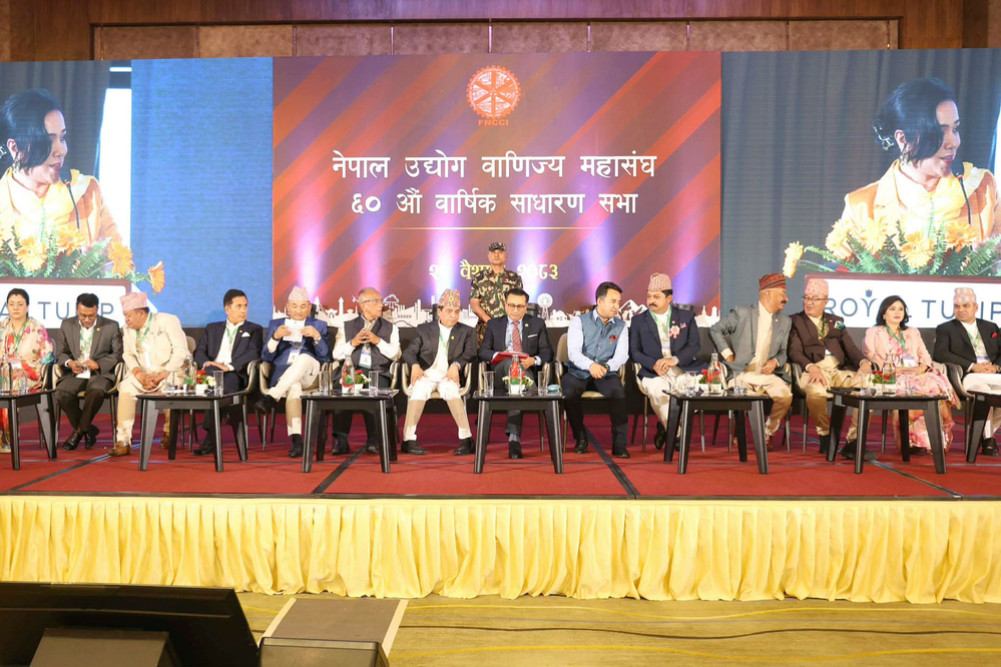
It is claimed that the expected economic progress will not be possible unless concrete reforms are made to reduce excessive regulation, increase investment, and provide employment to the youth in the country.
We use Google Cloud Translation Services. Google requires we provide the following disclaimer relating to use of this service:
This service may contain translations powered by Google. Google disclaims all warranties related to the translations, expressed or implied, including any warranties of accuracy, reliability, and any implied warranties of merchantability, fitness for a particular purpose, and noninfringement.
Strong collaboration between the private sector and the government, policy stability, an investment-friendly environment and job creation are essential for accelerating Nepal's economic development, stakeholders have said.
At the inaugural session of the 60th Annual General Meeting of the Federation of Nepalese Chambers of Commerce and Industry on Monday, they said that the expected economic progress will not be possible unless concrete reforms are made to reduce excessive regulation, increase investment and provide employment to the youth in the country by utilizing the opportunity of a stable government.
The Federation's President Chandra Prasad Dhakal said that the time has come to accelerate the country's economic development through the empowerment of the private sector. The time has come to accelerate the country's economic development through the empowerment of the private sector, said the Federation's President Chandra Prasad Dhakal. He also thanked the private sector for having high expectations from the government with a two-thirds majority and for the government's first cabinet meeting's decision to immediately implement the Private Sector Promotion and Protection Strategy (PSPP). He said that the strategy will provide not only physical but also policy security to the private sector.
Dhakal, citing that the private sector has been affected in past movements, claimed that such a strategy would boost the morale of businessmen. He stressed that the country has an unprecedented opportunity and that the presence of a stable government should be utilized for economic development and policy stability. He said that if Nepal gets duty-free market access in developed countries, its products can be made competitive in the global market.
Chairman Dhakal clarified that the capacity of both the government and the private sector is limited to provide employment to the approximately 500,000 youth who enter the labor market every year. As approximately 700,000 youth are still migrating abroad in search of employment, he is emphasizing on creating internal employment. He said that the average economic growth rate in Nepal is low and foreign investment has not come as expected.
Chairman Dhakal said that the possibility of post-COVID-19 reform has been weakened due to policy decisions and that necessary reforms are needed to make the market dynamic. He said that the crisis in West Asia, the increase in fuel prices and the impact on the tourism sector have created additional challenges in the economy. He said that the main need now is to build a self-reliant economy and create jobs with high wages. He stressed that the private sector needs a safe and respected environment as 86 percent of employment comes from the private sector. Chairman Dhakal said that excessive regulation has become an obstacle in creating an investment-friendly environment and that all government bodies should prioritize investment incentives. He said that income-generating opportunities should be expanded for development and capital investment is the first condition for that. He believes that good governance is indispensable to attract foreign investment and that maximum use should be made of technology. Chairman Dhakal also urged the government to facilitate service delivery from business registration through the Nagarik app. Stressing that the policies and programs and budget for the upcoming fiscal year should be made the basis for reform, Dhakal said that the private sector should now take the lead in economic reform. He said that cooperation between the federal, provincial and local levels should be increased. Finance Minister Swarnim Wagle said that the government understands the importance of the private sector and that it will play an equal role in fulfilling the government's goals. He said that the role of the private sector has been placed at the forefront in the priorities mentioned in the Rashtriya Swayamsevak Sangh (RSS) election manifesto and after coming to power. He said that a hundred billion dollar economy has been envisioned in the next 7 years. ‘It is impossible to achieve the goal of a hundred billion dollar economy without the support of the private sector,’ he said. Finance Minister Wagle said that the private sector is very important in creating jobs, expanding the size of the economy and taking it to the next level.
Wagle also said that the current government will chart a new path instead of following the old path. It has also committed to reducing the burden of all taxes, along with ensuring that revenue will not decrease
he said.
, the expenditure is even less than that. While the GDP is currently at Rs 6.6 trillion, Finance Minister Wagle said that an economy of Rs 7.4 trillion is envisaged in the fiscal year 83/84. ‘In the current fiscal year, we have estimated that we will spend only around Rs 1.6 trillion, while capital expenditure is not more than Rs 2/3 trillion,’ he said, ‘Compulsory obligations are various parts of current expenditure.’ ‘It is about 19-20 trillion, including domestic and foreign debt. If the government does not spend it, it is investable capital that can be spent by the private sector,’ Wagle said, ‘The taxes paid by the public will be thrown back into the economy through public expenditure.’ He said that even though the budget allocates 25 to 30 percent of the gross domestic product (GDP)
Finance Minister Wagle says that the private sector will be allowed to spread its wings but the regulatory body will remain strong. He also comments that in the past years, the regulatory body has been captured. ‘The private sector should be allowed to spread its wings, but a strong state will be there,’ he said, ‘We believe that the regulatory body should be healthy and capable. In the past few years, these regulatory bodies were captured. It was distorting the private sector. We were forced to only watch it with bated breath.’
Wagle also said that the current government will not follow the old path and chart a new path. He also promised to reduce the burden of all taxes, along with a guarantee that revenue will not decrease.
If the government creates a proper environment, the private sector will run 82 percent of the economy, said Anjan Shrestha, senior vice president of the federation. He said that with each change of government, policies, priorities and mechanisms change, and even good policies have not had a positive impact due to insufficient time for implementation.
‘The economy is paying the long-term price of decisions made for short-term gains today,’ Shrestha said, ‘But now the situation should be different. There is an increased possibility of a stable government providing policy stability, and the private sector should also be ready to fulfill its responsibility. If the government creates a proper environment, it is up to us, the private sector, to run 82 percent of the economy.’