The government plans to return the savings of around Rs 500,000 held by troubled cooperatives within a year.
We use Google Cloud Translation Services. Google requires we provide the following disclaimer relating to use of this service:
This service may contain translations powered by Google. Google disclaims all warranties related to the translations, expressed or implied, including any warranties of accuracy, reliability, and any implied warranties of merchantability, fitness for a particular purpose, and noninfringement.
Cooperative victims will get their savings back from the first week of Jestha. The troubled cooperative management committee is going to return the money to the victims from the amount collected in the revolving fund.
A revolving fund was established last week by a decision of the Council of Ministers for the purpose of returning the money of savers of troubled cooperatives. The Ministry of Finance has already released Rs 250 million to the fund on behalf of the government. This is the amount allocated for savers of cooperatives under the current heading in the budget of the current fiscal year.
About Rs 350 million has been recovered from the debtors of cooperatives in the revolving fund operated by the troubled cooperative management committee. By doing both of these, the money of small and large savers will be returned gradually from the approximately Rs 600 million accumulated in the revolving fund so far, informed the committee chairman Dilliraj Acharya.
At a press conference held on Tuesday, Minister for Land Management, Cooperatives and Poverty Alleviation Pratibha Rawal said that returning the money of the victim savers of cooperatives is the government's priority. ‘The government is making every effort to recover the loans. We have discussed with various bodies including the National Bank, the Attorney General’s Office, and others. We are working on it because the more loans we can recover, the more savings we can return,’ she said. ‘We have now called for information to repay the loans. If we do not repay the loans, we will make their names public through the website.’
Minister Rawal said that people who do not repay loans taken from problematic cooperatives will be gradually banned from public service. ‘The loans will not be recovered that easily, but the government is determined to recover the loans at any cost. The government may have to be ruthless for this,’ she said.
The government has removed the old office bearers of the problematic cooperative management committee and appointed new ones last week. The new committee started work on April 9. According to the committee, 20 cooperatives under the federal government are problematic. About 76,444 of their savers will have to get their savings back worth Rs 45.6 billion.
Committee Chairman Acharya informed that the committee is continuously active in activities such as debt recovery, savings reconciliation, internal work restructuring, discussions with various stakeholders, and action plan formulation. He said that the committee's action plan will be formulated to inform savers about the committee's work plan and working style and to draw the attention of debtors and warn them about loan repayment.
The committee has also stated that the time for re-claiming from the victim savers who have been left behind will be opened in the first week of next Shrawan. 'A scientific and fair procedure will be formulated for savings reconciliation,' the committee said in a statement. 'If the amount allocated by the Nepal government to the revolving fund is not sufficient from the fund of the concerned committee, it will be spent only as a loan.'
The committee has stated that a strict policy as per the law will be adopted for loan recovery. The borrower is prepared to give time to repay the loan in installments with a written commitment. If necessary, there is a plan to publish a three-generation list and include the names of family members in the blacklist if necessary to put pressure on loan recovery.
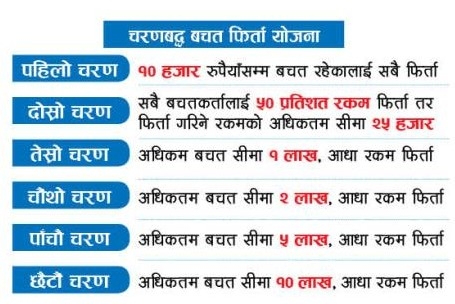
The committee will return the amount of savers up to 10 thousand rupees in the first phase. After that, the committee is prepared to return the amount gradually based on loan recovery, up to a maximum of 50 thousand rupees.
According to the committee, there are 17 thousand savers with savings of less than 25 thousand rupees in the problematic cooperatives and 9 thousand savers with savings of 25 thousand to 50 thousand rupees. Including them, 36 thousand 522 savers with savings of up to 1 lakh rupees and 21 thousand 619 savers with savings of 1 lakh to 5 lakh rupees will have to return the amount. There are 18 thousand 303 savers with savings of more than 5 lakh rupees.
In the ordinance brought to amend the Cooperative Act 2074, there is a provision that the committee should recover the amount currently received from the government in the revolving fund by selling the loans and assets of the problematic cooperatives. ‘The expenses incurred in the course of managing the assets shall be borne from the assets of such an organization,’ the ordinance states, ‘If the amount required for the return of savings cannot be recovered from the assets of such an organization, the Government of Nepal may provide the necessary amount for that purpose by recovering it from the assets of such an organization.’
Earlier, the ‘Working Procedure for the Establishment and Operation of the Savings Return Revolving Fund for Members of Problematic Cooperative Organizations 2083’ issued by the government had stated that a revolving fund would be established to return the savings of cooperative members. However, after there was a voice that the savings of savers should not be returned from the taxes paid by citizens, the government brought an ordinance and made new arrangements regarding the arrangement of the amount required for the return of savings.
The ordinance has made a provision that the troubled cooperative management committee should gradually replenish the amount received from the government in the fund from the movable, immovable and other sources of the debtors under the jurisdiction of the troubled organization. The ordinance also includes a provision for the establishment of a revolving fund envisioned by the government in the working procedure for the return of savings. ‘The Government of Nepal may establish a revolving relief fund in the management committee for the purpose of immediately returning savings to members of troubled cooperatives,’ the ordinance states.
The fund will include the amount received from the Government of Nepal, the amount returned for reimbursement from the concerned organization, and the amount received from other sources.’ The ordinance also states that the fund’s amount should be deposited in a separate account in a commercial bank and separate records should be kept.
000
How is the savings refunded?
In the first phase, savers with savings of up to Rs 10,000 will get all the money back. The number of such savers is about 18,000. From the second phase, the refund will be started for all the remaining savers. But a maximum limit of Rs 50,000 will be set and the amount will be refunded at the rate of 50 percent. For example, if a saver has only Rs 20,000 to be withdrawn, he will get Rs 10,000. If someone has savings of Rs 50,000, they will get half of it, Rs 25,000. Those with savings of more than Rs 50,000 will also be refunded half of it (only Rs 25,000) based on Rs 50,000.
In the third phase, the maximum limit will be Rs 100,000, in the fourth phase, the maximum limit will be Rs 200,000, in the fifth phase, the maximum limit will be Rs 50,000, and in the sixth phase, half of it will be refunded. The government is preparing to refund savings of up to Rs 50,000 within a year. The troubled cooperative management committee has stated that the amount will be refunded based on how much savings are left and how much is the source.

