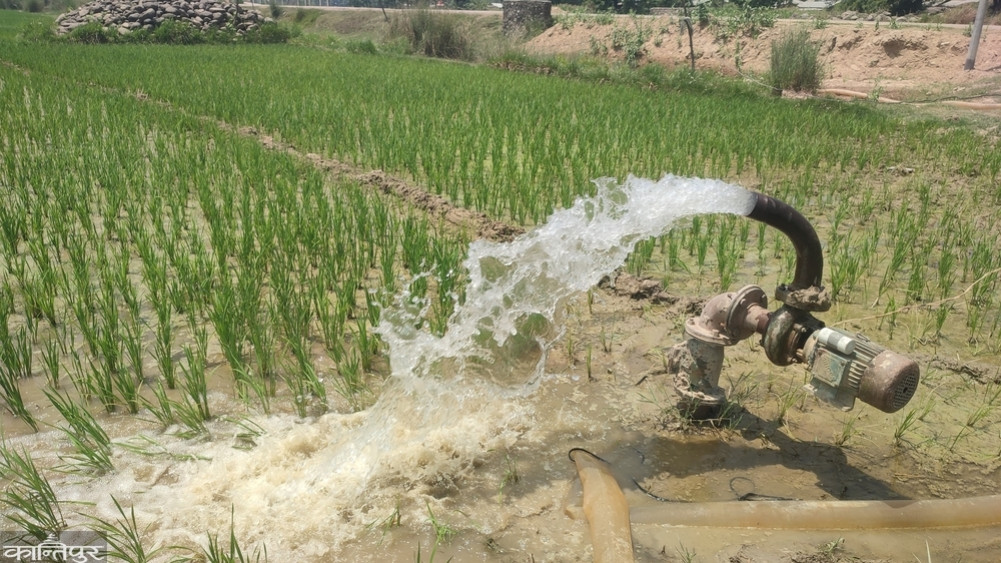
The efforts of Sitaram Dagoura, which turned the flood-affected area into a hub for Chaite rice.
We use Google Cloud Translation Services. Google requires we provide the following disclaimer relating to use of this service:
This service may contain translations powered by Google. Google disclaims all warranties related to the translations, expressed or implied, including any warranties of accuracy, reliability, and any implied warranties of merchantability, fitness for a particular purpose, and noninfringement.
For the farmers of the southeastern part of Kailali, the rains used to be a constant threat. The paddy planted in Asar with sweat and tears would be wiped out overnight by the floods of Bhadau and Asoj. When the water mixed with the rivers of Khetra Mohana, Kandra, Kanda and Patharaiya, the stoves of the farmers here would burn slowly.
But now the situation has changed. Despite not being able to fight the floods, the farmers of Kailali have made a deal with time. That is, they have made Chaite paddy the basis of their livelihood by importing paddy before the floods.
Kailali is at high risk of floods and inundation. Thousands of families are affected and displaced by floods every year. Unseasonal rains have a major impact on agriculture in various areas. Which made the locals victims of food insecurity.
To avoid this problem, farmers have adopted climate adaptation measures by planting rice in Chaitra. This rice ripens in 120 days by the first week of Magh. Farmers say that the yield is also higher than that of rain-fed rice.
Chaitra rice has been expanded in various places in Bhajani, Tikapur, Joshipur and Kailari rural municipalities of Kailali, which were the most affected by the floods. Moreover, wards 3 and 8 of Bhajani have been declared rice zone areas.
Farmers in this area, where only wheat crops are grown, used to buy and eat rice throughout the year. But after the expansion of Chaitra rice, they are now selling rice. This has brought great relief to the farmers financially and mentally.
An example of this is Punsi Lama. Punsi, 50, of Bhajani Municipality-8, Krishnanagar, said that Chaite rice saved her family from hunger. She has been planting this rice continuously for the past 4 years.
She keeps enough rice for the family to last the whole year and sells the rest. Last year alone, she said that she sold rice worth 30,000. ‘Earlier, Chaite rice was not the custom. Rice did not grow during the rainy season.’ Punsi says, ‘Those who had enough to eat would buy rice from the market. Those who did not have money would always go hungry.’
Punsi has been facing the threat of floods since 2040 BS. She says that floods are more frequent now than before and that will seriously affect farming, households and daily life.
‘They called me crazy when I planted rice in Chait’
Initially, farmers in this area started planting Chaite rice themselves. After its positive impact, the attention of the Agricultural Knowledge Center, local and state governments focused. Now, on the initiative of all three levels of government, subsidies have also been distributed to farmers planting Chaite rice.
Sitaram Dagoura of Bhajani-3 Dhusi has been planting Chaite rice for two decades. He said that he is the first farmer to plant Chaite rice in Bhajani. Initially, he started farming with the ‘Munwa’ variety of rice.
He still remembers the challenges he faced while planting this rice in the initial days. ‘When I planted rice in Chait, everyone thought it was crazy, saying that rice planted in Asar should be planted in Chait,’ says Sitaram, ‘the villagers did not even let him bring water from the well.’ Later, I dug a canal from the ground and brought water to the field and planted rice.’ 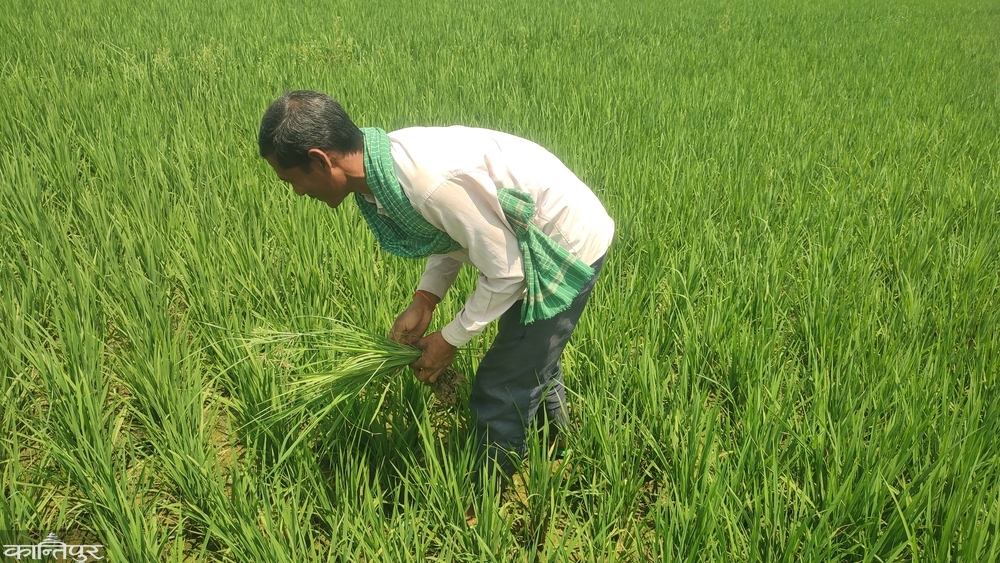
When the rice grew, everyone was surprised, Sitaram said. Later, he gave rice seeds to others and made them plant them. Now, Sitaram has planted Chaite rice in an area of eight and a half bighas. Last year alone, he sold four hundred quintals of rice. The area of Chaite rice is expanding every year in Kailali.
According to the data of the Agricultural Knowledge Center Kailali, the area and production of Chaite rice in the last five years:
Fiscal year Area (hectares) Production (metric tons)
2078/79 710 1988
2079/80 850 2380
2080/81 1200 3600
2081/82 1660 5478
2082/83 1800 5940 (estimated)
This data shows that Chaite rice is expanding rapidly in the district . Tek Bahadur Bista, Information Officer of the Agricultural Knowledge Center Kailali, says that the trend of production and productivity is also increasing along with the area . He says that if modern technology, advanced seeds, and sufficient amount of fertilizers are available, Chaite rice will be produced more than expected .
A high priority for the government
The contribution of the agricultural sector to the economy of the Far West Province is important . In the fiscal year 2080/81, the agricultural sector contributed about 33 percent of the gross domestic product .
Like other products, the province has also given special priority to Chaite rice . In the provincial budget for the fiscal year 2082/83, this rice has been included in the list of special programs under the 'One Local Level, Two Products' campaign . A budget of Rs 704 million was allocated for this campaign.
Along with the provinces, the Agricultural Knowledge Center, the National Agricultural Modernization Program and the local level have also taken the lead in this rice expansion.
According to the data of the Ministry of Agriculture and Livestock Development for the fiscal year 2080/81, rice was cultivated in an area of 14,38,989 hectares in Nepal and 5,724,234 tons of rice was produced. Its average productivity was 3.97 tons per hectare.
Due to the lack of systematic irrigation infrastructure, lack of early-maturing varieties and limited spread of post-harvest rice drying technology, data shows that Chaite rice is being cultivated on only 7-9 percent of the total rice production area in Nepal.
As the demand and consumption of rice in Nepal is higher than the domestic production, rice imports are increasing every year. Experts say that Chaite rice can be an important alternative to reduce rice imports as the productivity of Chaite rice is higher than that of annual rice.
Dheeraj BK of Bhajani-8 Krishannagar is the former chairman of the rice zone area. He has currently planted Chaite rice on more than two bighas of land. According to BK, Chaite rice has made farmers in areas where rice does not grow in the rainy season self-reliant.
He, who has worked on Chaite rice under the National Agricultural Modernization Project, says that rice imports can be reduced if farmers are encouraged to produce it.
‘If the government can encourage farmers in this rice production, Nepal can become self-sufficient in rice,’ says BK, ‘If farmers are given modern machinery, improved seeds and fertilizers and given a fair price for rice, farmers can produce large quantities of rice.’ Chief Scientist of the Nepal Agricultural Research Council Dr. Bhanubhakta Pokharel also agrees with this.
But Bista, Information Officer of the Agricultural Knowledge Center Kailali, says that rice imports can be stopped not in large quantities but to some extent. ‘Chaite rice is planted only in areas where barkha rice does not grow.’ Therefore, it cannot be said that it will stop imports in large quantities. Imports will only decrease if the area is expanded and two crops of rice can be grown, namely chaite and barkha,’ he said.
He says that since fine rice is imported from outside Nepal, the government should give priority to fine rice production.
Farmers in Mar, not getting fair price
With the expansion of area and increase in production, the problems of farmers are also increasing . It has not yet become easy for farmers to cultivate this crop . Farmers are constantly struggling with lack of irrigation, expensive land, government hassles and lack of modern agricultural equipment .
The subsidies provided by the Agricultural Knowledge Center, local levels, provinces and the Agricultural Modernization Program are not enough for farmers . First of all, to get subsidies for Chaite paddy, farmers must necessarily join a group or agricultural cooperative . Farmers who are spontaneously planting Chaite paddy cannot get government benefits . 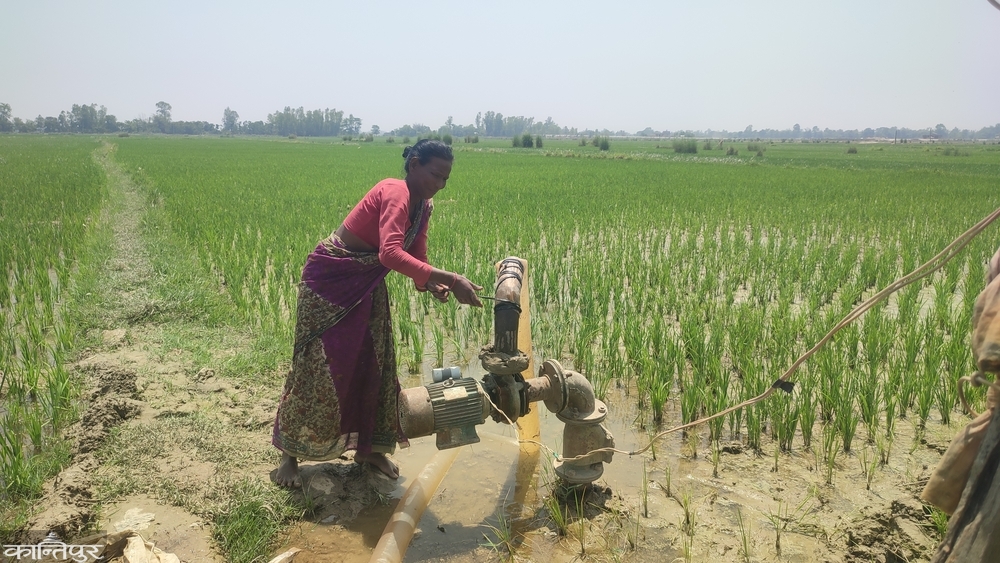
Farmers say that even farmers eligible for subsidies are forced to go through excessive paperwork . They say that both time and money are spent on arranging dozens of papers with many details .
Not getting fair price for paddy has become another big problem . They say that even though the government fixes the support price, farmers are forced to sell paddy at a low price . Farmers are demanding that the price of paddy should be Rs 35 to 36 per kg after adding the inputs.
But the government has fixed the support price of this paddy at Rs 28 per kg. Farmers are not satisfied with this. They complain that they suffered losses by selling paddy at Rs 22 to 25 per kg last year.
‘No matter what support price the government sets, we are forced to sell it for Rs 2,200,’ said farmer Krishna Chaudhary. She has been planting Chaite paddy for the past 12 years. Before that, she said that she had kept her fields fallow during the rainy season and sold paddy worth Rs 4 lakh last year alone. She said that if she does not get a fair price for Chaite paddy this year, she will plant paddy on only a small area next year.
All farmers complain about not getting a fair price for paddy. ‘We are not allowed to set the price for our paddy.’ People who buy rice are bargaining that if they give it at this price, they will buy it, otherwise they will not buy it. We are forced to sell rice at a loss,' complained farmer Hiralal Chaudhary. He said that the Agricultural Knowledge Center also gives priority to fine rice over coarse rice.
Lack of modern equipment
Even though there is enough water for farming, farmers say that the increase in the price of petrol and diesel has made farming expensive. Another farmer, Sitaram Dagoura, said that a lot of money is spent on buying pesticides and fertilizers due to the high incidence of pests. According to him, government subsidies for farmers are not sufficient.
Another big problem for farmers occurs after the rice ripens. The time when rice ripens and the monsoon becomes active coincides. In this situation, rain damages the rice. Farmers themselves say that although dryer machines are necessary to protect rice from rain, common farmers do not have the ability to purchase them.
Farmer Hiralal Chaudhary says that the greatest need is for large agricultural equipment like dryer machines and combine harvesters. He says that although such machines are essential for harvesting, drying and preserving rice, small farmers are not in a position to buy them themselves.
During the rice ripening season in Ashar, rice is soaked in water and has to be covered on the road. A threshing floor is also required to protect rice from rain.
According to the current market price, the price of a combine harvester ranges from 3.6 to 5.5 million. Similarly, a small dryer costs 4 to 5 million and a large dryer for commercial farmers costs 6 million, says Hikmatraj Upadhyay, Sudupaschim Province Regional Manager of Muktinath Agriculture Company.
The government should provide 85 percent subsidy for both these machines, which are essential for farmers, says Dheeraj Bik, former chairman of Bhajani-8 Rice Zone Area. He says that the remaining 15 percent can be paid by the farmers themselves. Other farmers have also demanded that the government provide the machines at a concessional rate.
Farmers say that the Biujin is also not available on time. Sitaram, who planted Chaini 4 and 5 rice, says that it yields more than other rice. Which is coarse rice. Hardinath 1, 2, 3 and Chaite 5, which are available under government subsidy, are among the fine rice varieties. He said that the Agricultural Knowledge Center gives more priority to fine rice and also provides this seed under subsidy.
Expert's suggestion to preserve soil fertility
Chaite paddy has become a reliable alternative for farmers who are unable to plant their main crops due to floods and inundations during the rainy season. But experts have warned about the impact that this cultivation may have on soil fertility.
Paddy is considered a crop that absorbs more nutrients in agricultural science. Continuous planting of only paddy affects soil health, says Dr. Mathura Yadav, coordinator of the National Paddy Research Program Hardinath. 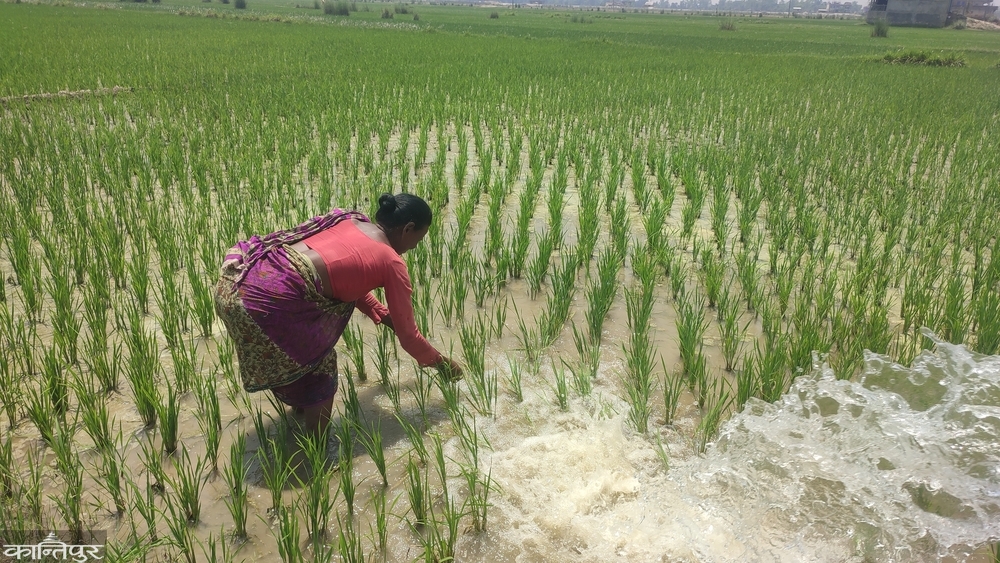
'Rice absorbs a lot of nutrients from the soil, so continuous planting of only Chaite paddy can weaken the soil.' For this, it is mandatory to adopt a 'crop cycle' by using fallow crops, lentils or green manure in between,' he said, 'This increases the amount of nitrogen in the soil and also improves organic matter.'
However, Nepal Agricultural Research Council (NARC) Chief Scientist Dr. Bhanubhakta Pokharel argues that rice cultivation alone will not damage the soil if the management aspect is improved. Dr. Pokharel says, 'It is not said that Chaite and Barkhe rice will have such a negative impact on the fertility of the soil. If we use balanced fertilizers, the strength of the soil can be preserved.'
He said that the right mixture of cow dung and organic fertilizers should be mixed along with chemical fertilizers to provide the nutrients required by the plants. Dr. Mathura Yadav has also emphasized on technology and variety selection according to the soil conditions. According to experts, to preserve the fertility of the soil, the stubble and residue left after harvesting rice should be turned over in the field and decomposed and the necessary elements should be replenished by testing the soil.
As farmers are confused about coarse and fine rice, Dr. Pokharel, Chief Scientist of the Agricultural Research Council, suggested planting Chaite-5 (fine rice). According to him, it is a medium-sized, good-yielding variety with high market demand. This will also help reduce the import of fine rice. Dr. Pokharel said that Chaite rice gets more sunlight than rain-fed rice, so its productivity is higher.
Therefore, although this is an opportunity for rice farmers, experts say that balanced fertilizer, crop rotation and modern technology are necessary for the long-term health of the soil. Dr. Pokharel said that the government has emphasized only on Chaite rice production.
According to him, although there is enthusiasm in production, this successful effort of Kailali farmers will only be meaningful in the long term if the market and technology are ensured.