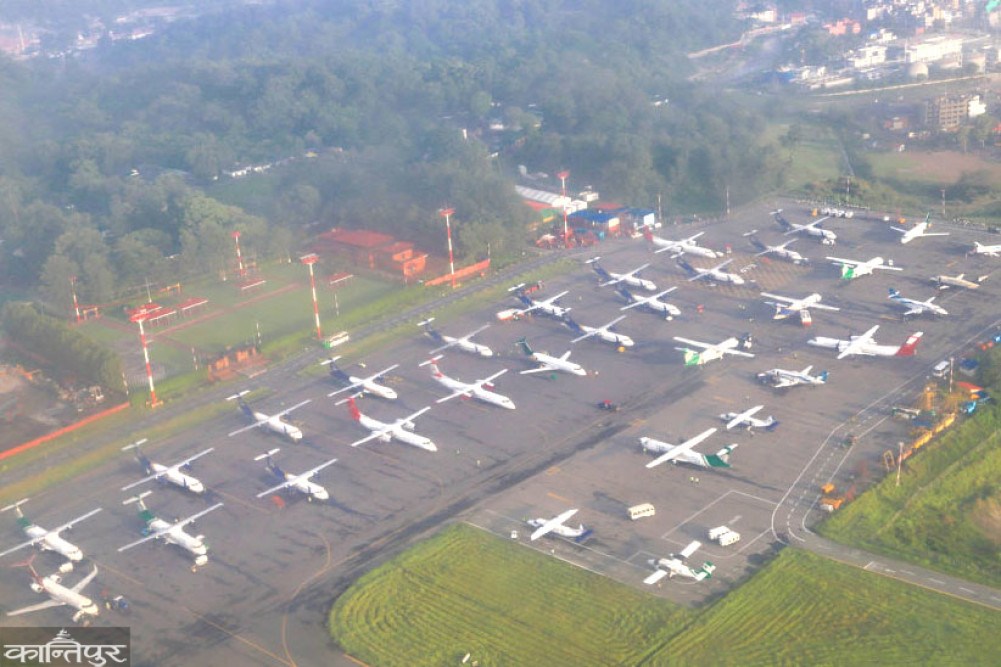
Aviation fuel prices rise by 112 percent, domestic passenger traffic drops by 30 percent
We use Google Cloud Translation Services. Google requires we provide the following disclaimer relating to use of this service:
This service may contain translations powered by Google. Google disclaims all warranties related to the translations, expressed or implied, including any warranties of accuracy, reliability, and any implied warranties of merchantability, fitness for a particular purpose, and noninfringement.
The domestic air market has unexpectedly slowed down in the busiest months for tourism, March, April and May. With the number of passengers declining by almost 30 percent compared to the previous year, airlines are under pressure to cover their expenses.
The Airline Operators Association of Nepal, the umbrella organization of domestic airlines, has sent a letter to the government on Thursday, stating that the airlines are in serious financial crisis after the airline companies started facing difficulties in operating flights.
In a letter to the Ministry of Culture, Tourism and Civil Aviation, the association has sought relief, stating that the aviation sector is under extreme pressure due to the increase in fuel prices, declining passenger numbers, high fares payable to the authority, and international circumstances. According to Pratap Jung Pandey, president of the association, the price of aviation fuel has increased significantly as the impact of the Corona pandemic has not yet been completely eliminated and the recent instability in the Middle East has led to a significant increase in the price of aviation fuel.
In April 2025, the airline, which operates on a smooth route for domestic flights, served about 415,000 passengers. This year, the number of passengers has been limited to around 296,000. This is a decline of about 30 percent. 'Compared to the same period last year, about 2,500 passengers are now decreasing per day,' said Yuvraj Bista, Chief Business Officer of Yeti Airlines, affiliated with the Airline Operators Association. 'Only major companies like Buddha, Yeti and Shree have lost about 30 percent of their passengers.'
Compared to the same period last year, about 2,500 passengers are now decreasing per day. Only major companies like Buddha, Yeti and Shree have lost about 30 percent of their passengers. - Yubaraj Bista, Chief Business Officer, Yeti Airlines According to Buddha Air, the main reason for this decline is geopolitical tensions and the resulting increase in fuel prices and the increase in the dollar exchange rate. After the United States and Israel launched an attack on Iran in mid-February 2082, oil prices in the international market had skyrocketed. Its direct impact has also been seen in Nepal's air transport.
Nepal Oil Corporation almost doubled the price of aviation fuel, which was being sold at Rs 127 per liter on 11 Chaitra 2082, in a single week to Rs 251 on 19 Chaitra. Since then, there has been a sharp decline in demand for domestic flights, said Pandey, President of the Airline Operators Association.
Although the increase in aviation fuel prices has gradually slowed in recent days, aviation fuel has exceeded Rs 260 per liter by 17 Baisakh 2083. With the price increase of about 112 percent in 35 days, the costs of airline companies have skyrocketed, while passenger demand has decreased. When the price of aviation fuel increases or decreases in Nepal, the fuel surcharge on domestic flight tickets is adjusted in the same proportion. The increase in fuel prices has increased airfares from at least Rs 1,500 to nearly Rs 6,000 for long distances. As a result, lower-middle-class air passengers are abandoning planes and using road transport, according to airline companies.
Not only fuel, but the exchange rate has also created additional pressure on airline companies. As the US dollar exchange rate has increased by about 16 rupees 52 paise in a year, the cost of aircraft parts, pilot training, engine maintenance costs, etc. has become expensive. Meanwhile, there has also been a slight decline in foreign tourist arrivals.
In April 2025, 116,490 foreign tourists visited Nepal, which was the highest at that time. However, this number has decreased to 107,934 in April 2026. Accordingly, according to the Immigration Department, tourist arrivals decreased by 8,556, or about 7.3 percent, in the same period of 2026.
In March, 120,000 foreign tourists visited Nepal, which was about 1,100 less than the previous year.
Overall, the 'triple pressure' of fuel prices, exchange rates and weak demand during the peak tourist season seems to have slowed the domestic aviation market. The decrease in the number of tourists coming to Nepal, especially those who come for trekking, has reduced income and airlines are facing problems in their daily operations, according to a letter sent to Tourism Minister Khadak Raj Poudel.
The association has drawn the attention of the government, saying that 'if the situation continues like this, there is a risk of shutting down the service itself'. They say that airlines will get relief from the crisis if the Civil Aviation Authority of Nepal gives a discount of at least 50 percent on the landing, parking, navigation, hangar and other fees charged at airports across the country, including Kathmandu.
The association also demands that the airport service fee regulations of the authority be amended to reduce the fees charged for domestic flights. The air service industry should be treated as a priority industry and given tax exemptions and incentives, and the fees currently charged by the authority in US dollars should be determined in Nepali rupees, and the fee charged by the authority at the rate of $ 10 per flight for weather services should be removed.
In a letter registered with the ministry on Thursday, it has also been warned that the domestic airline sector will be pushed further into crisis if the government does not address the demands of airlines in a timely manner. Tourism Minister Poudel said that he will study the letter submitted by the Airline Operators Association and take necessary steps.