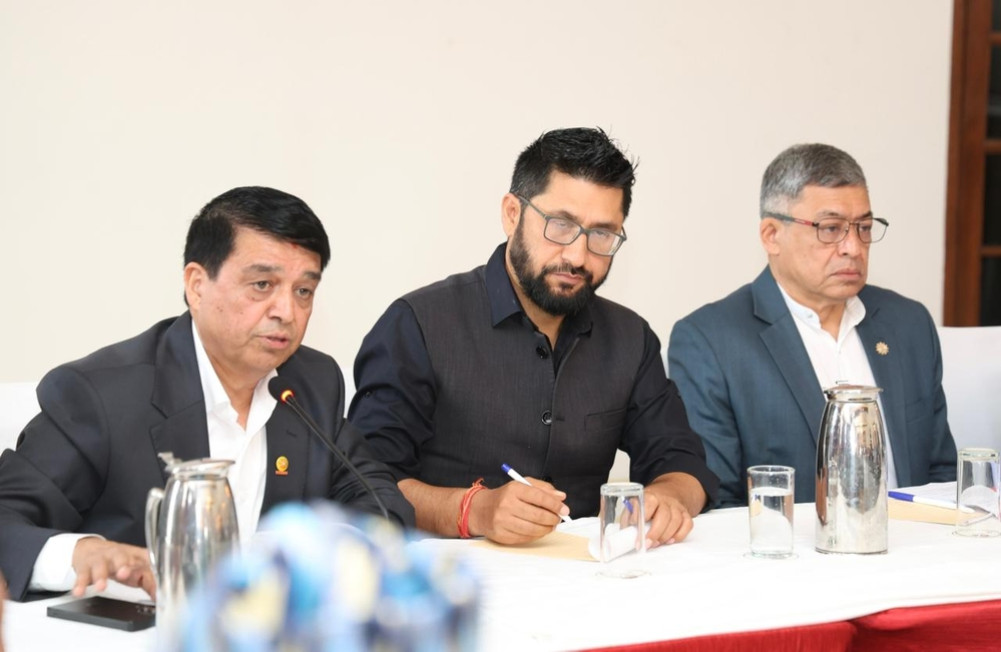
The government aims to achieve the country's economic prosperity by involving the private sector, and the Rashtriya Swayamsevak Sangh (RSS) claims that it will adopt a working style in accordance with that.
We use Google Cloud Translation Services. Google requires we provide the following disclaimer relating to use of this service:
This service may contain translations powered by Google. Google disclaims all warranties related to the translations, expressed or implied, including any warranties of accuracy, reliability, and any implied warranties of merchantability, fitness for a particular purpose, and noninfringement.
While doubts are being raised about some of the activities taking place immediately after the formation of the government, the National Independent Party has assured the private sector to focus on its business and not to be intimidated by state bodies. RSP President Ravi Lamichhane has tried to assure various private sector organizations that the government aims to achieve the country's economic prosperity by taking the private sector along with it and that it will adopt a working style accordingly.
At a program organized by the Federation of Nepalese Chambers of Commerce and Industry in Lalitpur on Sunday, President Lamichhane urged businessmen to engage in business activities, saying that the state's policies and laws will protect them. 'The country cannot achieve any goal without promoting the private sector. Moreover, the morale of the private sector should also be high for this government's goal,' he said.
As the government continues its campaign for good governance and anti-corruption, some business houses have come under the radar of investigation. Immediately after Balendra Shah was appointed as the Prime Minister, investigation processes have been initiated in various areas. During the investigation, the 91-year-old business house Shankar Group has been drawn into the investigation. The group's chairman Shankarlal Agrawal has been arrested and released. His son Sulabh Agrawal is in custody.
Controversial businessman Deepak Bhatt has also been arrested and is in custody for investigation. Former president of the Federation of Nepalese Chambers of Commerce and Industry Shekhar Golchha has also been arrested on charges related to insurance and money laundering. Investigations are ongoing against them and other industrialists and businessmen have also been brought under the ambit of the investigation. In such a backdrop, the private sector is complaining that the business environment has deteriorated and morale has declined.
000
The country cannot achieve any goal without promoting the private sector, and for this government's goal, the morale of the private sector must be high - Ravi Lamichhane, President, Rashtriya Swayamsevak Sangh (RSS)
000
In a situation where the confidence of the private sector has weakened recently, the clear message received from the political leadership has given a positive message - Chandra Prasad Dhakal, President, Federation of Nepalese Chambers of Commerce and Industry
000
The existing 'crisis of trust' between the public and private sectors should be improved, this will increase production, import substitution and increase employment in the country - Birendra Raj Pandey. President, Confederation of Nepal Industries
000
The private sector's support is also necessary to meet the government's employment target, said RSP President Lamichhane. 'Out of 10 jobs given by the government, we can provide one or two people with our own capacity. The private sector will provide employment to the remaining 8-9 people. Therefore, we have set a target of creating jobs for as many people as we can, and for that, we need people here,' he said.
The current government, RSP President Lamichhane said, will run by looking at the party's pre-election promise. He said that the people voted by looking at the party's promise and there is a need for cooperation with the private sector. He explained that he came to the interaction to keep the morale of industrialists and businessmen high. He said that he was going to consult them to reassure them that he had heard that the morale of the private sector has been weak recently. Urging the government to take the steps taken to maintain good governance smoothly, Lamichhane said, 'We will work together. The government has no intention of discouraging any businessman or ruining his business.'
He said that the work done in the past by capturing the state machinery to destroy the country's economy will be brought under the scope of investigation. He also urged industrialists to cooperate in such work. Chairman Lamichhane claims that industrialists have also crossed the line due to the activities of political parties in the past. He said that the state itself will protect industrialists through policies in the coming days.
'Sometimes, due to circumstances, legal difficulties, political environment and becoming victims of unstable politics, you have been forced to knock on the doors of many political parties and leaders. We do not understand that by fulfilling their interests, you have sometimes crossed the line of values and norms,' Lamichhane said. 'You can be confident, I do not see any need to worry about this.'
Chairman Lamichhane said that the government has also taken steps to end the practice of capturing institutions related to the economy. He said that changes are needed in those matters and work has been done for that. Lamichhane claims that the steps taken by the government will help the private sector.
If state bodies knock on the doors of businessmen in the course of maintaining good governance and controlling corruption, President Lamichhane urged them not to make it a matter of the reputation of the entire private sector and to cooperate in the investigation. "We will protect you by making good policies. However, since this is in the transition phase, we are investigating the irregularities that have occurred in the meantime from a governance perspective. If your door has been knocked on somewhere in it, please provide clarification. Ultimately, cases related to economic crimes should be viewed from an economic perspective. We are very clear that it should not be viewed from a criminal perspective," Lamichhane said.
He said that if the government cooperates in the investigation of major scams in the past, it will create a good business environment for the next generation. President Lamichhane said that since the state protects the private sector through laws and policies, industrialists will not have to knock on the doors of any political party or party office in the coming days.
The clear commitment and assurance received from the leadership of the party leading the government will restore the waning confidence of the private sector, says Federation of Nepalese Chambers of Commerce and Industry President Chandra Prasad Dhakal. He said that the support of the state and political parties is indispensable to increase private sector investment and business activity in the country.
‘The clear view received from the political leadership has given a positive message when the confidence of the private sector has weakened recently. This will help in attracting more investment, expanding business activities and achieving the goal of building a prosperous Nepal in the coming days,’ said President Dhakal.
With the formation of a strong government of a single political party after a long time, the investment environment in Nepal will be good and initiatives should be taken to bring in foreign investment, said former Federation President Ravi Bhakta Shrestha. According to businessman Ananda Raj Mulmi, the investment environment in Nepal will be determined by the relationship between the leadership of the Rashtriya Swayamsevak Sangh (RSS) and the government. In response, President Lamichhane assured the private sector to invest and engage in business without worrying about any problems as the division of labor between the party leadership and the government leadership has been clarified. Businessman Mulmi urged that the private sector is facing problems in investing due to the many laws and regulatory bodies in Nepal, and to end the hassles faced when operating a business outside the capital.
Suraj Baidya, former president of the federation, said that it is important to understand why corruption is happening. ‘Corruption is not one-sided, it is due to compulsion. It is right to eradicate corruption. But it is necessary to think a little about how to eliminate it,’ he said. He said that if any file of a businessman is forwarded by the state body without taking bribes, no industrialist will get involved in corruption.
Birendra Raj Pandey, president of the Confederation of Nepalese Industries (CNI), said that the private sector is excited about the current stability seen in the country's economic system. He stressed that the existing ‘crisis of trust’ between the public and private sectors should be improved. ‘Investor confidence will increase only if there is clarity and predictability in the business environment. This will ultimately help in increasing production, replacing imports and creating employment opportunities in the country.’
Senior Vice President of the Federation of Nepalese Chambers of Commerce and Industry Anjan Shrestha said that it is necessary to increase the morale of the private sector. He said that a commitment to policy, business and peace and security is needed from the state. ‘First you have to listen, then you have to lock up,’ he said. He said that in the past, when people involved in business were taken action, businesses and industries collapsed and when businessmen were taken action, it is necessary to ensure an environment that does not close businesses.
Entrepreneur Juna Mathema said that the Rashtriya Swayamsevak Sangh (RSS) government, which is leading the government, should discuss with the private sector how to work for the next 5 years. President Lamichhane urged the private sector to work at a fast pace and to provide reliable support in this. He said that physical infrastructure has not been built for years and the government wants to work with the help of the private sector. Stating that he would adopt economic diplomacy in the coming days, Lamichhane opined that Nepal, located between India and China, should benefit economically from both countries.