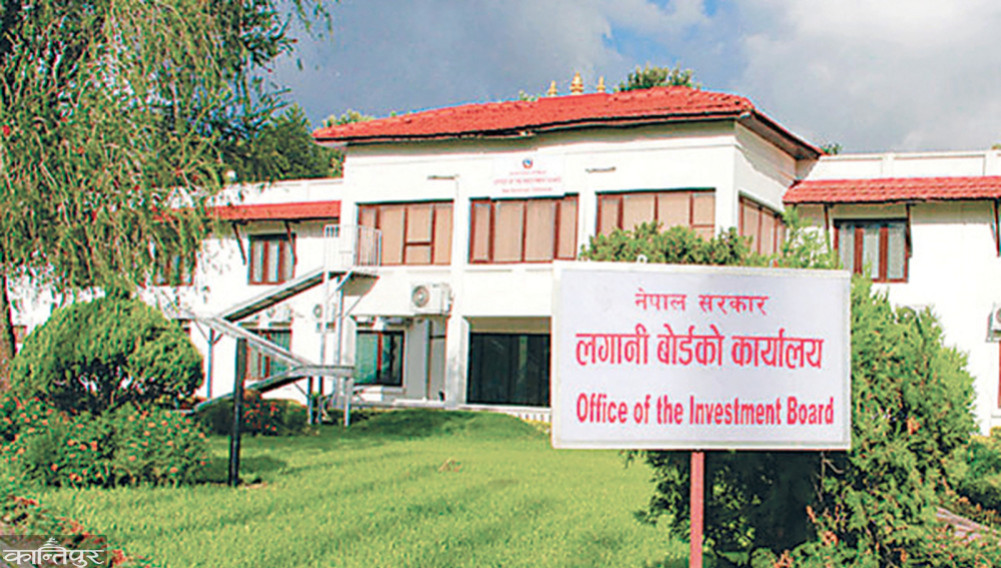
Of the 53 projects that the board has approved and is moving forward with, only 2 have been operational so far.
We use Google Cloud Translation Services. Google requires we provide the following disclaimer relating to use of this service:
This service may contain translations powered by Google. Google disclaims all warranties related to the translations, expressed or implied, including any warranties of accuracy, reliability, and any implied warranties of merchantability, fitness for a particular purpose, and noninfringement.
There are 53 projects under the Investment Board Office. Some of them have been approved for investment and some are being promoted by the office itself. There are also projects presented at the International Investment Conference organized by the Investment Board itself. But only 2 of the 53 projects approved and promoted by the board have been operational so far.
Former CEO of the board office Radhesh Pant says that Hongsi-Shivam Cement and Hwasin Cement, which have already come into operation, and the under-construction Arun-3 project have been advanced in their own time. According to the Investment Board Office, only the privately invested Hongsi-Shivam Cement and Hwasin Cement industries have come into operation. According to the office, investment worth about Rs 1.673 trillion has been approved for 53 projects so far. Of these, two cement industries worth Rs 58.81 billion have been completed and put into production. Similarly, 28 projects worth Rs 598 billion are under construction. According to the office, all the projects under construction are hydropower projects.
2 projects worth Rs 255 billion have reached the implementation stage with financial management. The 669 MW Lower Arun and 900 MW Upper Karnali hydropower projects are yet to be financially managed. That is, only the work of raising investment for the construction of the projects remains. Although the promoter Grandhi Mallikarjuna Rao (GMR) submitted the documents for the financial management of Upper Karnali, the process has not been able to move forward as the Investment Board meeting has not taken a decision.
According to the office, 11 projects worth Rs 555 billion are in the process of signing Project Development Agreements (PDAs) and Project Implementation Agreements (PIAs). The office has stated that PDAs will be signed for 7 hydropower projects and PIAs for the remaining 4 projects. A detailed study is being conducted on 5 projects worth Rs 84 billion. A detailed study is being conducted on Grid Connected Solar and Battery (Dolpa), Dang Cement, Samrat Cement, Suryatara Cement and Kathmandu Wastewater (Packages 1 and 3). According to the
office, Dangote Cement, Reliance Cement, Vehicle Manufacturing and Assembly Plant, Venture Waste to Energy, Dharan and Hotel Project (Dahchowk, Bhaktapur and Pokhara) are inactive. Sushil Gyawali, Chief Executive Officer (CEO) of the Investment Board Office, said that the projects on the inactive list will be given a last chance. ‘If the policy processes had been completed on time, the Dangote Cement Industry could have also been operated, however, many cement industries with domestic and foreign investment are currently operating in Nepal,’ Gyawali said, ‘Now we will move the process towards canceling the inactive projects.’
The Investment Board had been approving investments in more than 6 billion rupees of foreign and domestic investment and more than 200 megawatts of hydropower and energy projects. But now the Department of Industries has given the authority to approve foreign investments of more than 6 billion rupees. Therefore, the Investment Board is now approving investments in domestic investment of more than 6 billion rupees and more than 200 megawatts of hydropower and energy projects. There is a provision that the Prime Minister will be the chairman of the Investment Board, while the Finance Minister will be the vice-chairman.
Although the board was established to work on a fast track, be led by the Prime Minister and not be politicized, former CEO of the Investment Board Radhesh Pant said that work has not been done accordingly. ‘With the appointment of full-time government employees and political appointees, politics has entered the Investment Board office,’ he said, ‘they do not understand the importance of investment. They could not even adopt a policy to bring private investment and develop.’
He claimed that the trust and morale of investors towards the Investment Board and the office, which was initially low, has also decreased. He said that it has become a body that approves investments rather than investing and building projects. ‘There is no attention towards bringing big projects, bringing investments and implementing them,’ he said, ‘The role of the private sector in the development of the country has not been prioritized.’ It has been a victim of unstable politics. The leadership has not paid enough attention.’
It has been decided to accelerate the implementation of the Public-Private Partnership (PPP) project being promoted by the Investment Board Nepal. Preparations are underway to select at least 10 priority projects that can be started within the upcoming fiscal year 2083/84 and submit a proposal to the Public-Private Partnership Project Prioritization Committee.
Emphasis has been placed on resolving problems related to forests and the environment to remove obstacles in implementation. For this, a task force has been formed with a mandate to submit a report with suggestions within five days. The task force, formed by the decision of the thirteenth meeting of the Monitoring and Facilitation Committee convened by Finance Minister and Vice Chairman of the Investment Board, Swarnim Wagle, will suggest necessary policy and procedural improvements for the speedy implementation of the project.
The work of identifying the problems and causes of the 5 projects that could not be implemented and preparing a proposal with solutions will also be taken forward. It is stated that the proposal will be submitted in the next meeting in coordination with the concerned developers and stakeholders.
Investment Board CEO Gyawali says that only a limited number of projects have been operational due to problems in the capacity of the projects and offices. ‘It should have been done on a fast track, it would have been good if other projects could have been brought into operation,’ he said, ‘There were also problems in the capacity of the projects and offices.’ The achievements so far are also good. Two projects have already started production and most of the projects are under construction, he said. He said that the financial management of large projects like Upper Karnali and Lower Arun is in the process of being completed and will soon begin construction. Stating that three international investment conferences have been held, Gyawali said that now it will be sectoral and investor-focused.
The construction of a 'project bank' for PPP projects has also been taken forward, which is expected to streamline the identification, prioritization and implementation process of potential projects. Pant said that the new government should make the Prime Minister, who is also the Chairman of the Investment Board, show interest and make the board office powerful and transparent. 'We should deprive the forest of excuses such as not doing it in projects under the Investment Board, and we should be able to attract investors,' he said.
He said that the government should give the Investment Board office the responsibility of bringing the best investors of the country to 7/8 large projects and completing them within 10 years. He believes that the board should focus on identifying, attracting and constructing projects of 3,000/4,000 megawatts instead of approving investments in 100/200 megawatts.
In the 13th meeting of the Investment Board's Monitoring and Facilitation Committee, Finance Minister Dr. Swarnim Wagle said that a brutal review should be conducted on projects for which investment has been approved but work has not started. 'Who is to blame for the lack of further work on the construction of the project despite accepting foreign investment? If there is a person, there is a person, if there is a law, the law must be changed,' he had said in the meeting, 'What is the problem, it is needed immediately. If there is no further progress after solving the problem in the 14th meeting of the committee, then it will be brutally considered.' He said that the powerful body that facilitates investment appeared innocent and very wrong information was being communicated.
Already operational
Hongsi-Shivam Cement Project
Hruvasin Cement Project
Under construction
Arun-3 Hydropower Project (900 MW)
Upper Trishuli-1 Hydropower Project (216 MW)
Marsyangdi Besi Hydropower Project (50 MW)
Upper Trishuli-3B Hydropower Project (60 MW)
Aankhu Khola Hydropower Project (42.9 MW)
Myagdi Khola Hydropower Project (57.3 MW)
Kaligandaki Gorge Hydropower Project (164 MW)
Isuwa Khola Hydropower Project (97.2 MW)
Ghunsa Khola Hydropower Project (77.5 MW)
Himchuli Dordi Hydropower Project (57 MW)
Dudh Khola Hydropower Project (65 MW)
Lower Manang Marsyangdi Hydroelectric Project (139.2 MW)
Jum Khola Hydroelectric Project (56 MW)
Tamor Fifth Hydroelectric Project (99.8 MW)
Rahughat Hydroelectric Project (40 MW)
Upper Marsyangdi-1 Hydroelectric Project (102 MW)
Dudhkoshi-2 (Jaleshwor) Hydroelectric Project (70 MW)
Simbuwa Khola Hydroelectric Project (70.3 MW)
Upper Madi Hydroelectric Project (43 MW)
Rolwaling Khola Hydroelectric Project (22 MW)
Chujung Khola Hydroelectric Project (63 MW)
Dana Khola Hydroelectric Project (49.95 MW)
Sanibheri Hydroelectric Project (44.52 MW)
Super Tamor Hydroelectric Project (166 MW)
Jagdulla Hydropower Project (106 MW)
Bakan Khola Hydropower Project (44 MW)
Chilung Khola Hydropower Project (43.2 MW)
Lower Apsuwa Hydropower Project (54 MW)
In financial management stage
Lower Arun Hydropower Project (669 MW)
Upper Karnali Hydropower Project (900 MW)
In PDA/PIA negotiation stage
China-Nepal Friendship Industrial Park, Damak
Upper Marsyangdi-2 Hydropower Project (327 MW)
Dabur Nepal Capacity Enhancement and Product Diversification
Kathmandu Valley Solid Waste Management (Package-1)
Nayapul-Muktinath Cable Car (81.04 km)
Chainpur Seti Hydropower Project (210 MW)
Budhi Gandaki Hydropower Project (341 MW)
Bajhang Upper Seti Hydropower Project (216 MW)
Betan Karnali Hydropower Project (439 MW)
Risen Clean Energy Solar Project (245 MW)
Upper Tamor Hydropower Project (285 MW)
In study/evaluation phase
Grid-connected solar and battery storage (Dolma-245 MW)
Dang Cement Project
Samrat Cement Project
Suryatara Cement Project
Kathmandu Valley Solid Waste Management (Package-2 and 3)
Inactive Project
Dangote Cement Project
Reliance Cement Project
Vehicle Manufacturing and Assembly Plant
Venture Waste-to-Energy, Dharan
Hotel Project (Dahachowk, Bhaktapur and Pokhara)