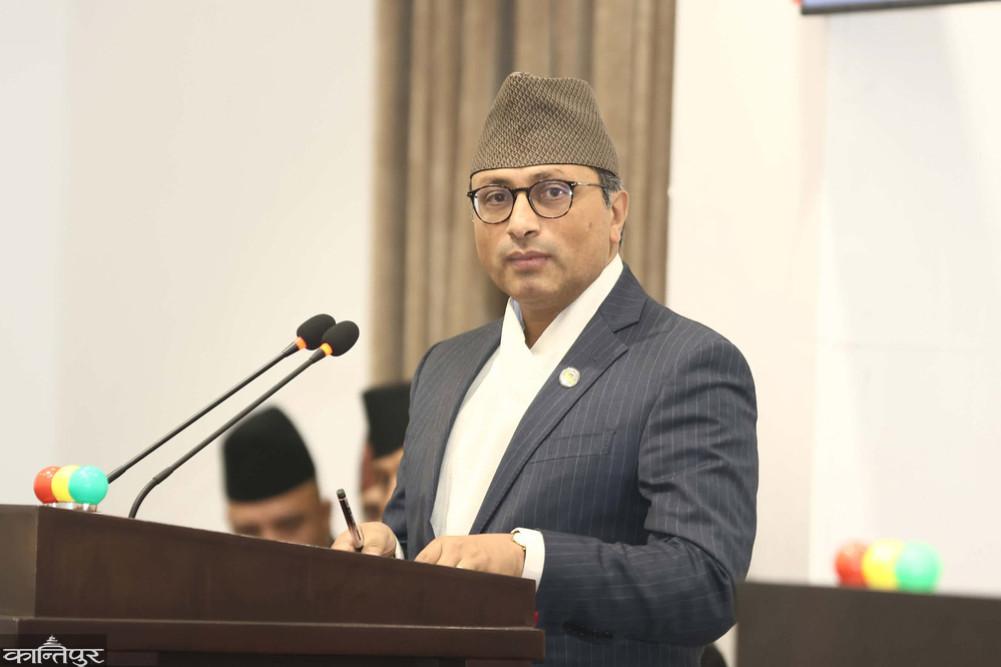
Stakeholders emphasize that the upcoming budget should be more realistic and implementable than ambitious.
We use Google Cloud Translation Services. Google requires we provide the following disclaimer relating to use of this service:
This service may contain translations powered by Google. Google disclaims all warranties related to the translations, expressed or implied, including any warranties of accuracy, reliability, and any implied warranties of merchantability, fitness for a particular purpose, and noninfringement.
Finance Minister Swarnim Wagle has said that the upcoming budget will focus on policy reforms, reducing the tax burden, promoting good governance and attracting private sector investment. He said that the government does not have the traditional mindset that revenue will decrease when taxes decrease and that revenue can be increased by reducing tax rates.
At a program organized by the Society of Economic Journalists of Nepal (SEJON) on Thursday on the topic of ‘Budget to Transform the World: What is the Path, How?’ targeting the budget for the upcoming fiscal year, Finance Minister Wagle claimed that the upcoming budget will be a reflection of good governance by introducing policy arrangements rather than pouring money. He clarified that preparations are underway to review the issue of high income tax and customs rates and to bring a budget with the aim of increasing consumption by reducing the tax burden.
In a different context, Finance Minister Wagle clarified that entrepreneurs who have not made mistakes should not panic. ‘Those who are engaging in criminal activities under the guise of entrepreneurs and businessmen will not be exempted, those who have not committed criminal acts should not panic,’ he said. Finance Minister Wagle said that foreign grants have been decreasing recently due to the government’s inability to spend. He claimed that the size of the economy in the upcoming fiscal year will reach more than 700 trillion rupees and the budget ceiling given by the National Planning Commission has been low. The commission has given a budget ceiling of Rs 1.89 trillion for the coming fiscal year. He claimed that the size of the economy in the coming fiscal year will exceed Rs 700 trillion and that the budget ceiling given by the National Planning Commission is low. Finance Minister Wagle said that sick projects and plans and programs included in the budget based on power and access will be removed from the budget. "We should cut programs that reflect capitalism around us and give a message of good governance," he said. "If we had been able to see it since Magh, we could have done major 'surgery' in this year's budget. However, we are still studying it." Finance Minister Wagle said that the plan is being presented as per the budget ceiling given by the Planning Commission for the coming fiscal year. He said that after the earthquake, the size of the budget has increased in proportion to the gross domestic product and it has not been possible to bring it back to normal. He said that the budget for the coming fiscal year will adopt a policy to attract private and foreign investment by focusing on economic growth and employment. He said that the basic needs of the middle class will be emphasized.
On the issue of budget, stakeholders have emphasized implementation, policy stability and bringing a realistic budget. Former Finance Minister Rameshwor Khanal said that the budget for the upcoming fiscal year should not focus on size and attractive slogans, but should focus on improvements and visible results. ‘In the past, the budget focused on numbers and slogans, with marginal improvements and implementation,’ he said, ‘The size of the upcoming budget should not be large, it should be realistic.’
In a different context, Finance Minister Wagle clarified that entrepreneurs who have not made mistakes should not panic. ‘Those who are engaging in criminal activities under the guise of entrepreneurs and businessmen will not be exempted, those who have not committed criminal acts should not panic,’ he said.
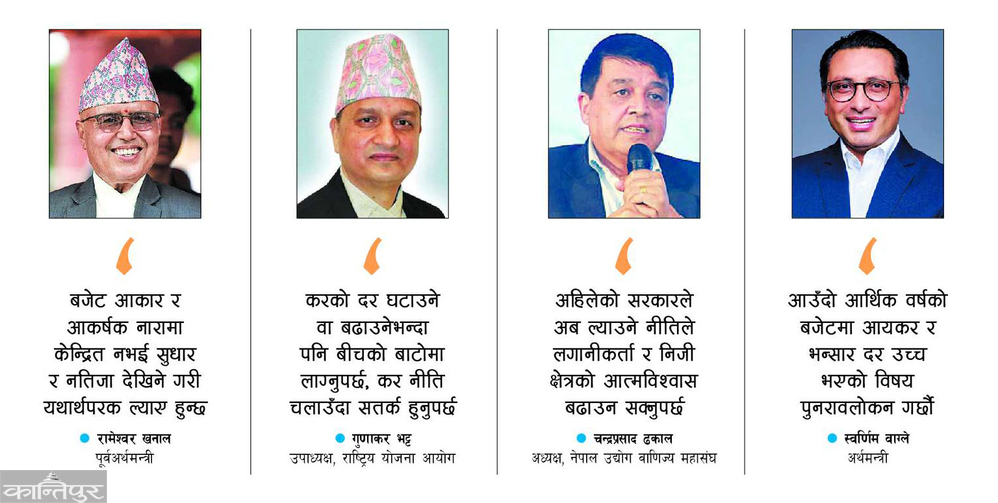
He stressed the need to continue the positive reforms and commitments started by the previous government. Khanal said that the government should also be serious about upgrading Nepal from a least developed country. Stating that the lack of stability in tax policy has weakened the morale of the private sector, Khanal said that the investment environment would improve if the government could give a clear commitment to keep tax rates stable for at least the next 10 years.
Chandra Prasad Dhakal, President of the Federation of Nepalese Chambers of Commerce and Industry, said that the private sector should be involved in infrastructure construction. He said that the government’s commitment to involve the private sector in infrastructure should be implemented. At a time when complaints about an unstable government and unstable policies are increasing, he said that the policies that the current government will bring should be able to increase the ‘confidence’ of investors and the private sector. Gunakar Bhatta, Vice Chairman of the National Planning Commission, said that instead of reducing or increasing tax rates, a middle path should be taken. ‘We should be very cautious when implementing tax policy,’ he said.
Birendra Raj Pandey, President of the Confederation of Nepalese Industries, said that as illegal imports are causing great suffering to domestic industries, it is necessary to control them together with the relevant bodies. He says that the budget comes every year, but there are always problems in its implementation.
Nepal Chamber of Commerce President Kamlesh Kumar Agrawal says that the country has not been able to create an investment environment due to the unstable government and unstable policies. He emphasizes that the government should now move forward with the private sector to fulfill the government's ambitious plans, including increasing the size of the economy to 100 trillion rupees and increasing per capita income to 3,000 dollars.