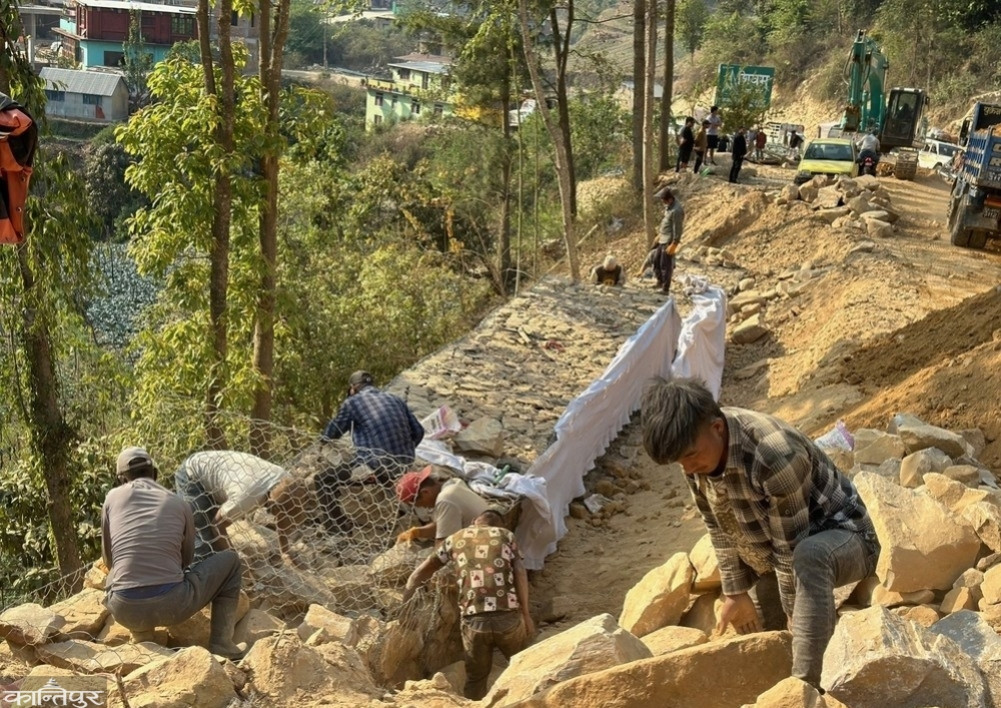
They are still struggling to make ends meet in precarious employment, low wages, and weak social security.
We use Google Cloud Translation Services. Google requires we provide the following disclaimer relating to use of this service:
This service may contain translations powered by Google. Google disclaims all warranties related to the translations, expressed or implied, including any warranties of accuracy, reliability, and any implied warranties of merchantability, fitness for a particular purpose, and noninfringement.
In Nepal's labor market, 84.6 percent of workers are involved in the informal labor sector. According to the latest Labor Survey-2075, out of 70 million 86 thousand employed in the labor market, 4.4 million 11 thousand are involved in the informal sector. These workers do not have social security, labor rights, and minimum wage guarantees.
The growing labor force in the informal sector is also deprived of learning skills according to their abilities and getting employment. They are still struggling to survive in the midst of unstable employment, low wages, and weak social security. Since the informal labor market has not been transformed into a formal labor market, workers are still struggling to survive.
The largest share of the informal sector is occupied by the agriculture, forestry, and fisheries sector at 21.5 percent, the construction sector at 13.8 percent, the retail trade sector at 17.5 percent, and the transportation sector at 4.5 percent. The growing labor force in the informal sector is also deprived of learning skills according to their abilities and getting employment.
'The largest main labor structure in Nepal is informal. This structure is not normal,' said employment expert Yubaraj Basnet, 'The situation of not getting employment even after higher education or learning skilled skills is creating despair in the Nepali labor force. Even skilled people have not been able to get employment according to their capabilities.'
As the agriculture-based economy (low productivity) and the industrial sector are weakening, employment has not been created in the formal sector. On the other hand, small entrepreneurs are hesitant to register formally due to the complexity of the business registration and tax system. Remuneration is not being received based on a formula linked to the cost of living. Laxman Sharma, General Secretary of the Federation of Nepal Trade Unions (GEFNT), said that it is necessary to establish 100 percent access of workers to the social security fund, starting from the full implementation of the minimum wage even in the so-called informal sector.
'The existing Labor Act does not distinguish between formal and informal. The Labor Act is applicable not only to establishments but also to employers who employ one worker. But it has not been implemented,' he said, 'now a law on gig workers should be made and the labor court should be strengthened.'
Workers working in the informal sector are not guaranteed to receive contracts, social security, and gratuity. Workers working in the formal sector have fixed working hours. Decent labor is practiced. Social security is guaranteed with minimum wages, gratuities, and compensation. Contribution-based social security has been implemented for all workers since 1 July 2076. As of 17 Baisakh, 23,460 employers have affiliated 693,160 workers with contribution-based social security, according to the Social Security Fund.
Only 915 workers working in the informal sector and 932 self-employed people have joined. This means that a large portion of the workers in the labor market are outside social security. Only 915 workers working in the informal sector and 932 self-employed people have affiliated. This means that a large portion of workers in the labor market are outside social security. 'There is no guarantee of employment in the informal sector. As a result, workers are doing whatever work they are given,' said Dhan Bahadur Bishwakarma, senior vice-president of the All Nepal Trade Union Federation. 'Not all workers are getting the minimum wage set in the tripartite agreement between the government, employers and trade unions.' The monthly wage has been fixed at Rs 19,550, effective from last Shrawan.'
Resham Dahal, a bus driver from Sindhuli, said that even though they have work, they have no future. 'I have a job, but no security,' he said. 'If an accident happens, we are responsible ourselves. There is no insurance, no medical treatment. I feel scared while working - who will take care of my family if something happens?'
According to the latest report of the Inclusive Commission, a structural program should be implemented to provide unorganized workers with access to registration, social security and labor rights. ‘Inclusion can only be ensured by bringing workers from the informal sector into the formal system and mainstreaming them,’ the report of the Inclusion Commission states, ‘If they cannot be brought under legal protection, workers are seen to be alienated from major challenges that may arise in the near future and deprived of their rights for the future.’
An agreement has been reached between Nepal and the International Labor Organization (ILO) to fully formalize Nepal’s labor market. The Central Labor Advisory Council of the Ministry of Labor has passed a five-year strategic plan to formalize the informal sector in Nepal. The Ministry of Labor has stated that technical assistance from the ILO is being provided for its effective implementation.
According to the five-year strategic plan of the Ministry of Labor, an action plan has been made to diagnose sectoral formalization with a focus on agriculture, construction, and transport sectors as well as women, identify the priorities, capabilities, and needs of domestic workers, and conduct a national survey on the priorities, needs, and capabilities of workers in informal employment/self-employment to fully participate in social security programs. However, its effective implementation has not yet been completed.
‘We are working extensively on our policies and programs, covering social security, labor rights, enterprise development, skills, and other necessary issues to bring them into the formal economy,’ said Labor Spokesperson Pitambar Ghimire. ‘The informal labor market is a big challenge.’