The draft states that the electronic invoice should include a QR or online payment link that displays the invoice number, date, time, details of the service and action, amount to be paid, and payment status.
We use Google Cloud Translation Services. Google requires we provide the following disclaimer relating to use of this service:
This service may contain translations powered by Google. Google disclaims all warranties related to the translations, expressed or implied, including any warranties of accuracy, reliability, and any implied warranties of merchantability, fitness for a particular purpose, and noninfringement.
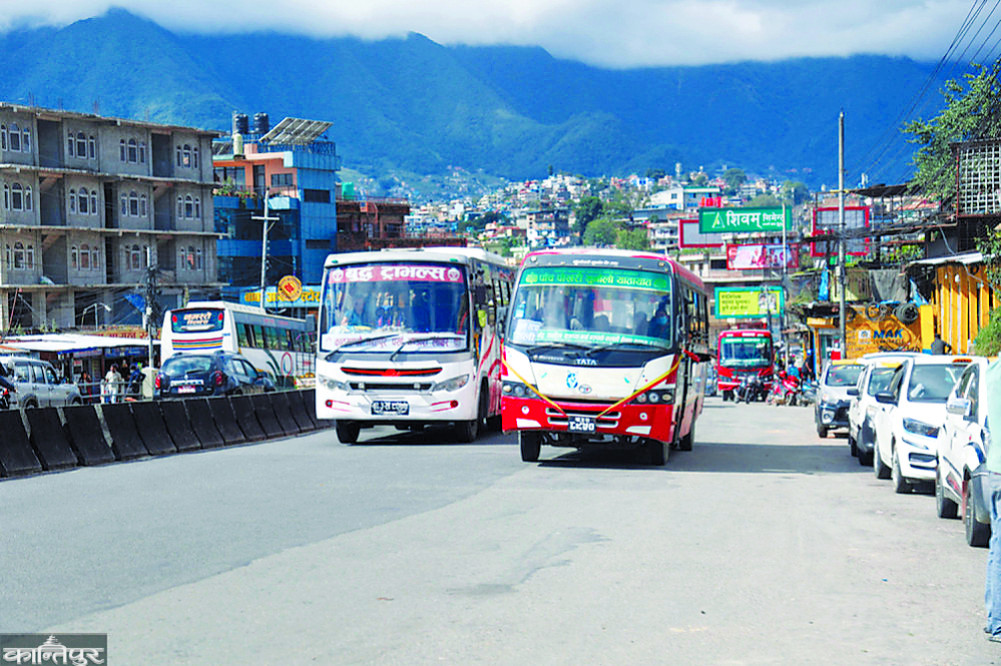
The Department of Transport Management has prepared a draft of the 'Directive on Making Public Vehicles Technology-Enhanced, Healthy, Safe, Dignified and Passenger-Friendly, 2082'. Considering the recent hardships faced by passengers in public transport, the directive is being brought to make GPS to CCTV installation mandatory. The department has prepared a draft of the directive and sent it to the Ministry of Physical Infrastructure and Transport.
The draft proposes that public vehicle owners must install mandatory GPS system equipment in their vehicles. 'The Department of Transport Management will provide necessary technical support to install this equipment,' the draft states, 'The department will have to prepare a system including a control center for the systematic operation and monitoring of the equipment.' The responsibility of keeping the equipment installed in good condition will lie with the driver, operator and vehicle owner. The department will be responsible for checking the condition of the installed equipment.
The draft states that two or more CCTVs should be installed in all public vehicles and the responsibility for installing them will be on the vehicle owner. ‘However, CCTV is not mandatory in the case of taxis,’ the draft states, ‘If the vehicle owner requests for CCTV installation, the department will provide necessary technical support.’ It is stated that the vehicle manager, its owner and driver will be responsible for preserving the CCTV data installed in the vehicle for at least three months.
The draft states that the electronic challan should include a QR or online payment link that shows the challan number, date, time, details of the service and action, amount to be paid, and payment status. The proposed draft states that the equipment installed in public vehicles should be installed in a way that records all activities inside the vehicle and such information should be posted in a way that all passengers can see. ‘The equipment to be installed should be based on AI technology that can recognize faces to count the number of passengers inside the public vehicle,’ the proposed draft states.
The online ticket system will be arranged by the concerned manager or vehicle owner. ‘For tickets purchased through the online system, every vehicle owner will have to arrange an online payment system through the use of a payment gateway or quick response code recognized by the Government of Nepal for payment of transport services,’ the draft states, ‘Electronic challans will be mandatory for payment of traffic fines, fines for violation of traffic rules, taxes, dustur, and fees.’
The department has stated that the draft has been prepared accordingly as it is necessary to make the transport sector more safe, organized, and reliable by installing new technologies and devices in public, freight, and other vehicles to control and minimize health and safety risks, irregularities, abuse, and accidents in this sector. A draft has been prepared and sent to the ministry on what can be done to improve public transport, said Ganeshman Singh Rai, the department's information officer. 'Discussions are underway in the ministry in the presence of the concerned bodies,' he said, 'It will take some time to make a decision and implement it.'
The draft mentions that the electronic challan should have a QR or online payment link that will show the challan number, date, time, details of the service and action, amount to be paid, and payment status. 'While issuing e-challans for traffic rule violations, the following are prohibited: breaking the rules when the red light is on, not wearing a helmet, not wearing a seat belt, using a mobile phone while driving, parking in prohibited places, lane violation, and driving at overspeed,' the proposed draft states. 'The system should be arranged to clearly show which section of the act, rule or rule has been violated and for which offense the challan has been issued.'
‘The department, Nepal Police or the concerned body shall issue a time card according to the route on which public vehicles are operated, with the vehicle number, route, details, checkpoints, minimum travel time, date of issue,’ the draft states. ‘To prevent fire, fire extinguishers according to the seating capacity of the vehicle shall be managed in every vehicle.’
The concerned vehicle owner shall manage a first aid kit in every vehicle to provide immediate treatment and safety in case of emergency. The proposed draft stipulates that an emergency aid button should be installed in every public vehicle so that a warning message with location is sent to the department’s central system in case of danger, accident, attack, health problem or any emergency.
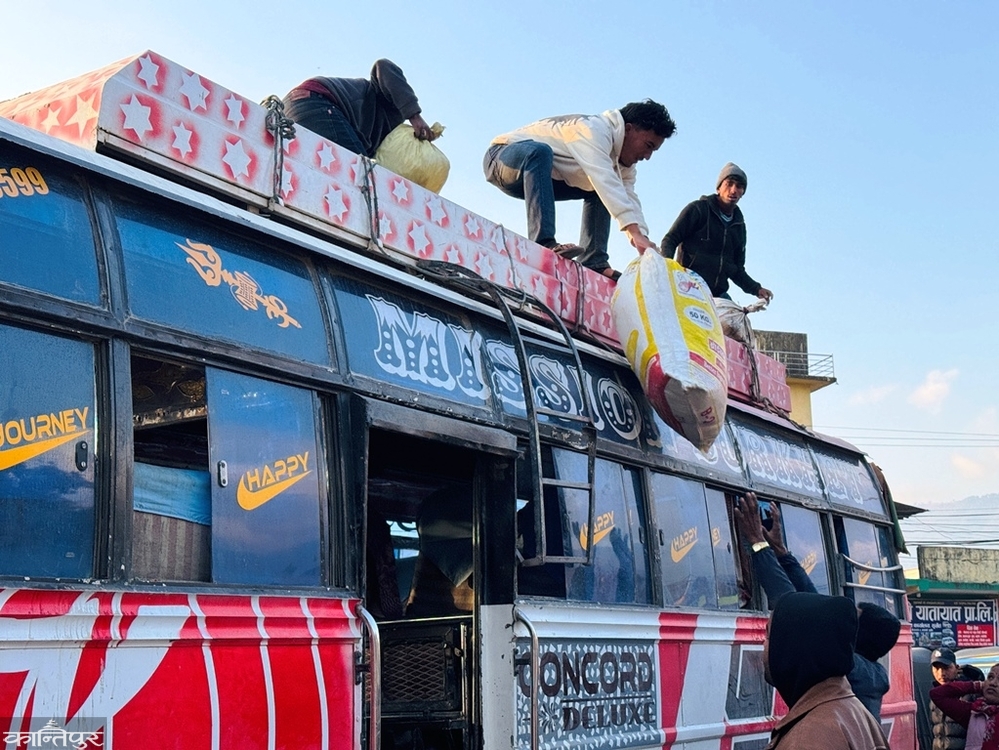 ‘At least two drivers must be provided for public transport vehicles operating on routes of more than 250 kilometers,’ the draft states, ‘Passengers must not talk or make noise in a way that affects others while talking to friends and other passengers.’ Public transport vehicles must stop and give priority to women, senior citizens, the disabled or the sick on their routes.
‘While driving, drivers are not allowed to use mobile phones or talk unnecessarily to passengers. Vehicles must charge the fare as prescribed by the relevant body and display the fare list in a place visible to passengers,’ the draft states, ‘Drivers and operators must wear clearly identifiable clothing as prescribed in the prevailing laws of the relevant bodies while operating vehicles on routes under the jurisdiction of the federal, provincial and local levels.’
The proposed draft has a provision that if it is proven that drivers, conductors, etc. in charge of vehicles are misbehaving while wearing uniforms, action will be taken as per the Act, Regulations and prevailing laws. Similarly, the draft states that drivers and conductors should undergo a health check-up at least once every 6 months. Joint Secretary and Spokesperson of the Ministry of Physical Infrastructure and Transport, Ramhari Pokharel, said that the draft received from the department is currently under discussion in the presence of stakeholders to seek suggestions. "It will be finalized only after taking everyone's opinions and suggestions and making changes to the proposed draft," he said.