The Nepal Electricity Authority claims that with the construction of the proposed project, electricity imports from India will be reduced during the winter.
We use Google Cloud Translation Services. Google requires we provide the following disclaimer relating to use of this service:
This service may contain translations powered by Google. Google disclaims all warranties related to the translations, expressed or implied, including any warranties of accuracy, reliability, and any implied warranties of merchantability, fitness for a particular purpose, and noninfringement.
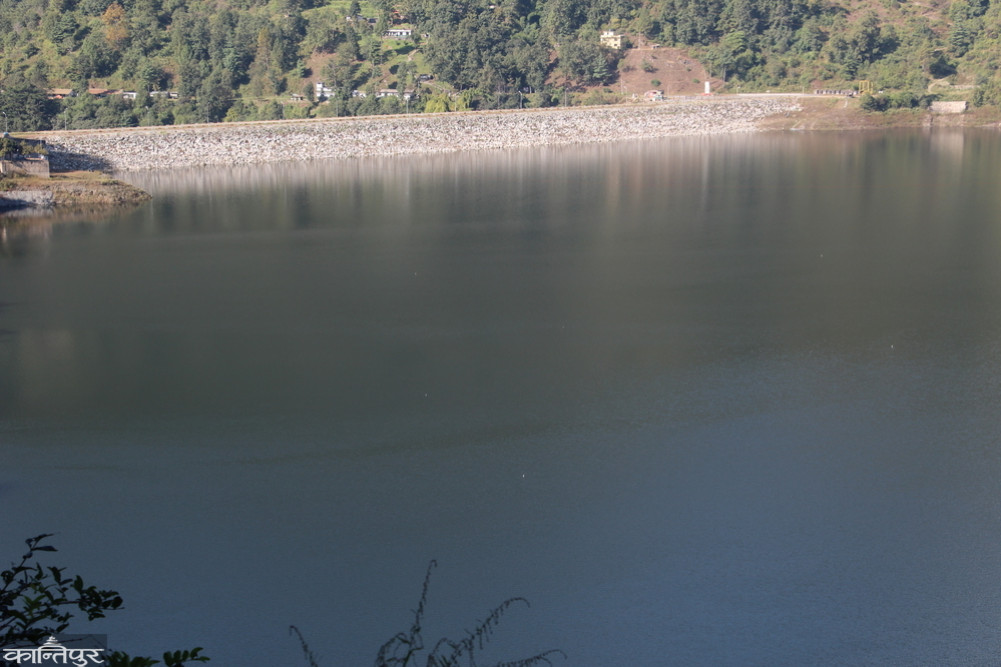
Nepal Electricity Authority is preparing to generate an additional 100 megawatts of electricity from the water of Kulekhani Reservoir in Makawanpur. Nepal Electricity Authority has taken forward the construction of the Kulekhani Cisnery Pumped Reservoir Hydropower Project in Indrasarobar Rural Municipality of Makawanpur. This will be the first pumping reservoir hydropower project in Nepal.
Nepal Electricity Authority claims that with the construction of the proposed project, electricity imports from India will be reduced in winter. The Authority has asked the public to provide opinions and suggestions for determining the area of environmental impact assessment while implementing the proposal for the pumped reservoir hydropower project to generate electricity using the water of Kulekhani Reservoir in Indrasarobar and return that water to the reservoir.
The Authority has also visited the affected wards of the municipality and conducted a review and collection of opinions. The project will affect wards 1, 2 and 3 of Indrasarobar Rural Municipality. The chairman of the rural municipality, Devkrishna Pudasaini, said that interactions were held in the affected wards of Indrasarobar Rural Municipality-1, 2 and 3 about the proposed project.
‘Along with discussions on the impacts of the project on human settlements, physical, economic, social and natural areas of the affected area, suggestions have been collected to solve the problem,’ he said. The proposed project will generate electricity for 6 to 10 hours a day during peak energy demand by releasing water collected in the Indrasarobar Reservoir in Indrasarobar Rural Municipality into the Kulekhani River, said Suryenath Bhurtel, manager of the Nepal Electricity Authority.
‘We are working to collect various suggestions including DPR to proceed with the construction of this pumping reservoir power project’, he said. The proposed project will use the existing Indrasarovar as the upper reservoir and a new 36-meter-high dam will be constructed on the Kulekhani River near Indrasarovar Gapa-2, Ranche, about three kilometers below the dam site of the reservoir. The Nepal Electricity Authority has stated that the storage capacity of the reservoir will be 1.54 million cubic meters.
The water from Indrasarovar will be pumped to the proposed power house at Lippane on the left bank of the Kulekhani River through a tunnel about 1.9 kilometers long by constructing an intake near Kalanki at Indrasarovar Gapa-2. The project has been proposed to store the water released from the tailrace in the lower reservoir.
During times of low demand for electricity, the water stored in the lower reservoir will be pumped through the same tunnel and drawn back into Indrasarovar. ‘The system of generating additional electricity by pumping water from the reservoir is called a pumping reservoir power project,’ said Manager Bhurtel. The Authority says that the proposed project will not change the existing storage capacity of Indrasarovar.
When the project is operated at full capacity daily, the water level of Indrasarovar will fluctuate by a maximum of 20 meters, while the water level of the lower reservoir will fluctuate by a maximum of 23.5 meters. In addition, two turbines of 50 MW capacity per unit are planned to be installed in the power house of this project. The design flow of the project will be 68.12 cubic meters per second. The total cost of the project is estimated to be 15 billion.
The Authority has stated that it will determine the area related to the Environmental Impact Assessment (EIA) study of the project proposal. In that process, written opinions and suggestions have been requested from the rural municipality and schools, hospitals, health posts and concerned individuals or organizations about the impact on the natural, physical, biological, social, cultural and economic systems of the area.
Kulekhani Hydropower Project has been generating 106 megawatts of electricity from the first dam, 60 from the second dam, and 32 from the third dam. The water holding capacity of the lake has been decreasing due to the increase in the level of stones, soil, sand and leaves carried by the river from the watershed area every year.
In the initial operation, the Kulekhani reservoir had a capacity to hold 85.3 million cusecs of water. That capacity has now decreased to 59.99 million cusecs. In the 44 years since Kulekhani came into operation, the reservoir's water storage capacity has increased by more than 15 meters. Due to the rise in the lake level, the reservoir's water storage capacity has decreased by 30 percent.
Electricity generation has also decreased by 30 percent. Due to the decrease in the reservoir's water capacity, the Electricity Authority has been incurring losses of more than Rs 310 million annually compared to the initial situation.
When the Kulekhani Hydropower Project was first commissioned in 2039 BS, 57 meters of water could be used to generate electricity. After the flood in 2050 BS, only 50 meters of water could be used to generate electricity. Currently, only about 46 meters of water can be used to generate electricity.
As 'debris' accumulate in the reservoir, the water level that can be used to generate electricity is decreasing. The flood in 2050 BS had raised the level of the reservoir's bottom by 6 meters. The water level is increasing every year. An engineer from Kulekhani I said that 170,000 cubic meters of 'debris' have now been collected in the man-made reservoir.
'If the 'debris' (sand, mud, leaves and stones) collected in the reservoir are not removed, the productivity of the Kulekhani I, II and the under-construction third hydropower projects will decrease,' he said. The reservoir must be completely emptied to remove the stones, mud and silt collected in the reservoir. Indrasarovar was built at a cost of 12 million US dollars.