Despite the great potential for hydropower generation in the Far West Province, only 166 megawatts are connected to the national grid due to transmission lines and legal complications.
We use Google Cloud Translation Services. Google requires we provide the following disclaimer relating to use of this service:
This service may contain translations powered by Google. Google disclaims all warranties related to the translations, expressed or implied, including any warranties of accuracy, reliability, and any implied warranties of merchantability, fitness for a particular purpose, and noninfringement.
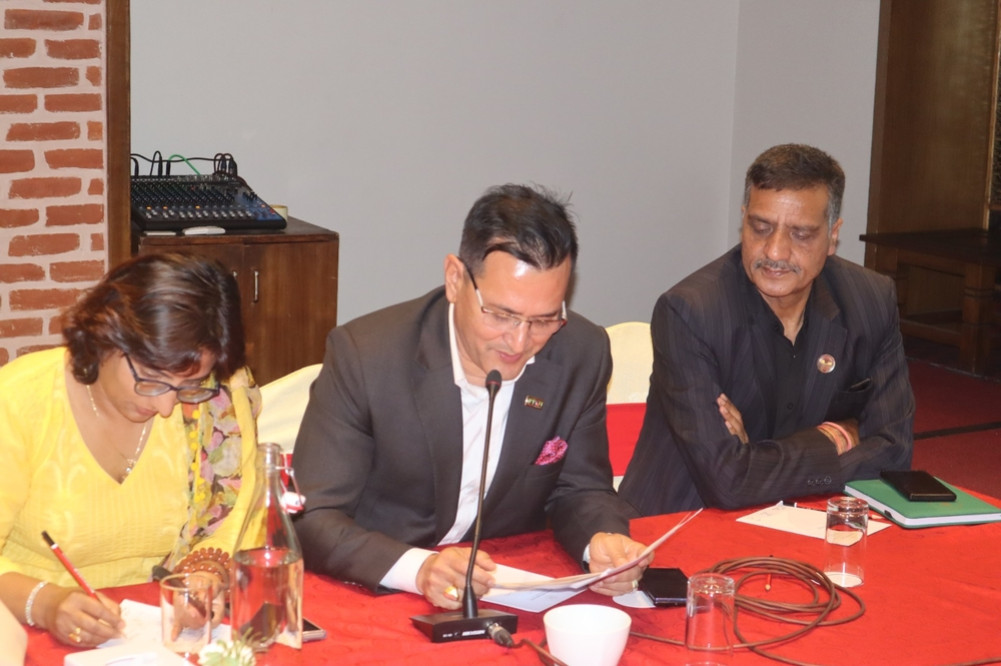
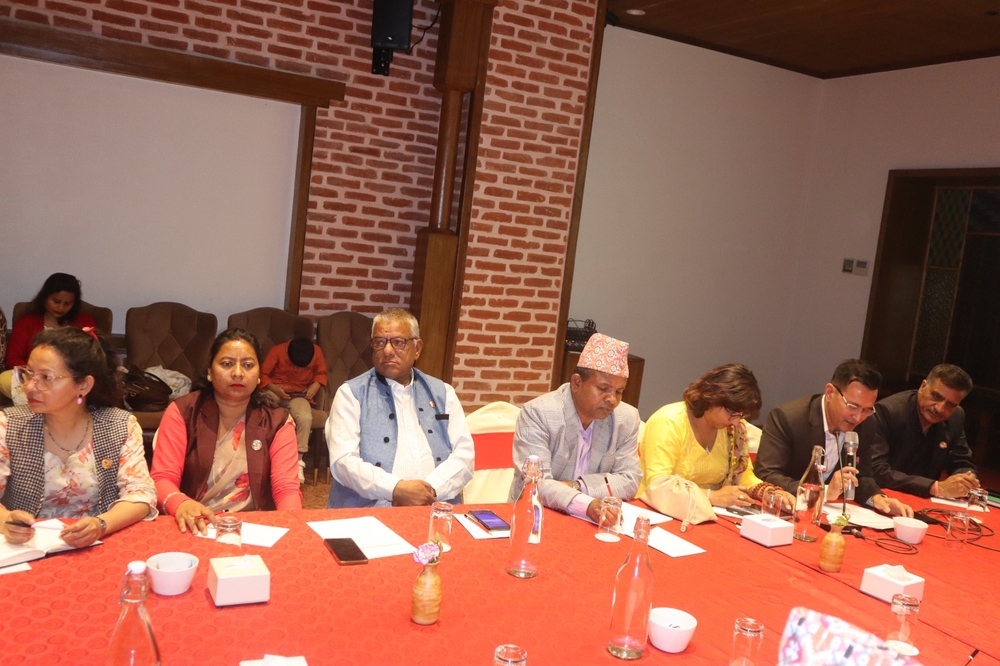
Although the Far West Province has a hydropower capacity of 7,720 MW, only 166 MW has been connected to the national grid so far. At an interaction on 'Hydropower Project Construction Potential and Challenges in the Far West Province' organized by the Independent Power Producers' Association of Nepal (IPPAN) on Wednesday, stakeholders said that despite the high potential of hydropower projects, the expected production has not been achieved in the Far West Province due to transmission lines, legal hurdles and delays.
Suman Joshi, a member of the IPPAN working committee, said that theoretically, the potential of the Far West is 18,000 MW, but it could be more. 'The potential of the Far West is said to be 18,000 MW. But I say it is even more than this because we still have the Karnali Chisapani and Multipurpose projects to come,' she said. Joshi said that the condition of the transmission lines in the Far West is complicated.
Even though only 3,800 MW of hydropower has been connected to the national grid, the share of the Far West is only 166 MW, she said. ‘The previous government had a target of 28,500 MW and this government has a target of 30,000,’ she said, ‘It is easier than a river in a bag.’ But it will take 7/8 years from the start of the study to the time of construction.’
She also said that if the transmission line is not built, there is no possibility of further projects being built in the Far West for years to come. According to the 2019 report of the Water and Energy Commission, the capacity of the Far West Province is 7,720 MW. So far, 61 projects of 5,718 MW are in various stages.
According to the data of the Department of Electricity Development, 2,522 MW projects have obtained survey licenses. 160 MW projects have applied for survey licenses. A total of 1,919 MW have been applied for construction licenses. A total of 1,117 MW hydropower projects have received construction licenses. So far, 61 projects of 5,718 MW are in various stages. The figures do not include West Seti, Seti River 6, Karnali Chisapani, and Pancheshwor.
IPPAN Chairman Ganesh Karki said that the government should bring a 'sunset' law for ten years to advance the hydropower projects. 'Work has not been allowed inside the park,' he said, 'the forest-related system has become like a separate government. It has become difficult to work.'
Karki said that the party's manifesto had said that the project would be allowed for 50 years, and he urged that it be implemented. 'There is a situation in Nepal where forests do not allow work. Now let the government make it easy to get permission from the forest,' he said, 'The government cannot do everything, if it facilitates, we are ready to move forward.'
Saying that it is very difficult to work across 16 ministries and 36 departments, he said that the government should now adopt a single-door system. 'The largest hydropower projects in Nepal are in the far west, but we are lagging far behind in production,' he said, 'If we produce now, there is an opportunity to export to India and Bangladesh. If we delay, another energy development may be an alternative to hydropower. Our time will pass by looking at water as we are rich in water resources. '
Sagar Shrestha, Chief Executive Officer of the National Transmission Grid Company, said that the investment modality has been approved to build the West Seti transmission line in partnership with the government and various companies on the PPP model.
'The transmission line will increase production They say it should be followed, but in Nepal, the transmission line is following the production,' he said, 'After the project is under construction, we are looking at where to take the transmission line.'
He said that an investment of Rs 70 billion is required for the construction of the transmission lines of the West Seti and Karnali corridors and the 7 substations related to them. He also suggested that since it is a provincial government, a 'Provincial Energy Fund' can now be formed. 'The provincial government can form a fund by creating a single basket fund for all national strategic projects, transmission lines and production parts,' he said, 'It would be better if the said fund is planned and invested only in lines of national importance.'
Former Secretary Anup Kumar Upadhyay said that since it has been realized that the construction of transmission lines is also impossible without the private sector, the government should now move in this direction. ‘If the current Electricity Act were amended and a clause on electricity trade was added, everything would have been covered. But why is the government after the new act?,’ he said.
National Assembly member Renu Chand said that the National Parks Act is in the process of being amended. ‘It is surprising that more than 80 percent of electricity has been generated by the private sector despite 16 ministries and 36 departments. This is a very encouraging statistic,’ she said.
Far West Province Infrastructure Minister Jagdish Pal said that he had seen foreigners coming and leaving to build hydropower projects in the Far West. ‘Now we should not see domestic investors returning. The government should pay attention to that,’ he said.
House of Representatives member Ganesh Bik said that the federal government did not give the Betan Karnali project to the province even though he requested it. ‘The failure of the hydropower project is not only due to minor legal hurdles, there are many other things involved,’ he said, ‘It is not just about how much money will be generated when the West Seti is built, what will the people get? How to rehabilitate them should also be discussed.’
National Assembly member Garima Shah said that it is not just about big mega projects, and small projects should also be built accordingly. ‘We spent 9 months studying to amend the policy related to the national park after it was said that forests were an obstacle to development,’ she said, ‘Environmental impact does not only mean the impact on trees. Projects should be built. They should also be made easy to build. But laws should be made to make it easier to build infrastructure projects while protecting the environment.’
House of Representatives member Ratna Kumari Thapa said that Karnali and the Far West provinces would benefit if the Betan Karnali and Upper Karnali projects were built. ‘While Dailekh and Surkhet benefit from Karnali, Achham is the only district in Sup. We will support and assist in moving these projects forward,’ she said.
Nrip Bahadur Sunar, a member of the Provincial Policy and Planning Commission of the Far West, said that while preparing for the Investment and Development Conference, they had discussions with the promoters of hydropower projects, keeping energy as the first priority.
Surendra Ghimire, Joint Secretary of the Ministry of Energy, said that efforts have been made to facilitate the services provided by the Electricity Development Department. ‘After the formation of the new government, the issue of file tracking and keeping the table clear has started,’ he said, ‘There is a voice being raised to do the work of 16 ministries and 36 departments through one door. We are in discussions on this. Trying to do the work of 16 ministries from one place will definitely cause complications.’
Stating that he got the opportunity to get to know the project closely while building the Budhiganga project, he said He said that transportation is expensive and some things have to be brought from Dhangadhi. ‘Infrastructure is being improved now.
Many people in the village say that they are victims of the project. They have bought land by paying money. They are not even displaced, if someone goes, they say that they are victims,’ he said.
National Planning Commission member Arjun Jung Thapa said that it is a commendable thing to have 85 percent private sector production. ‘A government project did not get permission to cut trees for 6 years, but a private company got permission to make cars in 6 months. Therefore, this is an example of the forest taking even longer to give permission to a government project,’ he said. The current situation of the country is that the income is 300 billion less than the expenditure, so it has to run on 300 billion internal loans, he said.
Senior Vice President of IPPAN Mohan Kumar Dangi said that the production of only 159 MW out of 18,000 production capacity is only 0.94 percent. 'When we go to build a hydropower project, we take the road and leave behind prosperity,' he said, 'Only water resources can make Nepal prosperous.' Since it can be produced in Darchula and sold in Dharchula, there is even more potential for hydropower in the Far West.'
Now, urging the private sector to open up transmission and trade, he said that after the next ten years, the private sector can export electricity in good quantities and develop a transmission line network.