Locals are collecting various vegetables grown in Patan, Jumla, and drying them in solar dryers to make Gundruk.
We use Google Cloud Translation Services. Google requires we provide the following disclaimer relating to use of this service:
This service may contain translations powered by Google. Google disclaims all warranties related to the translations, expressed or implied, including any warranties of accuracy, reliability, and any implied warranties of merchantability, fitness for a particular purpose, and noninfringement.
Locals of Patarasi-2 Talfigaun have started making Gundruk and Sukuti using 'solar dryers'. They are collecting various vegetables produced in Patan in the district and drying them in solar dryers to make Gundruk. They are preparing to send the Gundruk and Sukuti prepared in this way to the market for sale.
They are making meat Sukuti, apple mada and chickpea to potato masala using solar dryers. Sarita Bohora of Patarasi-2 said that the compulsion to dry Gundruk eaten in winter in the sun has been removed. 'A lot of Gundruk can be made in a short time with solar dryers,' she said, 'It is also profitable in terms of business.'
In Patan here, more than a dozen vegetables are available, from dooro, rugha. She said that earlier, Gundruk made by drying it in the sun on the roof of the house used to be eaten. ‘Now, quality gundruk is being prepared in a day in the solar dryer. It is not only for our own consumption but also for taking to the market,’ she said. According to locals, there was a problem of mixing stones and soil when drying gundruk on a clay roof. With the solar dryer, gundruk can be prepared in a day and taken to the market.
Jayakala Budha of Patarasi-5 Lashi is currently busy collecting sisno and pet greens produced in the village. She dries sisno greens in the solar dryer every day. ‘From meat stew to various vegetable products, we can make sukuti in the solar dryer,’ she said. ‘We have been making apple chickpeas, tomato wings and cauliflower.’ She said that after using the solar dryer, the obligation to dry gundruk for many days in the sun has been removed. ‘Now the municipality should do the work of packaging and labeling the dried gundruk,’ she said. Janaki Budha of Patarasi-5 is excited after the installation of a solar dryer in the village. Earlier, there was a concern about spoilage when making gundruk by drying it in the sun. ‘Earlier, there were problems ranging from flies to rotting when drying vegetables in the sun,’ she said. ‘Now, the gundruk that the customer wants and the market wants is ready in two days.’
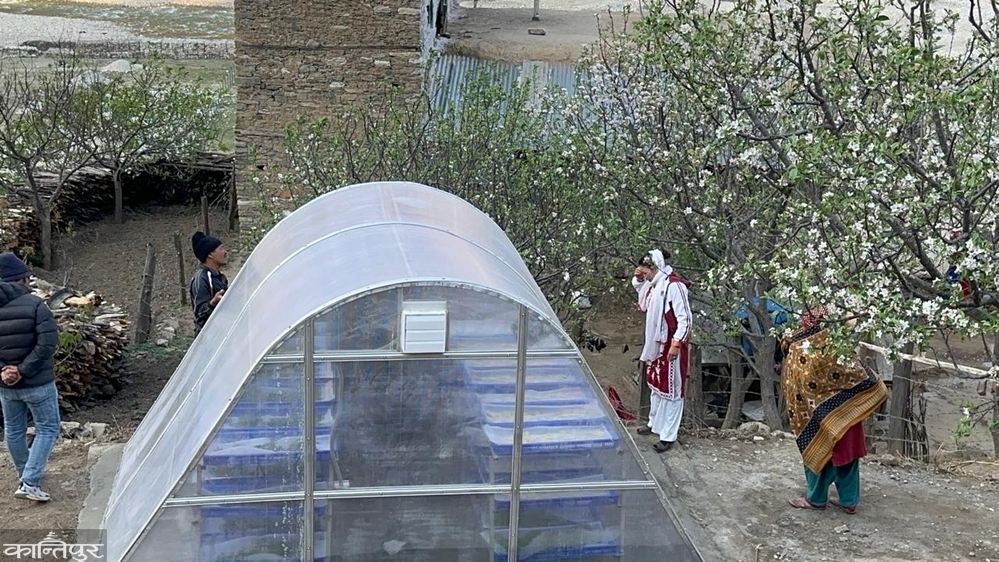
Patarasi Rural Municipality Chairman Purna Singh Bohora said that two solar dryers have been installed for the first time to make good use of the raw materials found in Patan and to address the farmers’ desire to make gundruk. He said that solar dryers have been installed in Patarasi-2 Talfi and Patarasi-5 Lasibazar.
‘There are many vegetables in Patan in Jumla. They are not reaching the market,' he said, 'Now the municipality will make arrangements to take the gundruk made by the farmers to the market.' He also said that initiatives will be taken to bring the vegetables that are sold cheaply to the Nepali market as gundruk.
Currently, potatoes were being bought and sold for Rs 20 per kg and greens for Rs 5 to 10 per bunch. It seems that when it is made into gundruk, it can be sold at a very high price. He said that there is a plan to move the rural municipality forward as a municipality that produces quality gundruk. In the first phase, two solar dryers have been installed after it was seen that there is demand from farmers and sufficient raw materials. Three solar dryers have been installed in Chandannath and Patarasi rural municipalities of the district.
Solar dryers arrive in Jumla for Rs 7 lakh per bunch. A solar dryer requires 36 carats for drying items including gundruk and sukuti along with a dryer. Packaging and leveling materials for the gundruk and sukuti prepared by drying in the dryer, as well as temperature management materials, are also provided.
It can be operated not only by solar but also by connecting to electricity. This is the first time that only 3 have been connected in the district. Kishore Nyapane, executive director of the NGO PACE Nepal, said that it cost 2.5 million rupees to bring the three solar dryers and all the necessary equipment to Jumla. This organization has borne half the cost of the solar dryer greenhouse project under the Patarasi partnership program. Nyapane said that up to 50 kg of gundruk and sukuti can be produced from this daily.

