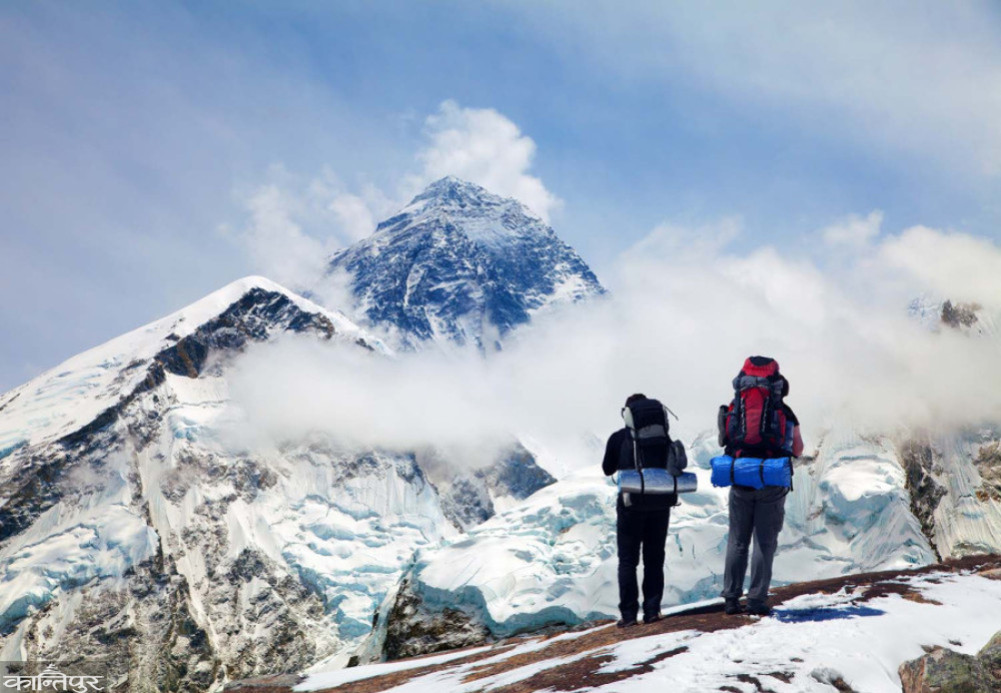
Tour operators say that while trekking and travel bookings have dropped by about 60 percent compared to normal due to ongoing tensions in West Asia, the Everest expedition has not been affected.
We use Google Cloud Translation Services. Google requires we provide the following disclaimer relating to use of this service:
This service may contain translations powered by Google. Google disclaims all warranties related to the translations, expressed or implied, including any warranties of accuracy, reliability, and any implied warranties of merchantability, fitness for a particular purpose, and noninfringement.
Airfares have skyrocketed due to the ongoing tensions in West Asia. The tourism sector has been badly affected by the increase in transportation, accommodation and other expenses. But the attraction towards Everest climbing remains the same.
According to tour operators, trekking and travel bookings have decreased by about 60 percent compared to normal days. But this does not seem to have had any impact on the Everest climbing campaign. While the government has increased the climbing fee in the meantime.
The government had increased the Everest climbing fee from $4,000 to $15,000 per person from September 1, 2025. The climbing fee was increased with the expectation that the rate of climbing would decrease. The new fee arrangement was made in the Mountaineering (Sixth Amendment) Regulations 2081 approved by the government.
But according to tour operators, this has not had an impact on the climb so far. Because climbers had already booked months in advance. Cheap Everest packages, which used to cost $30,000 to $35,000, now start at around $45,000. The love of climbers for Everest is unique, says Mingma Sherpa, managing director of Seven Summit Treks. “Despite the many changes in the world situation, including the Iran conflict, no climbing plans have been canceled,” he said. He said that 80 to 90 climbers are expected to climb Everest this year. That is slightly less than the 100 or so people last year.
Nepal issued 469 Everest climbing permits in the spring of 2025, one of the highest ever. According to Sherpa, the participation of climbers from Iran and Israel has dropped to almost zero, while the number of Russian climbers has started to increase. Pemba Sherpa, executive director of ATK Expeditions, also said that although trekking bookings for April have dropped sharply, climbing permits are still available. “We have not received any information about any cancellations,” he said, “but the entire tourism industry is under pressure due to the conflict in West Asia and the fake rescue incident.”
The Central Investigation Bureau (CIB) of the police has investigated the fake rescue incident and recommended that the accused be charged with a criminal offence. The police submitted a 1,243-page report to the government attorney’s office, concluding that the country’s reputation was tarnished by the fake rescue flight and the insurance money was stolen.
Airfares have doubled or tripled in recent days, and many tourists are hesitant to use the West Asian transit center, says Executive Director Pemba Sherpa. He says this has had a major impact on trekking trips. “Many trekkers have cancelled their treks due to disruptions to regular flights and high re-routed flights,” he said. Although Everest is usually climbed in mid-May, climbers start arriving as early as March to acclimatize to the high altitude. The spring climbing season in Nepal lasts until the end of May.
The cost of everything from climbing equipment, oxygen, food, insurance and helicopter services has increased, Pemba said. “Everything has become expensive – from road to air transport, hotels to restaurants, equipment to guides, oxygen to insurance,” he said.
Trek operators say the price of mountaineering equipment alone has increased by 20 to 30 percent. Boots, which used to cost around Rs 25,000, are now being sold for Rs 40,000. Meanwhile, the value of the US dollar has appreciated. While Nepali companies have been made a little more comfortable, the costs have increased for foreign climbers and climbing team members.
Meanwhile, the value of the US dollar has increased. Although Nepali companies have been made a little easier, the costs for foreign climbers and climbing team members have increased. As of Friday, the tourism department has issued permits to 360 people to climb Mount Everest, generating revenue of about Rs 710 million. Last year, 331 permits were issued during the same period. This generated revenue of about Rs 480 million. This year, citizens of countries including China, the US, the UK, India, Russia, Japan and Poland are among the major climbing groups.
This year, China has closed the Everest route towards Tibet to foreign climbers, which has completely closed the northern route. This has mostly focused international climbers on the southern route towards Nepal. Tourism department spokesperson Himal Gautam said that the number is expected to decrease initially due to tensions in West Asia. “But the pace of permits being issued seems to be similar to last year,” he said, “which is a positive sign for Nepal’s high-end tourism.”
Nepal issued 469 permits to climb Mount Everest in the spring of 2025, one of the highest ever. There were 722 successful ascents that season, including 272 foreign climbers and 434 guides. In 2023, 479 permits were issued. Including Nepali guides, it is estimated that more than 1,000 people will attempt to climb Mount Everest this year.