Data from the Kalimati Fruit and Vegetable Market Development Committee also shows that banana prices increased in Magh, Falgun, Chait and Baisakh of 2082 compared to Magh, Falgun, Chait and Baisakh of 2082.
We use Google Cloud Translation Services. Google requires we provide the following disclaimer relating to use of this service:
This service may contain translations powered by Google. Google disclaims all warranties related to the translations, expressed or implied, including any warranties of accuracy, reliability, and any implied warranties of merchantability, fitness for a particular purpose, and noninfringement.
The price of bananas in the market has reached Rs 250 to Rs 350 per dozen. Retailers have said that bananas have become expensive due to the lack of sufficient bananas and the arrival of Matatirtha Aunsi in the meantime.
This time, the price of bananas has been continuously increasing since Falgun. The price of bananas has increased not only because of Matatirtha Aunsi but also because they have not been imported. The data of the Kalimati Fruit and Vegetable Market Development Committee also shows that the price of bananas has increased in Falgun, Chaitra, Chaitra and Baisakh of 2082 compared to Magh, Falgun, Chaitra and Baisakh of 2082.
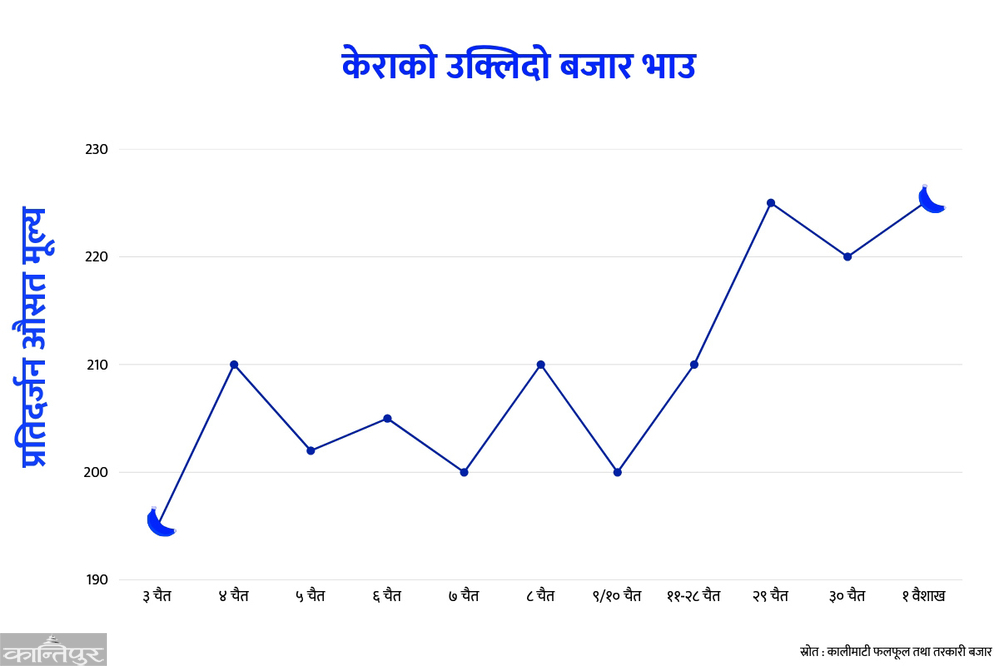
The price of bananas per dozen has increased by 50 percent compared to 1 Baisakh 2082 and 1 Baisakh 2083 alone. The price of bananas per dozen has increased by 50 percent in the wholesale market itself. On 1 Baisakh 2082, the average transaction in the Kalimati wholesale market was Rs 150 per dozen. On 1 Baisakh 2083, the average transaction price was Rs 225.
The average price per dozen of bananas was Rs 145 from 22 Magh to 9 Chait, Rs 150 from 10 Chait 2081 to 3 Baisakh 2082. But on 26 and 27 Magh 2082, it had reached Rs 180. On 27 and 28 Falgun, it was Rs 185 and from 29 Falgun to 2 Chait 2082, it was Rs 190.
On 3 Chait, it was Rs 195, on 4 Chait, Rs 210, on 5 Chait, Rs 202, on 6 Chait, Rs 205, on 7 Chait, Rs 200, on 8 Chait, Rs 200 and from 9 and 10 Chait, it reached Rs 210. On 29 Chait, the average price per dozen of bananas in the wholesale market reached Rs 225.
The reason for the increase in price in the wholesale market is the lack of supply of bananas as per consumer demand. Since 2 Asoj 2082, the Plant Quarantine and Pesticide Management Center has not issued a new entry permit for importing bananas. Therefore, traders say that the price has increased due to the inability to supply bananas as per the demand in the market.
Roshan Adhikari, Information Officer of the Plant Quarantine, said that the import permit has not been issued due to the risk of Tropical Race-4 (TR-4) disease. ‘TR-4 is a fungal disease, it has been seen in a garden in Chitwan, we dug up the plant and buried it, it can create a terrible situation,’ he said, ‘We are studying this further.’ He said that even though it is not allowed to be imported formally, in the case of bananas imported informally, they are being destroyed according to the legal process until information is received.
The official said that the issuance of new permits for banana import has also been stopped for biosecurity. "Previously, banana imports were easy, but this time the price may have increased," he said. The customs department's data also shows that banana imports have decreased. In the first eight months of the last fiscal year, 28 million 28 thousand 386 kg of bananas worth Rs 1.15 billion 22 million 86 thousand were imported.
In the first eight months of the current fiscal year, only 19 million 439 thousand 241 kg of bananas worth Rs 765 million 56 thousand have been imported. Due to the lack of banana imports, consumer demand has not been met and its impact has been seen in the increase in prices. However, the quarantine has stopped the import of Indian bananas citing the fear of the introduction of the 'TR-4' disease, says Amar Baniya, president of the Nepal Fruit Wholesalers Association, Kathmandu.
Baniya claims that it is not logical that the disease can enter when imported after paying customs duties, but not when imported through illegal routes. 'Even now, there are bananas that have been illegally imported everywhere in the market,' he said. 'We did not bring them. But taking advantage of the opportunity, non-businessmen are bringing bananas and selling them.'
Baniya says that bananas that used to cost Rs 100 per dozen have now gone up to Rs 300 to Rs 350. He claims that Nepali consumers are having to buy bananas that are not edible at a high price. 'All the plump, fat bananas seen in the market are illegal, because Nepali bananas are not being produced in that size right now,' he said. He understands that Nepali production can only meet the market for 3-4 months (Bhadau-Mansir). He argues that imports should be opened according to market demand during the rest of the time.
Although businessmen say that domestic production will meet the demand only from Bhada to Mansir, banana producers claim that there will be problems only in Baisakh, Jestha and Asar and that domestic production will be sufficient at other times. Baisakh, Jestha and Asar are the 'insufficient' times for Nepali bananas, said Bishnu Hari Pant, president of the Nepal Banana Producers Federation.
‘From April to June, the heat causes higher consumption and lower production, so prices increase,’ Pant said. ‘Although Indian bananas arrive at other times, they have not officially arrived this time. But the price of bananas sold by farmers has not increased much.’ He said that he himself has to buy bananas that he used to sell for Rs 80 a dozen at Tandi in Chitwan for Rs 180, and the government should control the huge difference through market monitoring. Pant himself admitted that 30 percent of the total demand has to be imported. But the data shows that only 12 to 14 percent has to be imported. Bananas are still being imported illegally due to the open border.
Pant said that farmers have planted bananas to ensure self-sufficiency in bananas for 12 months and that there will be no such problem from next year. ‘If we keep it this time, we will be self-sufficient in bananas from next year, we will not have to import at all,’ he said. ‘It is good for farmers that the government has stopped imports. We have started to increase production.' He also alleges that businessmen are trying to open banana imports by making it an excuse for consumers to pay more.
Senior Planning Officer of the Program Management Unit of the National Agricultural Modernization Program, Indra Sharma Dhungana, said that only 12 to 14 percent should be imported. Last fiscal year, 382,000 tons of bananas were produced domestically and 56,000 tons were consumed in the country, out of which 440,000 tons. In this way, only 12 to 14 percent should be imported. But banana producers say that the country is forced to produce 70 percent domestically and import 30 percent.
Dhungana says that the problem is now due to high production and consumption. He said that the problem will be reduced as the Malbhog bananas from Chitwan will arrive in the market in the next 20 to 25 days. 'This year, the wind blew down the banana plants, which were used for production now,' he said. He said that despite the shortage of bananas in the market and the sharp increase in prices, farmers have not increased the price. He claims that farmers are currently selling them for 60 to 80 rupees. "Farmers have not increased prices, but rather others have increased prices by showing shortages in the market," he said.