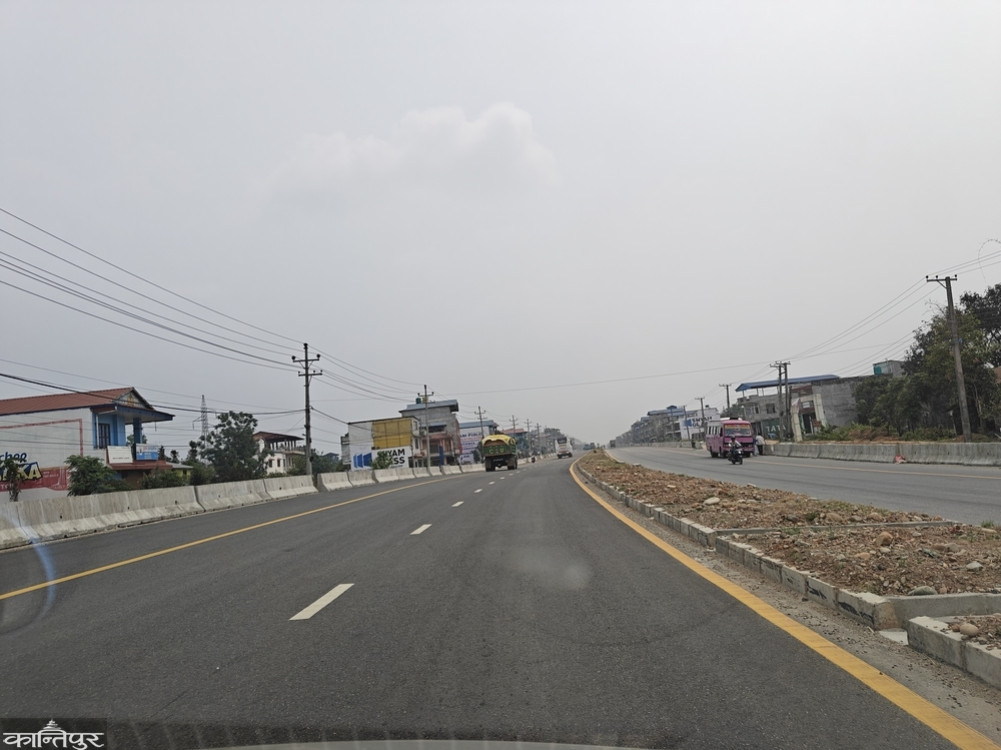
According to Chudaraj Dhakal, Chief Engineer of the Road Projects Directorate, the speed limit on the straight sections of this highway will be 80 km/h, while in market areas and highway crossings, it will be one minute per kilometer.
We use Google Cloud Translation Services. Google requires we provide the following disclaimer relating to use of this service:
This service may contain translations powered by Google. Google disclaims all warranties related to the translations, expressed or implied, including any warranties of accuracy, reliability, and any implied warranties of merchantability, fitness for a particular purpose, and noninfringement.
The country's longest, widest and newest road, the Mahendra Highway, will now allow vehicles to drive at speeds of 80 to 40 km/h on the Butwal-Narayangadh road. The construction of the road has now been completed.
The construction of this highway has reached its final stage. As of Friday, 81 percent of the work on this highway has been completed. The road construction work on the flat areas is almost complete.
According to Chudaraj Dhakal, Chief Engineer of the Road Projects Directorate, the speed limit on the straight sections of this highway will be 80 km/h. Similarly, vehicles will be allowed to drive at a speed of one minute per kilometer in the market areas and highway crossings. On the 14-kilometer section between Dumkikas and Bardaghat, the speed limit will not exceed 40 km/h.
Signs indicating the speed of 80, 60 and 40 km/h have been put up at various places. For this, work is underway to draw yellow signs on both sides of the highway and white signs in the middle. It is believed that this will help in enforcing lane discipline on the highway.
Traffic police officers with speed guns (vehicle speed measuring devices on the highway) have been arranged to fine drivers who drive faster than the prescribed speed. District Traffic Police Kushal Bartaula informed that after the speed limit signs are put up, the police will increase surveillance of drivers by placing 'speed guns'. He said that the traffic police will pay attention to enforcing lane discipline by placing traffic signs at necessary places on the highway. The task of enforcing lane discipline on this 6-lane highway is challenging.
A 6-lane road is being constructed in the main market, 4 lanes elsewhere, and 3 lanes in Daunne. The construction of a sloping road in the uphill and water-logged areas of Daunne is in the final stages. Project Director Dhakal informed that work is underway to complete a one-way highway in the Daunne hills by mid-Baishakh. The ground at the completed construction site has been marked and marked.
The construction of the 61-kilometer road from Gaindakot to Dumkibas in the eastern section of the Butwal-Narayangadh road is almost complete. Blacktop and sloping road work is underway on about 14 kilometers of the Daunne road. Similarly, most of the road construction work from Bardaghat to West Butwal has been completed. Currently, work is underway to install dividers on both sides of the highway.
It is estimated that it will take about 2 hours to cover the 114-kilometer road from Narayangadh to Butwal at the current speed. The responsibility of constructing the Butwal-Narayangadh road has been given to the Chinese contractor company China State Engineering Corporation. The contract for constructing this highway has been awarded at a cost of 17 billion.
‘CCTV cameras will be installed in the main 8 markets of the highway and in the Thumsi area of Gaindakot,’ said Project Director Dhakal, ‘There are preparations to install CCTV cameras even at the places where wildlife cross.’